International politics · Jordan · Syria · Security
Jordan Says Syria Strikes Killed ISIS Militants; Syria Reports Seven Civilian Deaths
The two governments agree that Jordan struck southern Syria and civilians died. They dispute whether the operation was coordinated, while the militant toll and target identities remain independently unverified.
By Health Politics Daily News Desk · October 27, 2026 at 8:01 a.m. ET

Watch in this article
Pumpjack operating at the Kern River Oil Field
A short CC0 field video provides visual context for reporting on oil production and fuel supply.
Thomas Farley / Wikimedia Commons · CC0 1.0 · License and source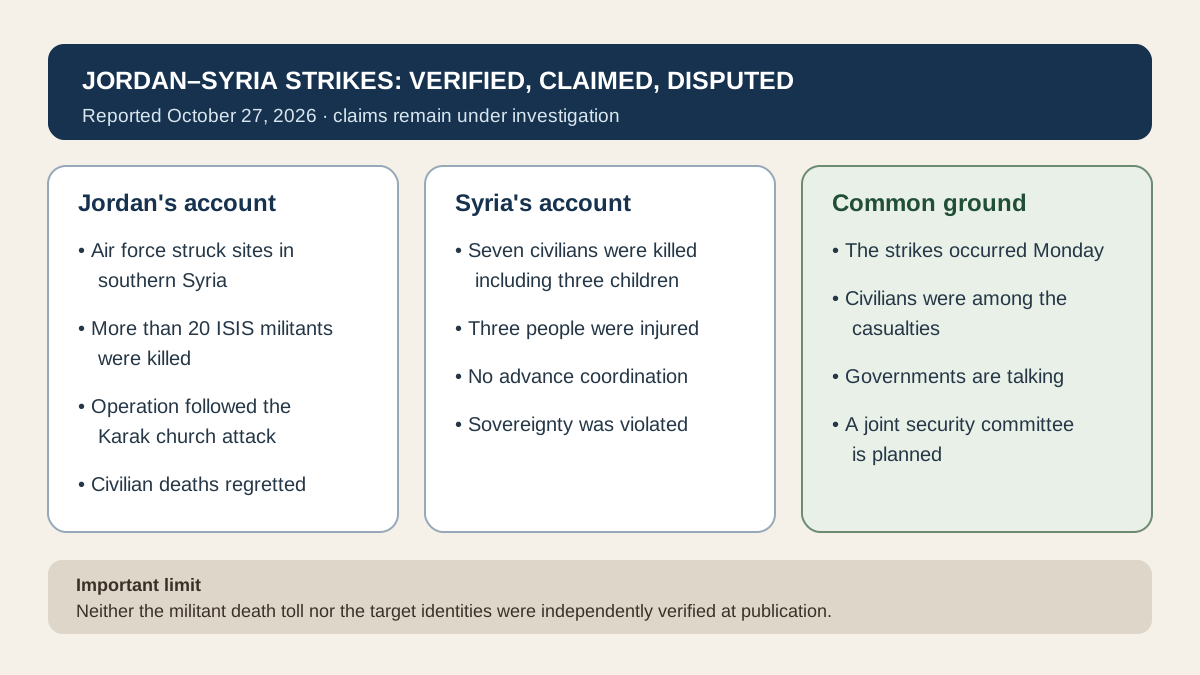
Verified baseline
Jordan's air force carried out strikes in southern Syria on Monday evening. Jordan said the operation targeted Islamic State positions linked to suspects in the October 23 attack on a Greek Orthodox church funeral in Karak. Syria's government said the strikes killed seven civilians—including three children and a woman—and injured three people. Jordan publicly expressed regret over civilian casualties.
Those points are supported by Reuters, the Associated Press and a Syrian health director's statement carried by SANA. The identities of the people Jordan says were militants and the claimed militant death toll have not been independently verified.
The accounts diverge on the operation
Jordan's government says more than 20 Islamic State militants were killed and a large weapons store was destroyed. Syria says those killed were civilians. The two figures are not necessarily mutually exclusive because they may refer to different locations or categories of casualties, but available public evidence does not establish Jordan's militant count.
Jordan's military said the strikes were coordinated with Damascus. Syria's official government statement says there was no prior coordination or notification. Syria's Foreign Ministry separately condemned the strikes as a sovereignty violation while saying the governments were communicating and would create an urgent joint field and security committee.
What connects the strikes to the Karak attack
The church assault killed nine people. Jordanian security forces later arrested two brothers and their brother-in-law after a shootout. Jordan says the suspects had links to militant groups operating across the border, but no organization has claimed the church attack and authorities previously said it was not planned in advance.
That uncertainty matters: a demonstrated connection between the arrested suspects, the Syrian sites and Islamic State would strengthen Jordan's stated rationale. Publicly available information has not yet shown that chain of evidence. This report builds on Health Politics Daily's earlier account of the Karak church funeral attack rather than retelling it.
Why it matters for people on both sides of the border
For families in southern Syria, the immediate consequences are deaths, injuries, damaged homes and uncertainty about further strikes. Syria temporarily closed the Nasib border crossing, disrupting travel and trade. Travelers and freight operators should check current instructions from the relevant border authorities because access can change quickly.
For Jordan, the operation raises a difficult security question: how to act against a claimed cross-border threat without harming civilians or destabilizing relations with Damascus. The planned joint committee may improve notification and targeting safeguards, but its mandate, membership and timetable are not yet public.
The episode also tests broader regional coordination discussed at the recent Tehran security meeting. Cooperation language does not by itself resolve the disagreement over this operation.
Fact, analysis, forecast and opinion
Verified fact: Jordan conducted the strikes; Syria reports seven civilian deaths; Jordan acknowledges civilian casualties and expresses regret. Contested claim: Jordan says more than 20 Islamic State militants were killed, while Syria describes the dead it counted as civilians. Analysis: contradictory coordination claims expose a serious operational and diplomatic gap. Forecast: whether the joint committee prevents another incident depends on rules and information-sharing that have not been disclosed. Opinion: Health Politics Daily supports transparent investigations into civilian harm and public evidence for military target claims.
Bias Lens: retaliation, civilian harm or border security?
Verified baseline: Jordan struck southern Syria; Syrian authorities report seven civilian deaths; Jordan regrets civilian casualties; and both governments say they are now communicating even as they dispute prior coordination.
Left-leaning coverage: The Guardian initially framed the operation as retaliation and emphasized Syria's civilian casualty report. Center coverage: Reuters foregrounded the incompatible casualty and coordination claims; the Associated Press added on-the-ground accounts from a bereaved Syrian family. Right-leaning coverage: Fox News had covered the precipitating church attack through Jordan's terrorism and extremist-ideology framing, but had not published an original report on the strikes at review time.
The differences are mainly about what leads the story: Jordan's counterterrorism rationale, Syria's civilian losses or the contradiction between the governments. Because the Fox report predates the strikes, it is context—not a symmetrical account of the newest facts.
What remains uncertain
Independent investigators have not publicly verified the militant toll, the identity of the targets or whether civilian and militant casualties occurred at separate sites. The precise evidence tying the Karak suspects to people or facilities in Syria is also undisclosed. It remains unclear when the border crossing will fully reopen or what authority the joint committee will have.
Principal sources
- Syrian government statement on prior coordination
- SANA report citing Daraa's health director on casualties
- Reuters — Jordanian and Syrian government accounts
- Associated Press — civilian impact and official claims
No suitable official or publisher-authorized video with clear downstream embedding permission was available, so no video was embedded.