Global health · Kenya · Ebola response
Kenya Reports Second Ebola Death; Seven Patients Remain in Care
The latest patient developed symptoms while already quarantined. Officials report no evidence of community transmission, but contact monitoring continues.
By Health Politics Daily News Desk · October 24, 2026 at 12:00 a.m. ET
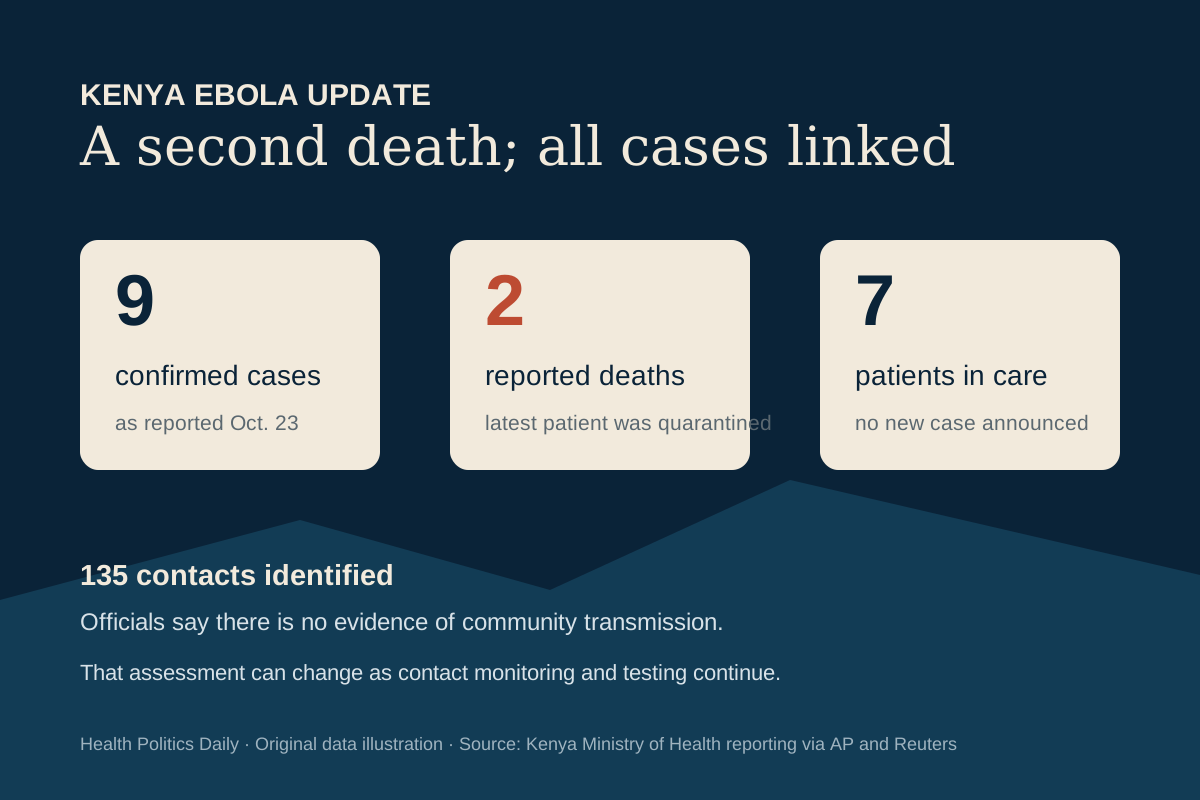
Verified baseline
Kenya’s Health Ministry reported Friday that a 65-year-old woman died after developing Ebola symptoms while in quarantine. She was a close relative and direct contact of the country’s first confirmed patient, who died October 5 after traveling from the Democratic Republic of Congo through Uganda to Nairobi.
Kenya has reported nine confirmed cases and two deaths. Seven patients remain in care at two isolation facilities, and officials have identified 135 contacts. The ministry said it had found no evidence of community transmission; that is a current surveillance assessment, not a guarantee that no additional linked case will be detected.
What changed
The death increases Kenya’s reported fatality count from one to two but does not represent a newly identified chain of transmission. The patient was already within the monitored contact group and began receiving supportive care after symptoms appeared.
The Associated Press reports that some contacts who completed 21 days without symptoms were due to leave quarantine. Reuters independently reports the nine-case total, seven patients in care and the ministry’s no-community-transmission assessment.
Why it matters
Detecting illness while a contact is already quarantined lowers the chance of unmonitored exposure, but every severe outcome matters to families and health workers. Four of Kenya’s infections have involved health workers, underscoring the need for protective equipment, rapid testing and careful infection control.
The wider Bundibugyo Ebola outbreak has reached multiple countries. Unlike Zaire ebolavirus, the Bundibugyo species does not currently have an approved vaccine or specific treatment, so early identification, isolation, contact tracing and supportive care remain central to control.
Practical implications
People in Kenya should follow national and county health guidance and avoid contact with the body fluids of anyone who is ill. Ebola is not spread through ordinary airborne transmission; infection generally requires direct contact with blood or other bodily fluids from a symptomatic person, or contaminated materials.
Travelers should check current official rules rather than rely on social-media summaries. The U.S. CDC’s Kenya notice describes the linked cluster, while its returning-traveler guidance gives separate restrictions for recent travel in the Democratic Republic of Congo, Uganda and South Sudan.
Fact, analysis, forecast and opinion
Verified fact: nine cases and two deaths have been reported in Kenya; the latest patient was already quarantined, and seven patients remain in care. Analysis: the known epidemiological links are reassuring for containment but do not eliminate risk while contacts remain under observation. Forecast: additional linked cases may still be detected during the incubation window, while sustained community transmission would require different evidence. Opinion: authorities should publish regular, consistent updates on contact follow-up and health-worker exposure without identifying patients.
For earlier context, see our reports on Kenya’s rise to seven cases, the difference between State Department and CDC travel scales, and Nigeria’s first confirmed case.
Bias Lens: outbreak status, preparedness and policy
Verified baseline: Kenya reports nine linked cases, including two deaths, and seven patients in care. Officials say they have no evidence of community transmission. That statement describes evidence available now and can be revised as monitoring continues.
Center coverage — Associated Press and Reuters: emphasize the death, contact tracing and cross-border outbreak status. International coverage — Al Jazeera: foregrounds the ministry’s containment assessment. A meaningful left-center-right split was not present in reliable reporting on this update, so the lens does not force ideological symmetry.
What remains uncertain
Officials have not established exactly how the index patient’s travel led to every exposure, and investigations continue into the source of Nigeria’s related outbreak. It is also too soon to know whether Kenya’s remaining patients will recover, whether every contact will complete monitoring without symptoms or when the cluster can be declared over.
Principal sources
- Associated Press — ministry announcement and contact-monitoring details
- Reuters — case totals and ministry assessment
- European Centre for Disease Prevention and Control — multi-country outbreak summary
- U.S. CDC — Kenya traveler notice
No suitable directly relevant official or publisher-authorized video with clear embedding permission was available, so none was embedded.