GLOBAL HEALTH — KENYA — EBOLA RESPONSE
Kenya Confirms Third Ebola Case in a Contact Already in Quarantine
The patient was being monitored as a known family contact. Health officials report no evidence of community transmission, while three listed contacts remain outside quarantine and surveillance continues.
By Health Politics Daily News Desk · Published October 16, 2026 at 9:57 p.m. ET · 6 minute read
Verified baseline
A known contact became ill while under observation
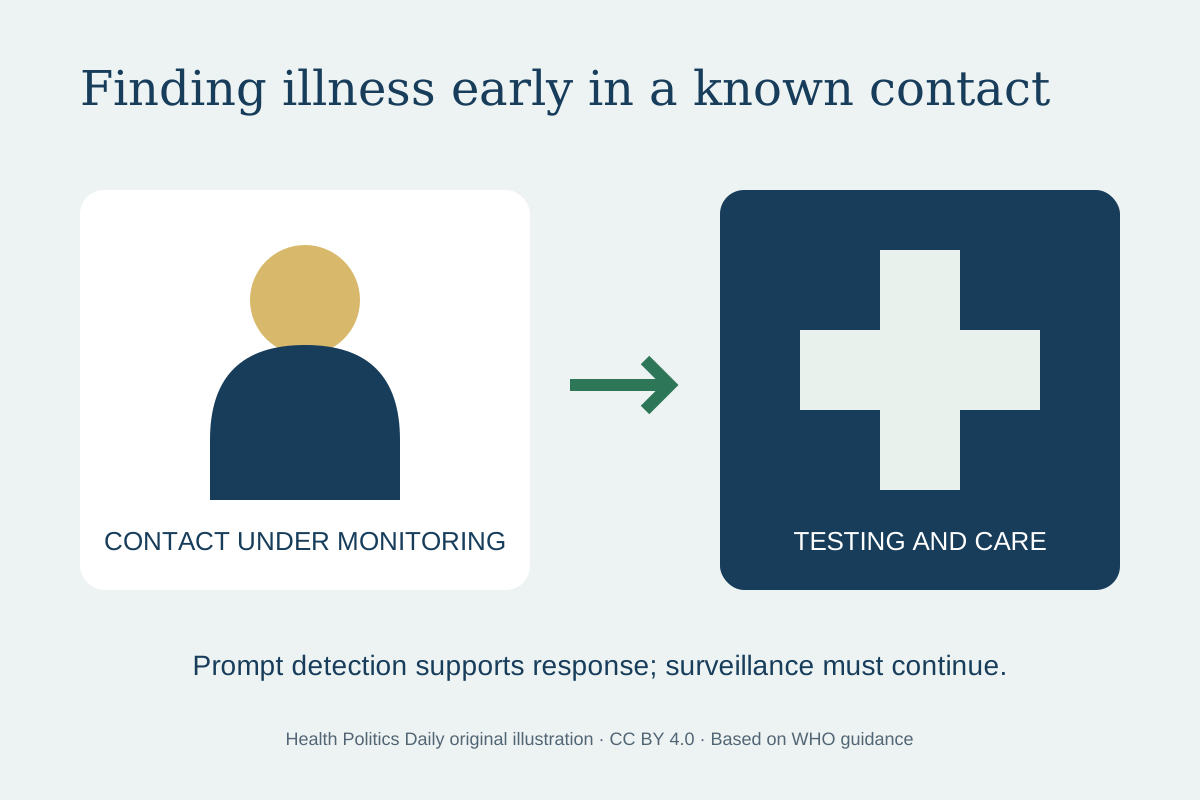
Kenya confirmed its third Ebola case on October 16: a 65-year-old woman who had been quarantined since October 6 and is related to the first two patients. She developed symptoms, tested positive and was moved into care, according to the Health Ministry’s statement reported by AP and Reuters.
A WHO update dated October 16 confirms three cases, including one death, and says 127 of 130 identified contacts were in quarantine. Both surviving patients belong to the first patient’s family. The ministry reports no evidence of community transmission.
Why detection matters
A rising case count can also show surveillance finding an existing chain
Analysis: the location of detection matters alongside the number of infections. Finding illness in a contact already being monitored offers a chance to isolate the patient promptly and investigate exposures. It differs operationally from discovering a patient whose connection to earlier cases is unknown.
The new diagnosis still represents serious illness and additional care needs. It does not, by itself, establish either containment or a wider transmission chain. Officials must keep looking for cases beyond the known family and complete follow-up of contacts. “No evidence” describes the findings available so far; it is not a guarantee that every infection has been found.
The three contacts not yet in quarantine make that uncertainty concrete. Their status is a reason to continue tracing, rather than infer from a high follow-up percentage that the work is complete.
Medical context
Contact monitoring addresses the incubation window
WHO explains that symptoms can begin two to 21 days after infection. Transmission occurs through direct contact with infectious blood or body fluids, including contaminated materials. People do not transmit Ebola before symptoms develop.
Early symptoms can resemble other illnesses, so laboratory confirmation matters. Supportive care, including fluid management and treatment of symptoms, can improve survival. Vaccines and medicines approved for Ebola virus disease should not be assumed to work against every related virus: there is no licensed vaccine or specific treatment for Bundibugyo Ebola, according to WHO.
That distinction prevents two misleading conclusions: that an existing Ebola vaccine automatically supplies an answer for this outbreak, or that the absence of a specific licensed product means clinicians have no useful care to offer.
Practical implications
Use current health instructions and avoid stigma
- Residents: official exposure and symptom guidance is more useful than judging risk from a person’s nationality or neighborhood.
- People identified as contacts: follow the monitoring and movement instructions provided by the local health team. WHO’s public questions and answers explain how follow-up works.
- Travelers: verify current entry and health requirements with authorities. The October 16 WHO release says Kenya has no restrictions on travel, trade or public gatherings; that does not remove screening requirements.
- Health facilities: early recognition, referral, testing and infection-control practices remain central to the response.
This is public-health reporting, not an individual diagnosis or treatment recommendation.
Regional context and uncertainty
Kenya’s contact cluster is distinct from Congo’s geographic expansion
The first Kenyan patient had returned from the Democratic Republic of Congo. Our earlier report on Ebola reaching an eighth Congolese province concerns the response area there; today’s Kenyan development concerns detection among known contacts. The two events should not be combined into a single count or treated as evidence of the same local conditions.
Forecast: additional diagnoses among monitored contacts remain possible during follow-up. Whether the response is containing transmission will depend on completion of monitoring, tracing of remaining contacts and investigation of any new cases. A single daily count cannot settle that question.
No editorial position on a party or government is advanced here. Assessment should follow published surveillance results, care access and documented response performance.
Bias Lens: verified cluster, response capacity and political context
The third case was identified in an already quarantined contact. Authorities report no evidence of community transmission and continue tracing.
Center: AP and Reuters emphasize the family link, monitoring and official assessment. Left-leaning contextual coverage: The Guardian’s October 6 report emphasizes regional response pressures. Right-leaning contextual coverage: Fox News’ earlier report focuses on a bipartisan aid appeal.
The latter two reports concern earlier developments, not today’s third case. They offer context about response capacity and aid policy, not opposing scientific interpretations of this diagnosis. The available coverage does not support a meaningful three-way partisan dispute about whether the patient tested positive.
Principal sources
Official response and corroborating reporting
- WHO Kenya: October 16 response update
- WHO: transmission, symptoms and care
- AP: third case and ministry statement
- Reuters: third case and contact monitoring
No suitable directly relevant official or publisher-authorized video with clear embedding permission was available.
Related Coverage