Global health · Kenya · Infectious disease
Kenya Ebola Total Rises to Seven, Including Three Health Workers
Four newly confirmed patients were already quarantined. Officials report no evidence of community transmission, while two listed contacts remain untraced.
By Health Politics Daily News Desk · October 17, 2026 at 8:04 p.m. ET
What changed on October 17
Kenya has confirmed four additional cases of Bundibugyo virus disease, an Ebola disease, bringing its cumulative total to seven, including one death. Three new patients are health workers and one is a family member of the initial patient. All four were already in quarantine when their infections were detected, according to Africa CDC’s October 17 statement, which cites Kenya’s Health Ministry.
The regional health agency says all four are receiving supportive care at a designated facility. It reports that 128 of 130 identified contacts have been traced and quarantined, with two still being sought, and that the ministry has found no evidence of community transmission at this stage.
Reuters reports that the three health workers cared for the first patient on October 3–4 and had been quarantined since October 9. The newly diagnosed relative had been quarantined since October 6. The Associated Press independently reports the new cases and says the two other surviving patients were stable.
Why linked infections are not the same as community-wide spread
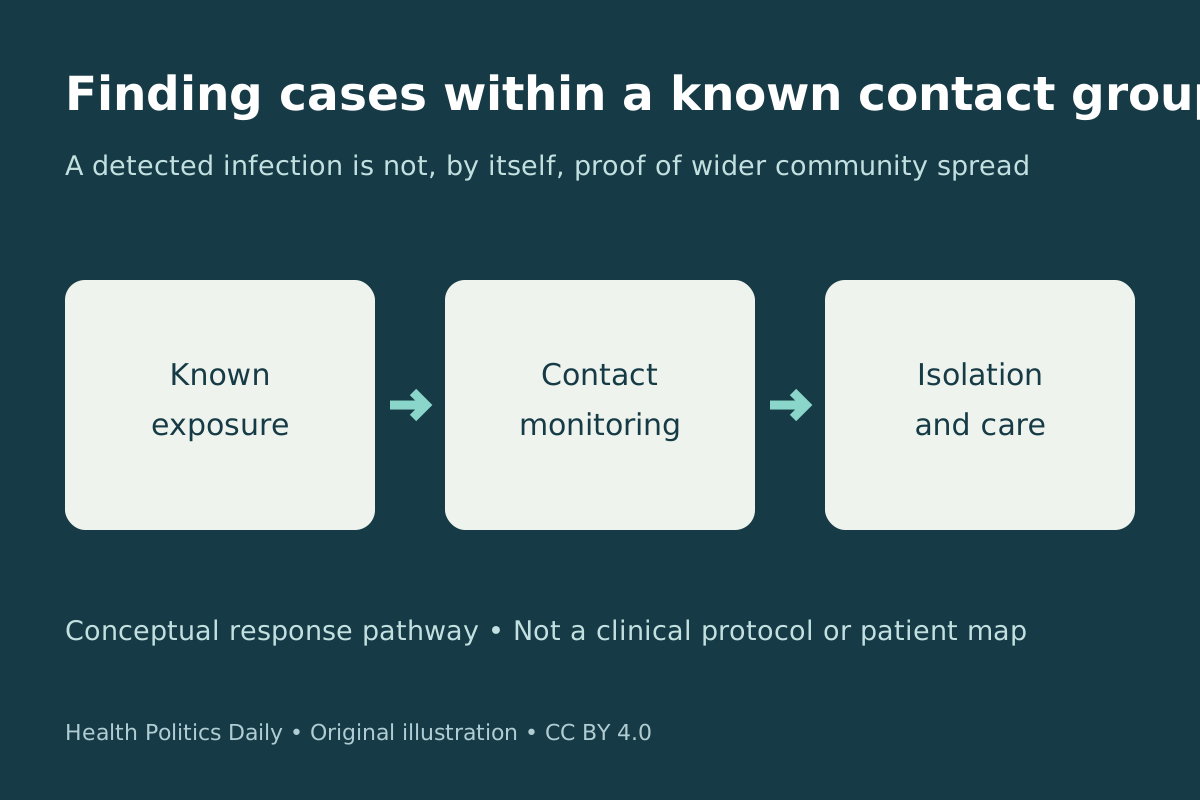
Analysis: These results show that people exposed to the initial patient became infected. Detecting them within a monitored contact group is different from finding infections without a known link. It is therefore possible for the case count to rise while officials still report no evidence of wider community transmission.
That distinction is not an all-clear. The count describes infections detected so far, and tracing is incomplete. Neither the current total nor a high proportion of traced contacts establishes that every exposure has been identified. The public statements reviewed do not establish the precise incident or infection-control failure that caused each health worker’s infection.
What the response needs to address
Africa CDC highlights protective equipment, infection-prevention training and support for frontline staff. It is also working with Kenya on surveillance, coordination and communication. Those are response priorities, not evidence that an investigation has already resolved every question about workplace exposure.
The WHO explains that Ebola diseases spread through direct contact with infected bodily fluids or contaminated objects and that people do not transmit the disease before symptoms begin. Incubation can last 2–21 days, helping explain why monitoring continues after an exposure.
WHO also distinguishes Bundibugyo disease from Ebola virus disease, for which licensed vaccines and therapeutics exist. There is no approved vaccine or specific treatment for Bundibugyo disease; supportive care, including fluids and management of symptoms, can improve survival. “No approved specific treatment” does not mean that care is ineffective or unavailable.
Practical implications and remaining uncertainty
Africa CDC directs people in Kenya seeking official information to the Health Ministry’s toll-free line 719. Anyone concerned about exposure should use official health guidance rather than diagnose themselves from a case-count headline. This report is general news, not an individual medical assessment.
Uncertain: Further cases among monitored contacts remain possible, but the available evidence does not support forecasting a final total, an individual patient’s outcome or inevitable nationwide spread. The next useful indicators are completion of tracing, any cases outside known contact groups and updated clinical reports.
This development updates our report on Kenya’s third case. Our coverage of the outbreak’s geographic expansion in Congo explains the wider regional setting; its earlier figures should not be substituted for Kenya’s current count.
Bias Lens: a common baseline, different framing
Verified baseline: Seven cumulative cases; four new infections detected in quarantine. Officials have not reported evidence of community transmission.
The left-leaning comparison, Al Jazeera, highlights the new total and health workers. The center comparison, Reuters, gives detail on quarantine timing and the ministry’s risk assessment.
The right-leaning comparison, WELT’s dpa wire report, places the Kenyan cases alongside the Congo outbreak. Its wire-service origin matters: the choice to carry a report is not proof that its medical account is a partisan argument.
The broad outlet labels are navigation aids, not verdicts on these articles. The reviewed coverage does not reveal a meaningful left-versus-right disagreement about the confirmed cases. Case linkage and official uncertainty are more important here than forcing political symmetry.
Sources and video
Africa CDC provides the current institutional update; WHO supplies disease-specific context. AP and Reuters corroborate the new cases. No suitable directly relevant, authorised video of this update was identified, so none is embedded.