GLOBAL HEALTH — EBOLA — CENTRAL AFRICA
Congo Ebola Outbreak Reaches an Eighth Province Near Central African Republic
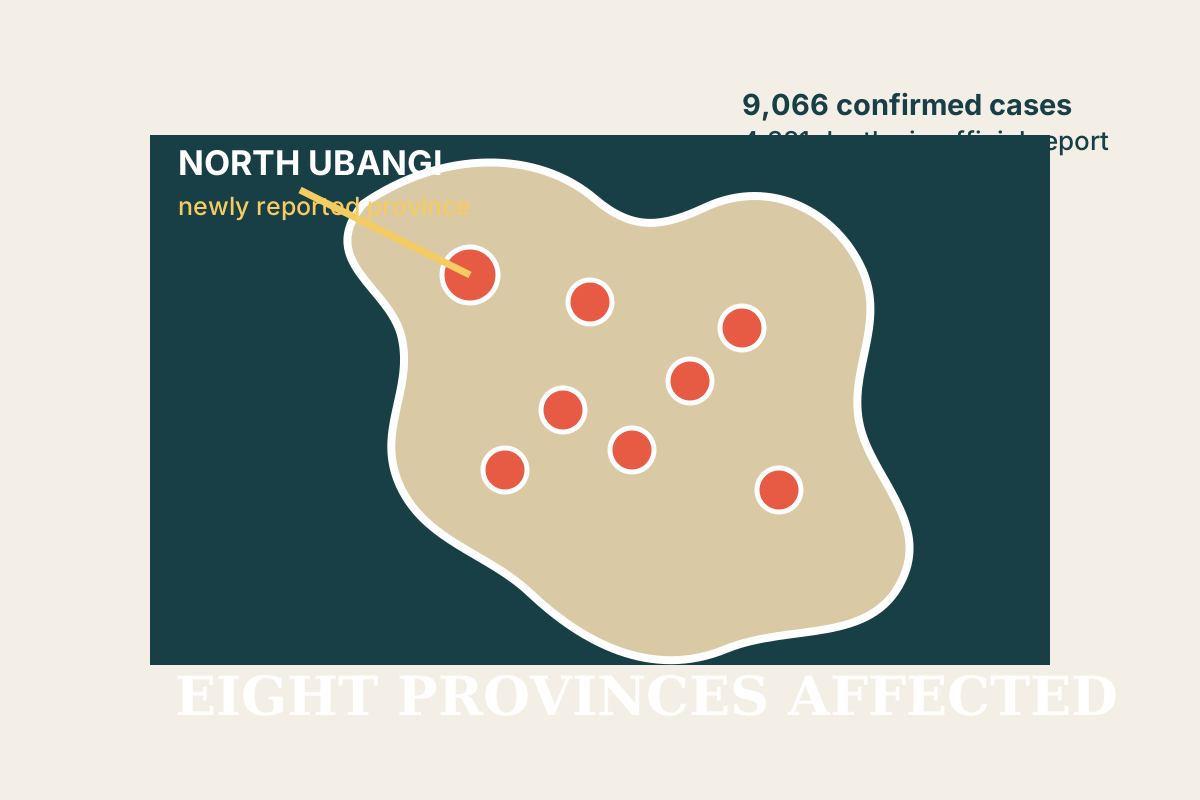
Two health officials say Bundibugyo Ebola has reached North Ubangi, widening the geography of Congo’s record outbreak. The national case count is official; the two new provincial cases had not yet been publicly announced.
By Health Politics Daily News Desk · Published Friday, October 16, 2026 at 6:00 a.m. America/New_York · Approximately 7 minutes
Verified Baseline
Congo’s official report counted 9,066 cases and 4,381 deaths
The Democratic Republic of Congo’s public-health institute reported 9,066 laboratory-confirmed cases and 4,381 deaths as of October 13. That makes this the country’s largest and deadliest Ebola outbreak and the world’s second largest after the 2014–2016 West Africa epidemic, according to Reuters and Associated Press.
The outbreak is caused by Bundibugyo virus, for which there is no approved vaccine or virus-specific treatment. Supportive care can improve survival, and candidate countermeasures are under study. The recorded fatality ratio is not an individual prognosis and is affected by delayed detection, missed cases and access to care.
What Happened
Two cases were reported in North Ubangi
Two Congolese health officials told Reuters on October 15 that testing confirmed two cases in North Ubangi, making it the eighth affected province. Suspected deaths in a mining area in Wapinda health zone prompted laboratory testing.
This detail requires a qualification: Congo’s national authorities had not publicly announced the North Ubangi cases when Reuters published. Health Politics Daily therefore treats the provincial expansion as credibly reported by named-role health sources, not yet as a published national situation-report update.
Why It Matters
The new location adds cross-border and response challenges
North Ubangi borders the Central African Republic and is far from the eastern epicenter in Ituri. A wider geographic footprint can stretch laboratories, contact tracing, safe-burial teams and treatment capacity, while movement through mining and border communities complicates the task of finding every exposure.
Geographic expansion does not prove sustained transmission in Central African Republic, and no such case was reported. It does, however, strengthen the case for coordinated surveillance and rapid information sharing across borders. Kenya has separately recorded two linked cases associated with travel from Congo; officials say there is no evidence of widespread Kenyan transmission.
Practical Implications
Direct contact drives transmission
Ebola spreads through direct contact with blood or other body fluids of a person who is sick or has died, or with contaminated objects. It does not spread through ordinary distant contact, and people are not infectious before symptoms begin. The World Health Organization’s guidance emphasizes early isolation, infection control, contact tracing and safe, dignified burials.
People in affected areas should follow local health-authority instructions and seek care promptly after a relevant exposure or compatible symptoms. International readers should not infer a general travel risk from the national case total. This is general public-health information, not personalized medical advice.
What Remains Uncertain
Public confirmation, transmission chains and the outbreak’s trajectory
Authorities have not yet published how the two North Ubangi patients were exposed, how many contacts are being monitored or whether additional samples are pending. The extent of undetected infection is also uncertain; case totals can rise when surveillance improves as well as when transmission accelerates.
Analysis: the move into an eighth province is more consequential than a numerical milestone because it adds a new operational front. Forecast: official case counts may increase as Wapinda investigations expand, but there is not enough public evidence to predict sustained provincial or cross-border spread. Opinion: Health Politics Daily takes no position on travel restrictions; decisions should follow current risk assessments rather than headlines alone.
Bias Lens: how coverage frames the outbreak
Congo’s official October 13 report recorded 9,066 cases and 4,381 deaths. Reuters subsequently reported two North Ubangi cases from health officials; the national government had not yet publicly announced them.
Center coverage: Reuters emphasizes the new province and border geography, while AP foregrounds the official national total, deaths outside treatment centers and response strain. Left-leaning coverage: The Guardian centers the human and health-system consequences, including Kenya’s first imported case and the absence of an approved Bundibugyo vaccine.
No timely, detailed report from a reputable right-leaning outlet was located for the North Ubangi development. That absence is disclosed rather than filled with a fringe source. The available framing differences concern geography, response capacity and human impact—not competing versions of the official baseline.
Principal Sources
Official guidance and corroborating reporting
- Congo Health Ministry — outbreak situation reports
- World Health Organization — Ebola disease facts and response guidance
- Reuters — North Ubangi cases and geographic context
- Associated Press — official national count and response conditions
No suitable directly relevant official or publisher-authorized video with clear embedding permission was available.
Related Coverage