PUBLIC HEALTH — NEW YORK — MEASLES
New York Seeks Federal Help as Measles Outbreak Reaches 108 Cases
The request follows a statewide disaster emergency that expands testing and vaccination capacity. Federal officials say assistance is available, but the exact support package has not been announced.
By Health Politics Daily News Desk · Published Thursday, October 8, 2026 at 12:01 p.m. America/New_York · Approximately 8 minutes

Watch in this article
HHS secretary discusses the Pennsylvania measles outbreak
Official government remarks embedded from the publisher’s YouTube upload.
U.S. Department of Health and Human Services · August 26, 2026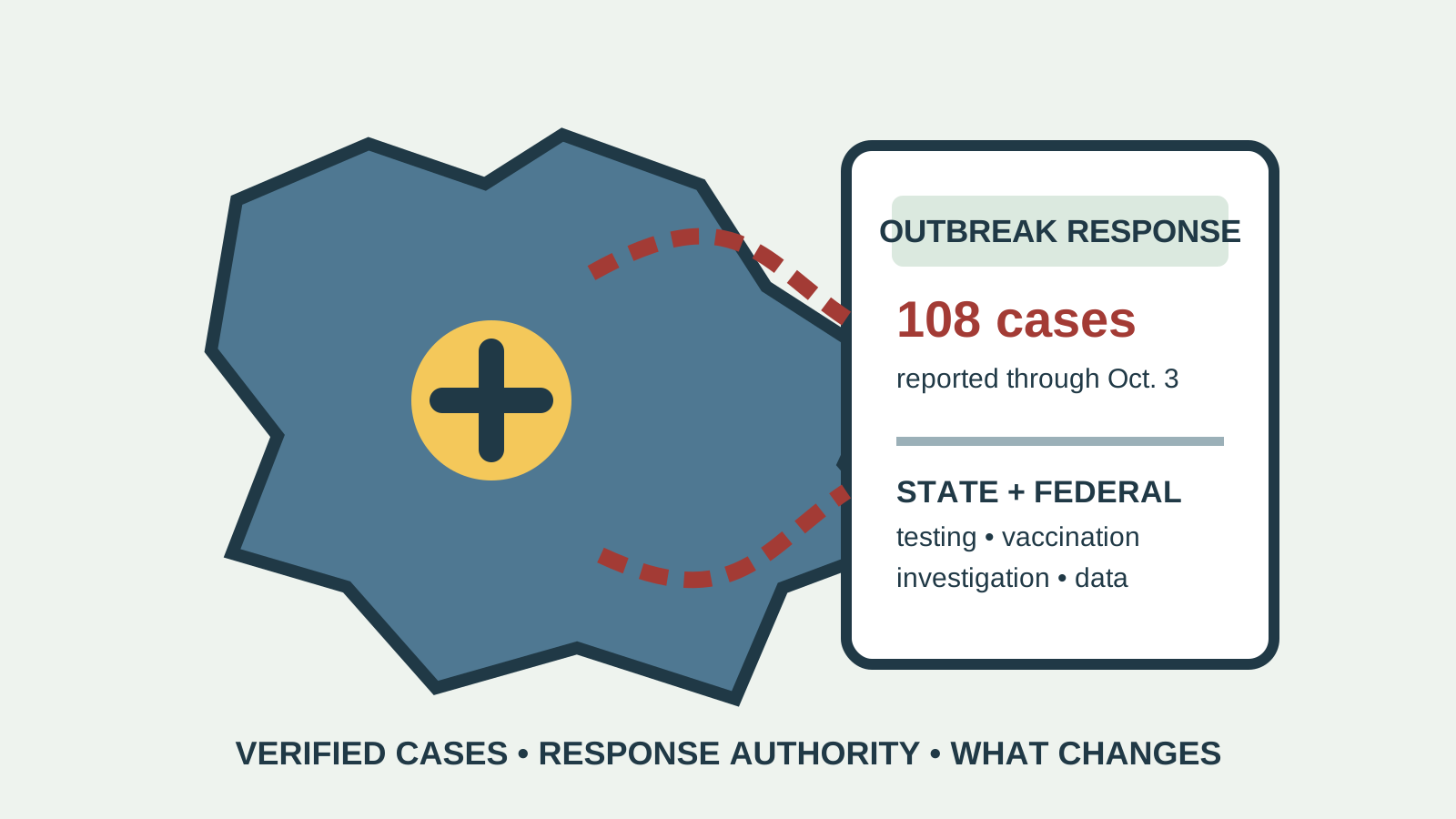
Verified Baseline
New York will request CDC and HHS assistance
Governor Kathy Hochul plans to seek federal assistance for New York's measles response from the Department of Health and Human Services and the Centers for Disease Control and Prevention, her spokesperson told Reuters. HHS said federal officials stand ready to assist, and Health Secretary Robert F. Kennedy Jr. connected Hochul with CDC Director Erica Schwartz.
The request comes after Hochul issued Executive Order 65, declaring a statewide disaster emergency from October 5 through November 4. New York reported 108 cases through October 3, including 92 since July 15 in under-immunized rural communities across 18 counties.
What the Emergency Changes
More professionals can vaccinate and test
The order temporarily broadens the health workforce available for outbreak control. It permits registered nurses to order measles tests under specified conditions, allows pharmacists to vaccinate children as young as two, and requires faster reporting of MMR doses to state or New York City immunization registries.
The order does not compel vaccination, erase informed-consent requirements or close schools statewide. It creates temporary authorities intended to make testing, vaccination and case tracking faster.
What Federal Help Could Mean
CDC support can add epidemiology, laboratory and response capacity
State and local health departments lead measles investigations. When requested, CDC can provide technical specialists, laboratory support, data analysis, infection-control guidance and help tracing transmission. The CDC says states may request assistance appropriate to an outbreak.
No detailed federal deployment, funding amount or timetable has been made public. An offer of support is not proof that a CDC team is already in the field or that federal officials will direct New York's response.
Why It Matters
The outbreak is part of the worst U.S. measles year in decades
CDC reported 3,887 confirmed U.S. cases as of October 1, with 95% associated with outbreaks. Pennsylvania has recorded more than 1,000 cases in a neighboring outbreak, while New York's cases are concentrated mainly outside New York City.
Analysis: the federal request matters because measles response is labor-intensive: every case can require interviewing patients, tracing contacts, arranging testing and protecting health-care settings. Additional personnel and laboratory capacity can shorten delays, but they cannot substitute for local trust or adequate vaccination coverage.
Forecast: more cases may be identified as surveillance expands. Whether transmission slows will depend on immunity levels, speed of case isolation and vaccination uptake—not the emergency declaration alone.
Opinion: Health Politics Daily takes no position on partisan disputes surrounding federal health leadership. Case counts, vaccine guidance and causation assessments should be reported transparently and kept separate from political claims.
Practical Implications
What residents and families should know
- Check official local guidance: the New York State measles page posts current recommendations and exposure information.
- Call before arriving: people with possible measles symptoms or a known exposure should contact a clinician before entering a waiting room so infection-control steps can be arranged.
- Review records: families can ask a clinician or local health department whether their MMR documentation is complete; recommendations may differ for infants in outbreak settings or travelers.
- Do not infer a mandate: the emergency expands who can test and vaccinate but does not remove consent requirements.
This is general public-health information, not personalized medical advice. For context, read our coverage of the Pennsylvania outbreak and the federal vaccine-panel court fight.
What Remains Uncertain
The scope of federal deployment and the outbreak's trajectory
Officials have not specified which CDC resources New York will receive, where they would be placed or how long support would continue. The 108-case state total is preliminary and may change as investigations connect or separate cases.
Bias Lens: how coverage frames the emergency
New York reported 108 measles cases through October 3, declared a disaster emergency and plans to request federal help. The order expands testing and vaccination capacity while retaining consent requirements.
Center coverage: Reuters emphasizes the state-federal coordination and the offer of CDC assistance. Left-leaning coverage: The Guardian gives more attention to declining vaccination and criticism of Kennedy's record. Right-leaning coverage: Fox News foregrounds the emergency declaration and spread from Pennsylvania.
The outlets differ mainly in emphasis—coordination, political accountability or interstate spread. The state order and reported case count are common factual anchors.
Principal Sources
Official records and corroborating reporting
- Governor of New York — disaster emergency announcement
- New York Executive Order 65
- New York State Department of Health — measles update
- CDC — national measles cases and outbreaks
- Reuters — federal assistance request and offer
No suitable directly relevant official or publisher-authorized video with clearly confirmed embedding permission was available.