Public health · Nigeria · Ebola response
Nigeria Confirms Ebola Case in Abuja; Authorities Identify 44 Contacts
Nigeria’s October 20 announcement confirms one Ebola case and starts contact tracing. Identified contacts are not confirmed infections, and travel history does not settle exposure.
By Health Politics Daily News Desk · October 20, 2026 at 4:01 p.m. ET
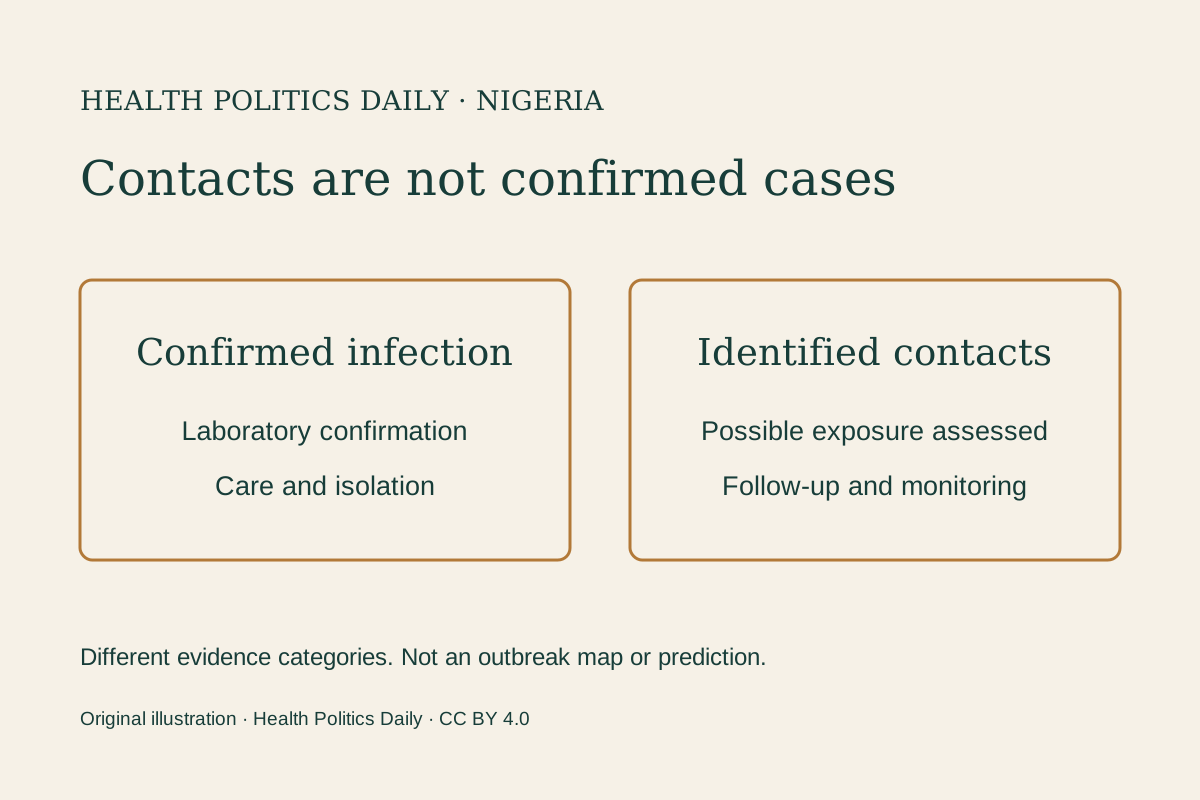
Nigeria confirmed an Ebola case in the Federal Capital Territory on October 20 and said public health teams had identified 44 close contacts. The patient is in isolation and receiving care. The contact count describes people being assessed for possible exposure—not 44 additional cases.
What Nigeria has confirmed
The Federal Ministry of Health and Social Welfare’s statement says laboratory confirmation was received on October 20. It describes a woman who recently arrived on an international flight from Uganda and received care for several days at a private hospital before diagnosis.
The ministry says the response includes NCDC, FCT health authorities, intensified surveillance and support for infection prevention at the hospital. The identified contacts include healthcare workers, patients, caregivers and travel contacts. It directs health facilities to identify and isolate suspected cases promptly and report them to public health authorities.
Associated Press reporting corroborates the announcement and says symptoms began October 7 and hospital admission occurred October 11. Those dates help explain why reconstructing contacts before laboratory confirmation matters.
Travel history is not a proven place of infection
Reuters reports that Uganda’s government spokesperson said there was no Ebola in Uganda. A patient’s reported travel route and the location where an infection was acquired are different facts. The Nigerian statement reviewed here does not provide a completed exposure investigation.
Analysis: It would be premature to identify an airport, flight, hospital encounter or country as the proven source without supporting investigation results. It would also be premature to infer widespread transmission in Abuja from a single confirmed case. Neither inference is established by the announcement.
Why contacts are monitored
The World Health Organization’s Ebola guidance explains that infection can spread through direct contact, through broken skin or mucous membranes, with an ill or deceased person’s blood or body fluids, or with contaminated objects. People do not transmit Ebola before symptoms begin. The incubation period ranges from two to 21 days.
WHO identifies contact tracing, laboratory services, infection prevention and patient care as parts of outbreak control. Being included in a tracing list therefore does not mean a person is ill, infectious or certain to become infected.
Analysis: The useful next measures are not simply whether the contact list grows. Investigators may identify additional people as interviews progress. More informative updates would say how many contacts have been reached and monitored, whether anyone develops symptoms, what testing finds and whether any additional confirmed cases are linked to known exposures.
What this means for patients, families and health workers
The immediate priority in the ministry’s announcement is safe care and follow-up of potentially exposed people. Readers should use verified public health instructions and cooperate if contacted by response teams. A person’s nationality, travel history or appearance is not a diagnosis, and sharing unverified patient identities does not help establish an exposure chain.
WHO says early intensive supportive care can improve survival. Anyone concerned about a possible exposure or symptoms should contact local public health or healthcare services for instructions, including how to obtain assessment safely. This is general reporting, not an individual diagnosis or treatment plan.
Our Kenya travel-advisory report explains why country travel advice and disease-specific notices use different scopes. Our earlier Congo response coverage provides dated regional context. Neither substitutes for a current Nigeria-specific investigation.
What remains uncertain
The reviewed ministry statement does not specify the viral species, publish the laboratory findings or establish the place and date of exposure. This article does not infer those details from outbreaks elsewhere. It also does not predict additional cases, claim all contacts have been reached or announce that containment is complete.
Analysis: Prompt confirmation and an active response are important, but the announcement alone cannot measure the response’s eventual success. Subsequent, dated case and contact updates will be needed.
Bias Lens: a confirmed case is not a forecast of spread
Verified baseline: Nigeria reports one laboratory-confirmed case, isolation and 44 identified contacts. Contacts and confirmed infections are separate categories.
Center—Reuters and AP: Reuters includes Uganda’s response to the travel history; AP adds the symptom and admission chronology. These emphases answer different verification questions.
Right-leaning publisher—WELT’s October 20 dpa dispatch: Emphasizes contact tracing, healthcare-facility precautions and regional context. This is agency news, not a statement from WELT’s opinion pages.
Comparison limit: Directly comparable left-leaning coverage of this new Nigeria announcement was not verified. Earlier political coverage of Kenya is a different story and cannot establish the cause or scope of this case. The meaningful question is what each report verifies—not whether a partisan position can be assigned to a public health finding.
Sources and media
The October 20 Nigerian ministry statement anchors the case and response details; WHO supplies general transmission and care context. AP and Reuters corroborate the announcement. The illustration is an original evidence-reading guide, not an outbreak map. No suitable directly relevant authorized video was verified, so none is embedded.