Public health · Kenya · Travel information
U.S. Raises Kenya Travel Advisory to Level 3; CDC Ebola Notice Uses a Different Scale
The October 19 Kenya advisory says reconsider travel, while CDC’s Ebola notice advises usual precautions. What the different alerts mean and which official details to check.
By Health Politics Daily News Desk · October 20, 2026 at 4:05 a.m. ET
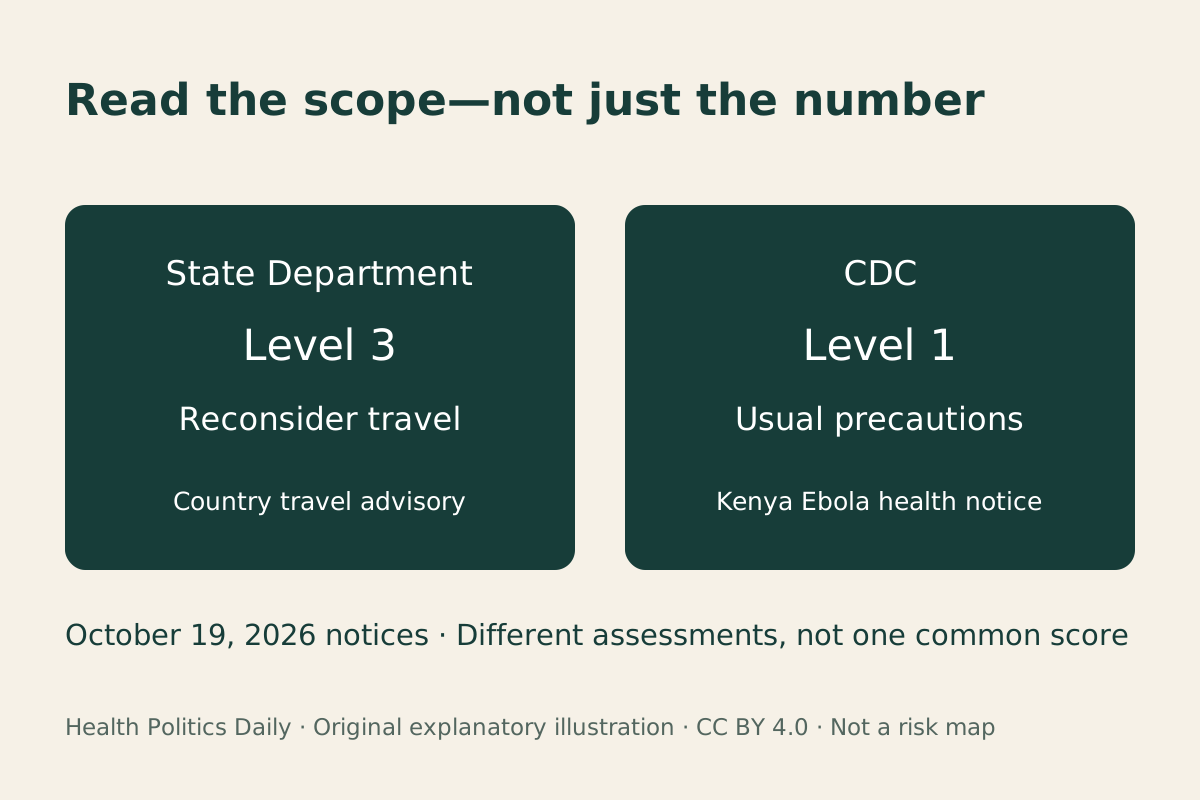
The U.S. State Department raised its Kenya travel advisory from Level 2 to Level 3 on October 19, citing health risks. The nationwide recommendation is now “Reconsider travel.” Separately, the CDC’s Kenya Ebola notice, reviewed October 19, is Level 1: “Practice Usual Precautions.”
Those labels should not be collapsed into a single score. One is a broad country travel advisory; the other addresses a particular disease and recommended precautions. A traveler needs the wording, geographic detail and date of each—not just the largest or smallest number.
What changed in the State Department advisory
The advisory history explicitly identifies health risks as the reason for the move to Level 3. Its current summary also lists crime, kidnapping, terrorism, unrest and traffic safety. Several specified locations carry stronger “Do Not Travel” advice, so the national level should not be read as describing every area identically.
Reuters independently reported the change on October 19. This is an advisory update, not evidence in these sources of a new blanket ban on every journey to Kenya.
The State Department also cautions that access to medical services can be limited, especially in rural areas, and that evacuation may be necessary for some medical problems. Its page recommends reviewing medical and evacuation coverage and enrolling in the Smart Traveler Enrollment Program for government alerts.
What CDC says about the linked cases
CDC’s notice identifies an imported Bundibugyo virus disease case and linked cases in Nairobi. It says local authorities are investigating contacts and the risk of further transmission. Its Level 1 advice includes avoiding contact with symptomatic people or their bodily fluids.
If a traveler develops symptoms such as fever, headache, muscle pain, weakness, diarrhea or vomiting, CDC advises separating from others, not traveling and contacting local health authorities or a healthcare facility. Calling ahead helps the facility prepare. Consult the full notice for its complete guidance rather than using this article to diagnose an illness.
Why the case count needs a date
Associated Press reported eight cases on October 18, attributing the update to Kenya’s health ministry. The newly identified patient was already in quarantine as a contact of the first patient. That is a dated report, not a live count independently compiled for this edition.
Our earlier report on Kenya’s seven-case update and coverage of the third case in quarantine document earlier stages. A difference between those numbers and a later bulletin is not, by itself, contradictory reporting.
Analysis: Cases detected among known contacts and a claim of widespread community transmission are different propositions. The official CDC notice reviewed here describes linked cases and an ongoing investigation; it does not quantify an individual visitor’s risk or establish the same conditions throughout the country.
What people with travel plans can verify
Read the full State Department advisory for the specific route and destination, and the CDC notice for health precautions. Separately confirm current airline, entry and transit requirements with the relevant authorities and operators. An advisory headline does not establish whether a particular ticket is refundable or a policy covers cancellation.
Practical distinction: A travel recommendation, an airline operating decision, an entry restriction and an insurance contract are separate things. Obtain current written terms for each relevant decision. This report supplies public information, not individualized medical, insurance or legal advice.
What remains uncertain
Contact investigations can change the understanding of transmission, and both agencies may revise their notices. This edition does not establish a future case trajectory, a date when guidance will change or a particular traveler’s probability of infection. Recheck the live official pages before departure and during a stay.
Bias Lens: practical guidance versus policy accountability
Verified baseline: State’s national Level 3 advisory and CDC’s disease-specific Level 1 notice coexist. Their wording and scope—not a presumed common scoring system—are the evidence.
Center—Reuters: Its short dispatch foregrounds the changed U.S. travel recommendation. AP’s October 18 account focuses on cases and quarantine.
Left-leaning—The Guardian, October 19: Its framing emphasizes U.S. preparedness, funding cuts and the quarantine-center controversy.
Comparison limits: The Guardian’s accountability focus is a different question from decoding the latest advisory. Its policy critique is not used here as proof of a particular transmission route. No directly relevant right-leaning report was verified for this edition, so no third narrative is invented. Publisher labels are orientation aids, not judgments about every article or an assumption that all perspectives are equally evidenced.
Sources and media
Primary sources: the State Department’s October 19 Kenya advisory and CDC’s October 19 disease notice. Reuters corroborates the advisory change; AP supplies dated case reporting. The original illustration compares the notices’ scope and is not a map of infection risk. No suitable directly relevant authorized video was verified, so none is embedded.