International politics · Middle East · Diplomacy
Iran, Saudi Arabia, Turkey and Pakistan Agree to Continue Regional Security Talks
Senior officials met in Tehran as conflict risks rose around Iran, Yemen and Saudi infrastructure. Their agreement to keep talking creates a channel for diplomacy, but it is not a ceasefire or mutual-security settlement.
By Health Politics Daily News Desk · October 26, 2026 at 3:59 p.m. ET

Watch in this article
Pumpjack operating at the Kern River Oil Field
A short CC0 field video provides visual context for reporting on oil production and fuel supply.
Thomas Farley / Wikimedia Commons · CC0 1.0 · License and source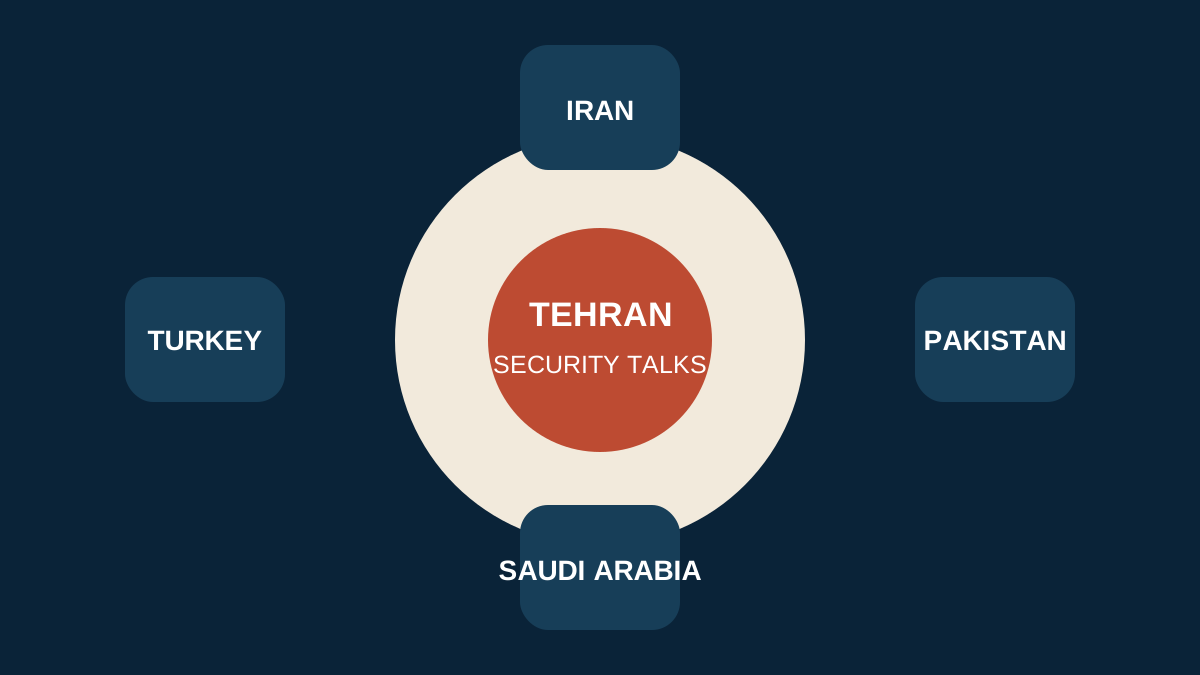
Verified baseline
Senior officials from Saudi Arabia, Turkey and Pakistan met Iranian leaders in Tehran on Monday. Saudi Defense Minister Khalid bin Salman, Pakistan’s army chief Field Marshal Asim Munir and Turkish intelligence chief Ibrahim Kalin participated alongside Iranian President Masoud Pezeshkian and Iranian security officials.
The four countries said they would continue discussions aimed at strengthening cooperation, peace and regional security. They did not announce a ceasefire, a treaty, a timetable for another meeting or a mechanism for enforcing commitments.
Why the meeting happened now
The talks came amid concern that fighting involving Iran, the United States and Israel could intensify again. Separate Houthi attacks and Saudi-led operations in Yemen have also raised risks for civilian infrastructure, air travel, shipping and oil supply.
Saudi Arabia, Turkey and Pakistan are members of the Mecca joint-defence framework. Their decision to meet Iran as a group is significant because Saudi territory has become a pressure point in the broader conflict and because all three maintain relationships that could support mediation.
What the participants said
Pezeshkian called for regional unity and said Iran supported agreements that deepen cooperation and resolve differences. Saudi statements described the purpose as de-escalating tensions and promoting regional stability. Turkish President Recep Tayyip Erdoğan separately warned that renewed attacks on Iran could destabilize countries beyond the immediate conflict.
Those statements establish diplomatic intent. They do not show that the parties resolved disputes over U.S.–Iran hostilities, the Strait of Hormuz, Iran’s nuclear program, sanctions or the Houthis’ attacks on Saudi Arabia.
Why it matters to people and markets
A durable reduction in regional violence could lower risks to civilian travel, shipping, energy infrastructure and humanitarian access. Failure could expose more communities to strikes and disruptions, while threatening routes that influence global oil and freight costs.
Markets responded positively to the prospect of diplomacy, but price moves are not proof that an agreement will follow. Households and businesses should distinguish negotiations from concrete changes to shipping restrictions, sanctions, flight operations or fuel supply.
Fact, analysis, forecast and opinion
Verified fact: representatives of the four countries met and agreed to continue dialogue. Analysis: the meeting creates a useful regional channel that includes both Iran and Saudi-aligned security partners. Forecast: further talks are plausible, but their timing and agenda are unknown. Opinion: Health Politics Daily supports verifiable diplomacy and civilian protection without endorsing any government’s negotiating position.
Bias Lens: peace initiative, strategic hedge or unfinished diplomacy?
Verified baseline: the Tehran meeting occurred and the participants agreed to continue discussions. No ceasefire, binding defence arrangement or sanctions agreement was announced.
Left-leaning coverage: The Guardian places the talks within a broader argument for regional security structures less dependent on the United States. Center wire coverage: Reuters foregrounds de-escalation, the Mecca defence pact and renewed Houthi attacks. Center-right financial coverage: Financial Times emphasizes efforts to prevent renewed U.S.-Israeli hostilities and the unresolved nuclear and maritime issues.
No detailed mainstream right-leaning English-language report was available at publication. Rather than force symmetry, the comparison identifies how available outlets emphasize regional autonomy, immediate security risks or negotiation obstacles.
What remains uncertain
The parties did not disclose a next meeting, negotiating text or specific confidence-building steps. It remains unclear whether the channel can influence U.S. or Israeli decisions, restrain Houthi operations, reopen maritime routes or produce a wider settlement.
Principal sources
- Reuters — participants, statements and regional context
- Associated Press — meeting outcome and de-escalation effort
- Al Jazeera — regional participants and official Iranian image
- Financial Times — diplomatic and nuclear context
No suitable official or publisher-authorized video with clear downstream embedding permission was available, so no video was embedded.