United Kingdom · Regional finance · Devolution
UK Budget to Give English Mayors New Funding and Borrowing Facility
The package includes £285 million in seed funding next year, £150 million for local capacity and a £1.5 billion borrowing facility planned for 2028.
By Health Politics Daily News Desk · October 24, 2026 at 10:00 p.m. ET

Watch in this article
Pumpjack operating at the Kern River Oil Field
A short CC0 field video provides visual context for reporting on oil production and fuel supply.
Thomas Farley / Wikimedia Commons · CC0 1.0 · License and source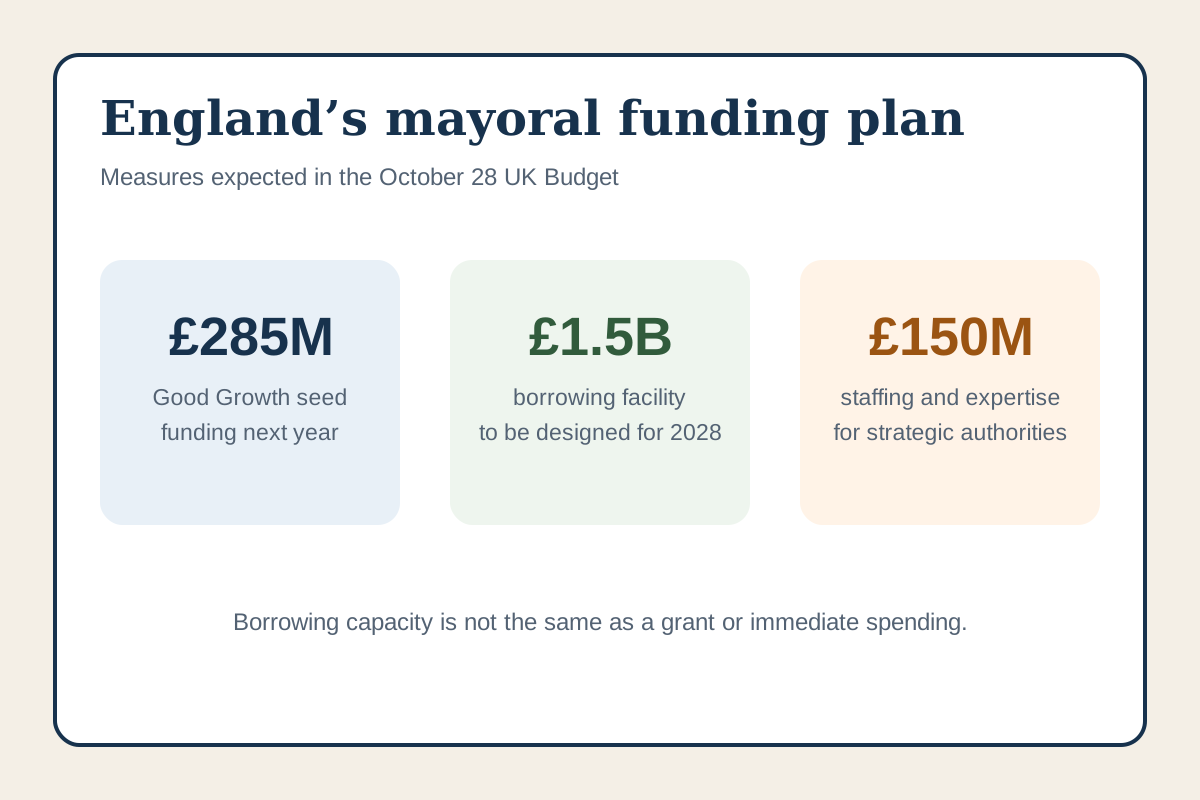
Verified baseline
Britain’s October 28 Budget will provide £285 million next year through a new Good Growth scheme for English regional leaders, according to the Finance Ministry plan reported by Reuters. The government also plans £150 million next year to strengthen staffing and expertise at strategic authorities.
Ministers will work with mayors to design a £1.5 billion borrowing facility intended to begin in 2028. The East Midlands Combined County Authority separately confirmed those headline amounts and timing.
What the money can—and cannot—do
The £285 million is seed funding that local leaders could direct toward priorities such as housing, transport and high-street regeneration without competing for multiple central-government grants. The £150 million is intended to build administrative capacity as regional bodies manage larger budgets.
The £1.5 billion figure is planned borrowing access, not a £1.5 billion grant. Its interest rates, allocation rules, safeguards, repayment sources and project eligibility are still to be designed, so the announcement does not authorize a particular road, housing development or regeneration project today.
Why it matters
The policy shifts some investment decisions away from Westminster and toward mayors who argue that local knowledge can produce faster, better-targeted growth. Greater flexibility can also reduce time spent bidding for short-term funds.
The tradeoff is fiscal risk and uneven capacity. Wealthier or more experienced regions may be better positioned to develop projects and service debt, while weaker authorities may need equalization and stronger oversight to prevent a two-tier system.
Practical implications
Residents and businesses should not assume immediate local construction or tax changes. The useful next documents will be the Budget, allocation tables, each authority’s public investment plan and later borrowing terms. Local consultations and approvals may still be required.
This is general public information, not individualized financial or investment advice.
Fact, analysis, forecast and opinion
Verified fact: the government announced £285 million in seed funding, £150 million for capacity and plans for a £1.5 billion facility. Analysis: the package advances fiscal devolution but leaves risk-sharing and distribution unresolved. Forecast: mayors are likely to propose housing, transport and town-centre projects, but project volume cannot be known until the rules are published. Opinion: Health Politics Daily takes no position on UK parties; success should be judged by transparent allocations, additional growth and manageable debt.
Bias Lens: local freedom or new fiscal exposure?
Verified baseline: the package mixes grants, administrative funding and future borrowing; the full borrowing design is not yet public.
Left-leaning coverage — The Guardian: emphasizes devolution’s promise alongside the need for accountability against misuse. Center coverage — Reuters: foregrounds the three amounts, local discretion and the government’s growth argument. Right-leaning commentary — The Times: places the wider Budget in the context of spending commitments and fiscal assumptions. The perspectives address different questions; criticism of the overall Budget does not by itself establish that this facility will fail.
What remains uncertain
The Budget must confirm allocations and conditions. It remains unclear how the £285 million will be divided, which authorities can borrow, how poorer areas will be protected, what collateral or revenue supports loans and how projects will be audited.
Related coverage
- UK Announces £600 Million AI Security Plan
- UK Borrowing Exceeds Forecast Ahead of Budget
- IMF Forecasts Regional Contraction
Principal sources
- Reuters — Finance Ministry announcement
- East Midlands Combined County Authority — regional confirmation
- The Guardian — accountability context
No suitable directly relevant official or publisher-authorized video with clear embedding permission was available, so none was embedded.