Technology policy · United Kingdom · Biosecurity
UK Announces £600 Million AI Security Plan With Biosecurity Lab
Britain’s new package directs public money toward biological-threat detection, medical countermeasures, cybersecurity and advanced-model testing. The allocations are concrete, but operational milestones and measures of success remain incomplete.
By Health Politics Daily News Desk · October 24, 2026 at 12:01 p.m. ET
Verified baseline
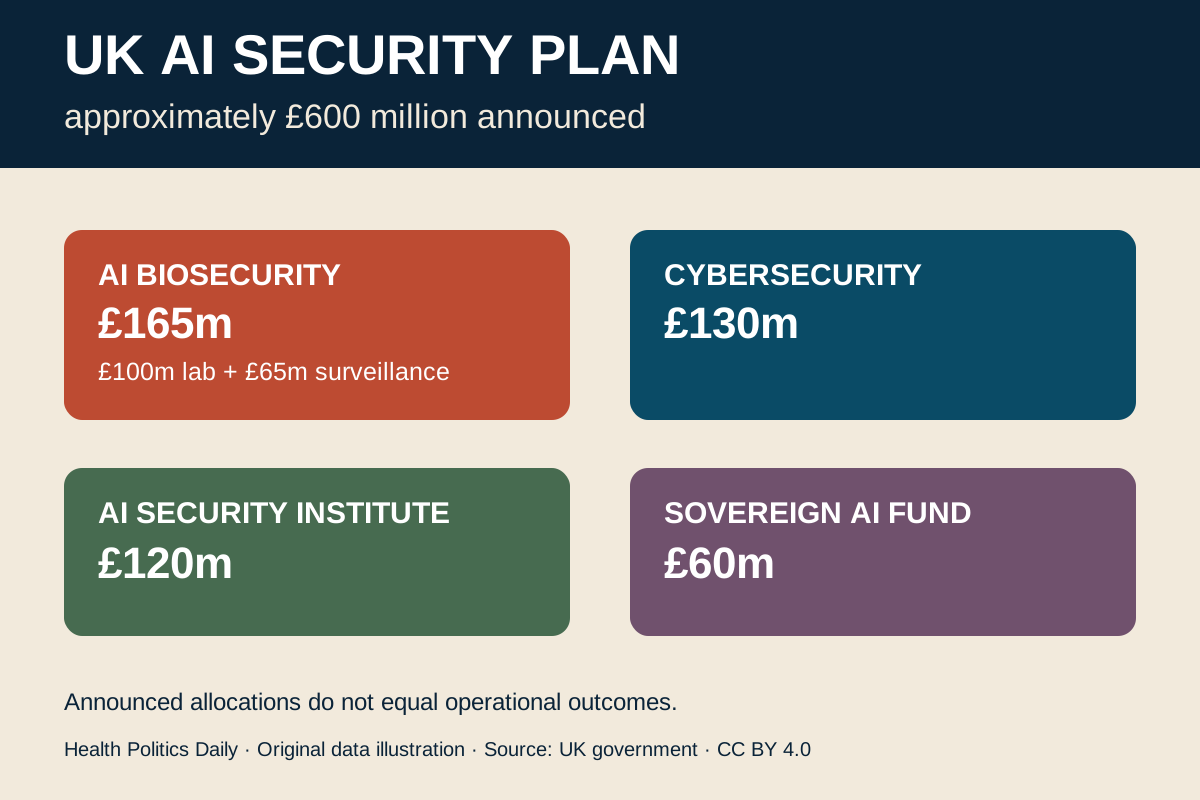
The UK government announced roughly £600 million for AI security and domestic capability. Its official plan includes £165 million for a National AI Biosecurity Initiative: £100 million for an AI Biosecurity Lab and £65 million for biological surveillance and medical countermeasures against priority pathogens.
The package also includes £120 million in new funding for the AI Security Institute, £130 million for national cybersecurity and £60 million for the Sovereign AI Fund, according to government figures and reporting by Reuters and the Financial Times.
What the biosecurity lab is supposed to do
The proposed lab would use advanced AI systems to detect, monitor and analyze biological threats. The government says it will bring scientific expertise together and accelerate protective measures. This is a funding and institution-building announcement, not evidence that a new detection system is already operating.
The release does not establish how rapidly the lab will open, which datasets it will access, how sensitive information will be governed or what performance threshold will count as successful detection.
Public funding and company support are different
OpenAI and Anthropic offered model access, computing credits and technical support worth up to £200 million, while Google DeepMind joined as a research partner. Those in-kind commitments are not £200 million in cash paid to the Treasury or the laboratory. Their practical value will depend on usage terms, security controls and how much access researchers actually use.
Practical implications
For researchers and public agencies, the plan could create access to computing, advanced models and pathogen-analysis expertise. For companies, the wider package may fund cybersecurity projects and British AI development. For the public, no immediate medical service or personal health protection changes because of the announcement alone.
People should not treat the initiative as proof that a specific outbreak or biological threat has been detected. It is a preparedness investment. Our earlier reporting on the WHO pandemic hub’s 24-hour detection goal explains similar gaps between surveillance ambitions and demonstrated performance, while our coverage of AI growth and financial risks shows why large investment announcements require outcome-based scrutiny.
Fact, analysis, forecast and opinion
Verified fact: the government announced about £600 million, including £100 million for the lab and £65 million for related surveillance and countermeasures. Analysis: the package combines defensive research, industrial policy and national technological capacity rather than funding one narrowly defined program. Forecast: the lab could improve early warning if it gains secure data, expertise and sustained resources, but the announcement does not prove that outcome. Opinion: Health Politics Daily takes no position on the government’s agenda; evaluation should focus on transparent milestones, safeguards and independently measured results.
Bias Lens: national security, industrial policy or AI-risk spending?
Verified baseline: the government announced specific allocations within an approximately £600 million package, while technology companies separately pledged non-cash model access and credits.
Center coverage — Reuters and the Financial Times: Reuters foregrounds the package total and health-and-security purpose; the FT emphasizes the lab, company credits and Britain’s pursuit of AI sovereignty. Left-leaning coverage — The Guardian: places the spending inside the wider budget, industrial strategy and concerns about jobs and public finances. Reliable right-leaning reporting adding distinct verified facts was not available at publication, so the lens does not force symmetry.
What remains uncertain
The government has not published a full operational timetable, laboratory location, staffing plan, detailed procurement rules or complete evaluation framework. It also remains unclear how data access, dual-use research risks, provider dependence and security-sensitive discoveries will be governed. Announced money may be spent over several years, so the headline total should not be read as immediate expenditure.
Principal sources
- UK government — official funding package
- Reuters — package overview
- Financial Times — laboratory and company credits
No suitable directly relevant official or publisher-authorized video with clear embedding permission was available, so none was embedded.