GLOBAL ECONOMY — ARTIFICIAL INTELLIGENCE — FINANCIAL STABILITY
IMF Says AI Investment Supports Growth but Raises Financial Risks
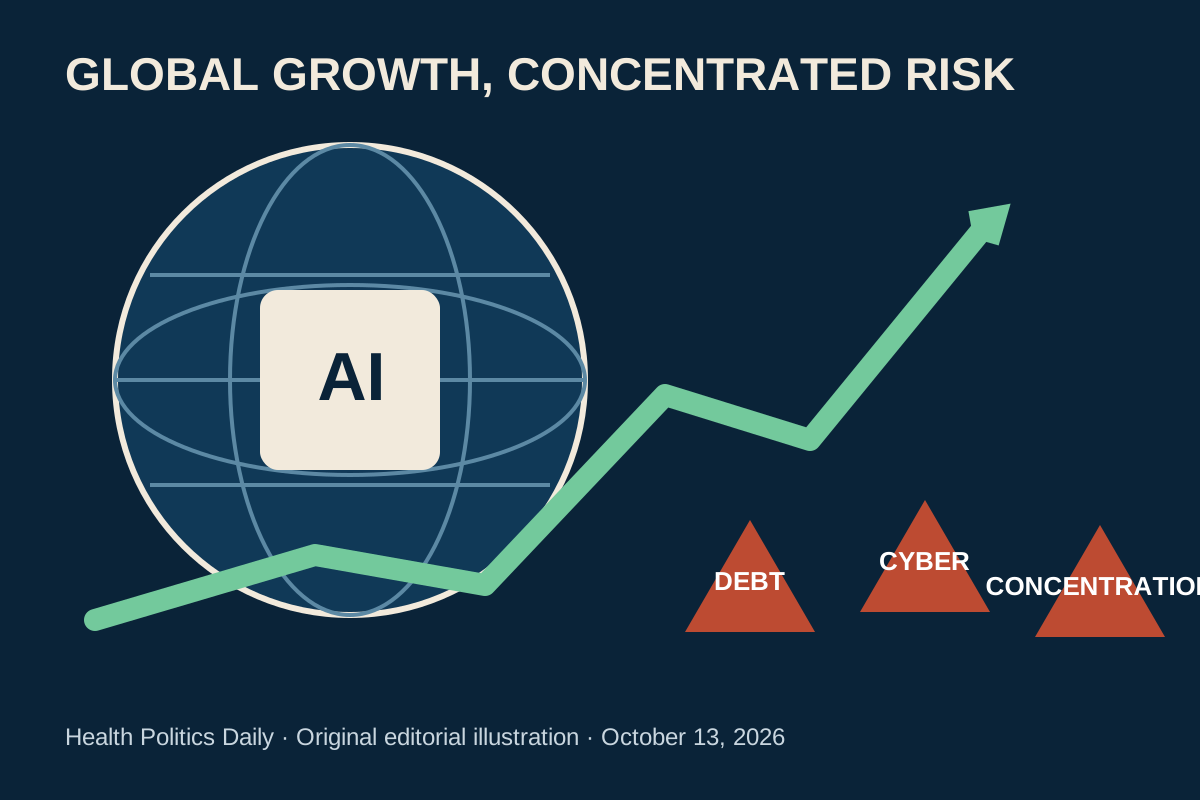
The fund projects 3.1% global growth in 2026, but warns that concentrated technology spending, rising debt costs and cyber vulnerabilities could amplify a reversal.
By Health Politics Daily News Desk · Published Tuesday, October 13, 2026 at 2:00 a.m. America/New_York · Approximately 8 minutes
Verified Baseline
Global growth is holding up, helped by an AI investment boom
The International Monetary Fund’s new World Economic Outlook projects global output will grow 3.1% in 2026, one-tenth of a percentage point above its July forecast. The IMF says investment tied to artificial intelligence is lifting the United States and technology supply chains, even as war, elevated public debt and costly energy weigh on many economies.
That number is a forecast, not a guarantee. It combines very different national paths: stronger activity in economies producing or deploying AI infrastructure can coexist with weak growth or inflation pressure elsewhere. Reuters reported that 32 countries account for roughly 95% of projected global growth, underscoring how uneven the headline is.
The IMF projects 2.3% U.S. growth and 7.0% growth in India this year. Those national estimates can change as energy prices, interest rates, conflict and incoming data change.
Financial Stability
The same boom creates concentration, financing and cyber risks
The IMF’s October Global Financial Stability Report identifies several plausible triggers for market stress: a reassessment of AI earnings expectations, a jump in government-bond yields and a major cyber incident. Large technology companies are funding an unusually heavy capital-spending cycle, while banks and markets are increasingly exposed to the same small group of firms and service providers.
According to Reuters’ review of the report, hyperscale technology companies now account for about 10% of global investment-grade bond issuance, up from less than 1% in 2024. That is not evidence of an imminent default. It means financing demand and investor exposure are more concentrated than they were two years ago.
The IMF’s bank stress tests still show broad resilience, but it found weak capital positions at banks holding about 22% of global banking assets, compared with 18% in its 2025 exercise. The scenario is a vulnerability test, not a prediction that those banks will fail.
Why It Matters
Markets can translate a technology repricing into everyday borrowing costs
Analysis: A sharp fall in AI-related valuations would matter beyond shareholders if it tightened credit, slowed data-center and semiconductor investment, or pushed lenders to reduce risk. Higher government yields can also feed into business loans, mortgages and public budgets, although the effect varies by country and loan structure.
For workers, rapid investment can create demand in construction, electricity, chips and computing while displacing or reshaping tasks elsewhere. The IMF’s growth forecast does not establish how productivity gains, wages or job losses will be distributed.
For governments, the report strengthens the case for credible debt management, competition policy and cyber resilience. It does not recommend suppressing AI investment; it warns against treating strong recent returns as proof that every project will deliver the expected payoff.
Practical Implications
How to read the forecast without overreading it
- Households: a 3.1% world-growth forecast does not predict an individual household’s wages, prices or job security.
- Borrowers: rising sovereign yields can influence loan pricing, but local central-bank policy and credit conditions still matter.
- Workers: sector and location matter more than the global average; AI investment can expand some occupations while changing others.
- Businesses: cyber concentration and dependence on a few cloud, chip and software providers are operational risks as well as technology questions.
This is general economic information, not personalized investment advice.
What Remains Uncertain
Productivity, war, energy and interest rates can still change the path
Verified fact: the IMF raised its 2026 global-growth projection to 3.1% and separately documented financial vulnerabilities around technology concentration, debt and cyber risk. Forecast: the growth figures depend on assumptions about conflict, energy, trade and policy. Analysis: a concentrated boom can support output now while increasing sensitivity to disappointment later. Opinion: Health Politics Daily takes no position on particular securities; policymakers and firms should publish enough exposure data for the public to distinguish productive investment from leveraged speculation.
Bias Lens: resilience or an AI-fueled fault line?
The IMF projects 3.1% global growth for 2026 and says AI investment is an important support. Its stability report also identifies an AI repricing, rising sovereign yields and cyber disruption as plausible stress triggers.
Left-leaning coverage: The Guardian foregrounded the risk that an AI-share crash could threaten stability. Center coverage: Reuters balanced the improved growth forecast with war, debt and market risks. Right-leaning business coverage: The Wall Street Journal emphasized the world economy’s resilience alongside policy and debt setbacks.
The difference is emphasis, not a dispute over the IMF’s published baseline. Labels describe the outlets’ general editorial orientation, not the accuracy of any individual report.
Principal Sources
IMF reports and corroborating coverage
- IMF — World Economic Outlook, October 2026
- IMF — Global Financial Stability Report
- Reuters — growth outlook and risk context
- Reuters — GFSR findings and market-risk figures
No suitable directly relevant official or publisher-authorized video with clearly established third-party embedding permission was available, so no video is embedded.
Related Coverage