Climate finance · Netherlands · Forest conservation
Netherlands Plans Up to $500 Million for Global Tropical Forest Fund
The proposed ten-year contribution would support a new investment fund designed to pay countries for keeping tropical forests standing.
By Health Politics Daily News Desk · October 26, 2026 at 10:54 a.m. ET

Watch in this article
Pumpjack operating at the Kern River Oil Field
A short CC0 field video provides visual context for reporting on oil production and fuel supply.
Thomas Farley / Wikimedia Commons · CC0 1.0 · License and source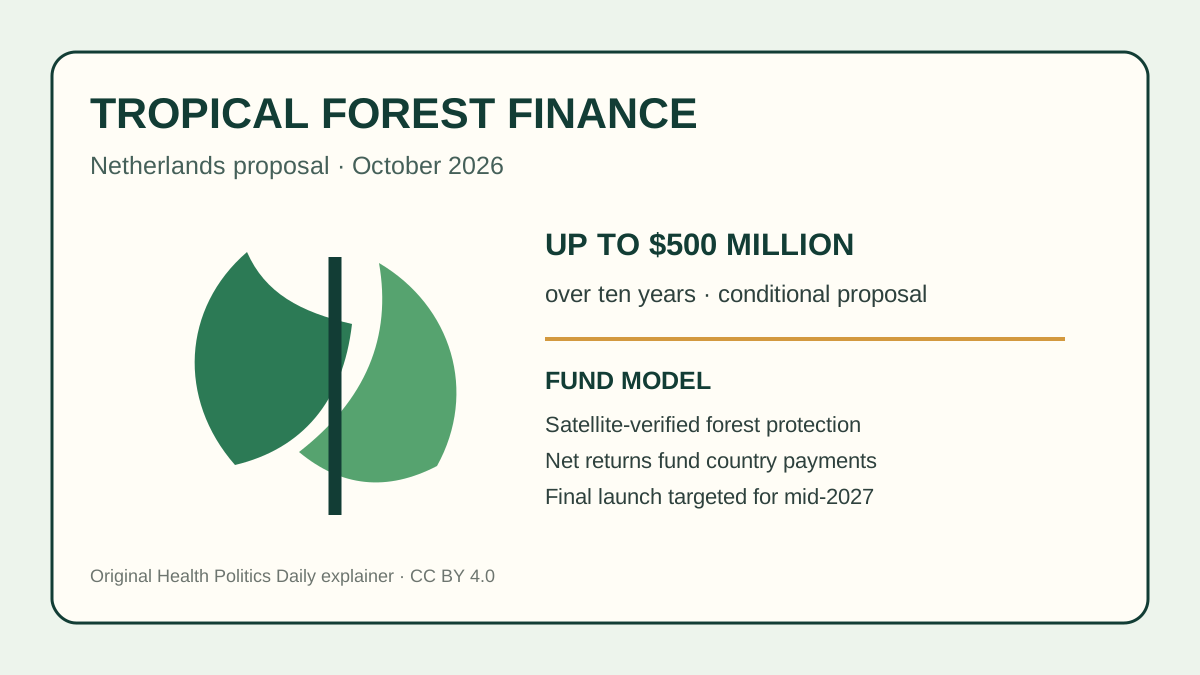
Verified baseline
The Dutch government said Monday that it intends to provide up to $500 million over ten years to the Tropical Forest Forever Facility, or TFFF. The proposed capital contribution is conditional and the fund is not yet operating.
The official announcement says the World Bank is helping develop the facility and that participants expect design work to conclude around mid-2027. Brazil, Indonesia, Norway, Germany, France and the United Kingdom are among the governments supporting the initiative.
How the fund is supposed to work
The TFFF aims to assemble a permanent $125 billion investment pool, including $100 billion from private investors. Net investment returns would finance payments to eligible countries that maintain tropical forest, with satellite data used to verify results.
The Dutch government describes an indicative payment of about $4 per hectare each year and says part of the proceeds would flow directly to Indigenous peoples and local communities. Those figures describe the planned model, not money already distributed.
Why the Dutch pledge matters
Standing forests store carbon, protect biodiversity and support water and food systems, but clearing can produce faster commercial returns than conservation. The facility tries to change that calculation by creating predictable payments for verified forest protection.
The Netherlands estimates that a fully funded facility could cover 800 million to 900 million hectares. That projection depends on fundraising, investment performance, eligibility rules, monitoring quality and participating governments’ compliance.
Practical implications
Forest countries would not receive the entire Dutch contribution directly. The proposed capital would become part of the wider investment structure, and payouts would depend on verified conservation and the fund’s net returns.
For taxpayers and investors, key issues include who absorbs losses, how satellite findings can be challenged, whether payments reach local communities and whether the model adds protection that would not have occurred otherwise. The proposal does not guarantee a particular climate result or financial return.
Fact, analysis, forecast and opinion
Verified fact: the Netherlands proposes up to $500 million over ten years, subject to conditions. Analysis: the pledge materially strengthens the public-capital base needed to attract private funding. Forecast: a mid-2027 launch is possible but depends on design, financing and approvals. Opinion: Health Politics Daily supports transparent measurement, community participation and public disclosure of financial risk, without endorsing a particular fund structure.
Bias Lens: climate ambition versus financial structure
Verified baseline: the Dutch contribution is proposed, capped and conditional; the fund’s long-term targets are not completed results.
Center-oriented wire coverage: Reuters foregrounds the pledge, investment structure and conservation payments. Center-left coverage: Folha de S.Paulo places the announcement alongside Brazil’s election and international confidence in forest policy. Center-right financial coverage: The Wall Street Journal emphasizes leverage, fundraising hurdles and investment risk. These frames address different parts of the same mechanism; none proves the fund will meet its goals.
What remains uncertain
The final Dutch appropriation, legal terms, risk-sharing structure, investment portfolio, country eligibility and monitoring appeals process are not settled. Actual payments will also depend on how much capital the facility raises and what its investments earn after costs.
Principal sources
- Government of the Netherlands — proposed contribution and fund design
- Reuters — independent confirmation and international context
- Finance for Biodiversity Foundation — institutional-investor statement
No directly relevant official or publisher-authorized video with clear downstream embedding permission was available, so no video was embedded.