FEDERAL BUDGET — FINANCE — U.S. POLICY
U.S. Budget Deficit Reaches $1.99 Trillion in Fiscal 2026
The year-end shortfall widened as spending grew faster than receipts. The result sharpens borrowing and budget tradeoffs, but does not itself change anyone’s taxes or benefits.
By Health Politics Daily News Desk · October 17, 2026 at 3:58 a.m. ET
What the year-end report establishes
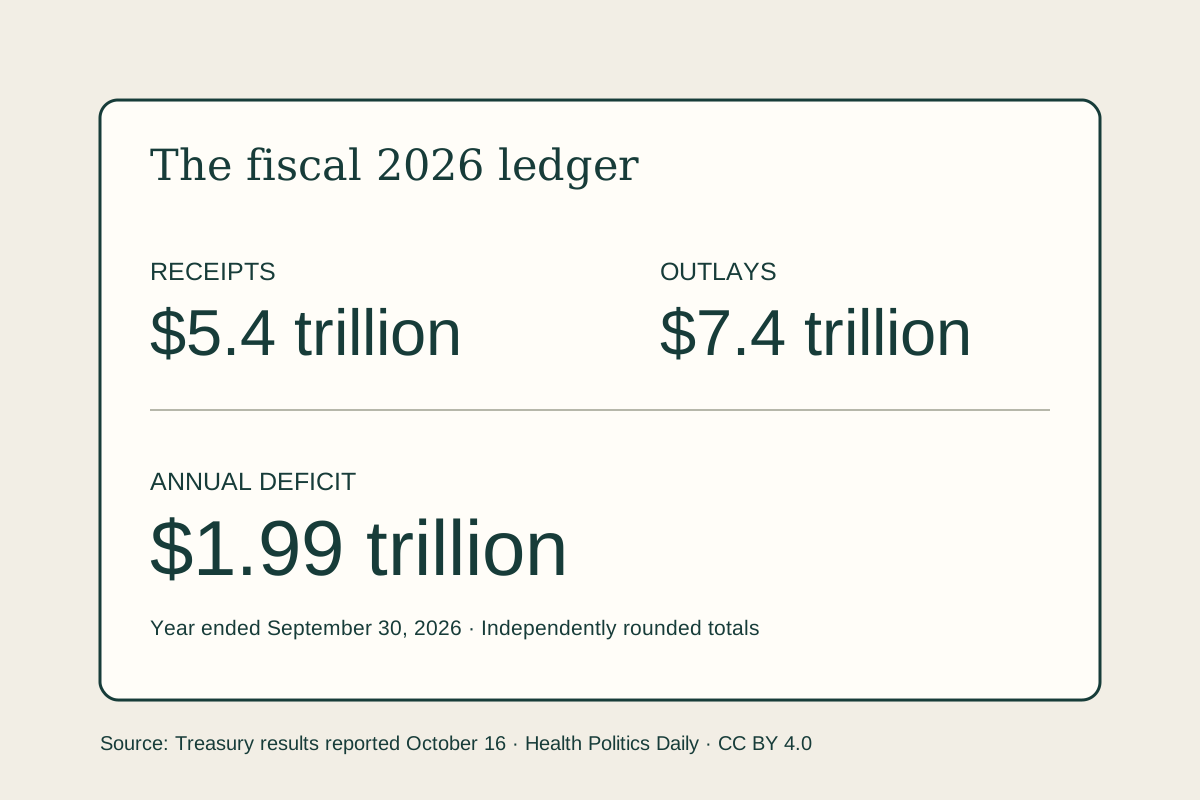
Verified fact: Treasury’s October 16 results put the fiscal 2026 deficit at $1.99 trillion, compared with $1.78 trillion a year earlier. Receipts reached about $5.4 trillion and outlays about $7.4 trillion. Bloomberg’s reporting on the release confirms that spending grew roughly 6%, against 3% growth in receipts.
The fiscal year ended September 30, not December 31. The Monthly Treasury Statement is the government’s cash-based monthly accounting publication. A deficit is the gap during a period; it is not the stock of outstanding federal debt.
Reuters reports that the shortfall increased by $217 billion and was the largest since fiscal 2021. It identifies tariff refunds and higher debt-service and benefit spending among the contributors—not a single explanation for the whole gap.
Why higher revenue did not close the gap
The Congressional Budget Office’s October 8 preliminary review had already estimated a roughly $2 trillion deficit. Its underlying tables show growth in individual income and payroll taxes alongside falling corporate tax and customs receipts. Net interest, major benefits and defense were among the spending increases.
CBO also explains that education outlays reflect changes in estimated student-loan costs. Its September comparison is affected by payment-calendar shifts. Those qualifications matter: a budget accounting increase is not necessarily an equivalent expansion in services delivered that month.
Analysis: a revenue record and a widening deficit can coexist. The relevant comparison is the change on both sides of the ledger, measured consistently. Nominal-dollar records also do not adjust for inflation or the size of the economy.
Interest figures need matching definitions
CBO’s preliminary net-interest estimate was $1.143 trillion, up $115 billion. Net interest subtracts interest the government receives from interest it pays. It should not be confused with broader gross debt-service totals in some headlines.
The CBO net-interest primer explains that financing costs depend on the debt stock and interest rates. Market demand for Treasury securities and Federal Reserve policy both matter.
Analysis: this creates a constraint, not an automatic verdict on any particular program. More revenue committed to financing past borrowing leaves less room for other priorities unless lawmakers raise revenue, reduce other spending or borrow more. Comparing a gross interest figure with a net program figure can exaggerate or obscure that tradeoff.
What this means for households and public services
The report does not enact a tax increase, reduce a benefit payment or set a mortgage rate. Those outcomes depend on separate laws, program rules and market conditions. People evaluating a proposed budget change should distinguish an enacted provision from a campaign promise or a financing forecast.
Analysis: federal borrowing is one influence on credit markets, not a sufficient explanation for every movement in consumer rates. Inflation expectations, economic growth and monetary policy also affect borrowing conditions. Our reporting on Fed Chair Warsh’s inflation outlook and September consumer prices examines those separate pressures.
What remains uncertain
The year-end cash result is not a forecast of fiscal 2027. Interest rates, tax collections, economic conditions, tariff policy and future legislation can change the next year’s balance. Preliminary category estimates should not be presented as the final release in every detail.
Forecast: a larger financing need can increase pressure for policy changes, but the report alone cannot establish which measures Congress will adopt or how markets will respond. No immediate crisis date or specific investment outcome follows from this release.
Bias Lens: shared budget math, different explanations
Verified baseline: the year-end deficit widened because outlays exceeded receipts by more than in the preceding year.
Center reporting: the linked Reuters report foregrounds the fiscal result and contributing revenue and spending changes. Right-leaning coverage: the Washington Examiner’s October 16 report stresses the longer-term mismatch and interest burden; it also says spending grew faster under Republican control.
Left-leaning contextual analysis: Eduardo Porter’s October 11 Guardian analysis questions whether AI-led growth can repair federal finances. It predates the final release.
These are different editorial emphases, not competing official totals. The Guardian piece is analysis, not confirmation of Friday’s figures. The labels describe broad editorial orientation, not every article or reader; none substitutes for checking definitions and dates.
Sources and video
Principal sources: Treasury’s statement program, CBO’s preliminary review and interest primer, and the linked Bloomberg and Reuters reports on the final results. No suitable directly relevant authorized video was verified, so no video is embedded or rehosted.