U.S. ECONOMY — INFLATION — HOUSEHOLD COSTS
U.S. Inflation Rises to 3.7% as Gasoline Drives September Increase
Consumer prices rose faster in September as gasoline accounted for more than half of the monthly increase. Underlying inflation also firmed, complicating—but not predetermining—the Federal Reserve's October interest-rate decision.
By Health Politics Daily News Desk · Published Thursday, October 15, 2026 at 12:00 a.m. America/New_York · Approximately 8 minutes
Verified Baseline
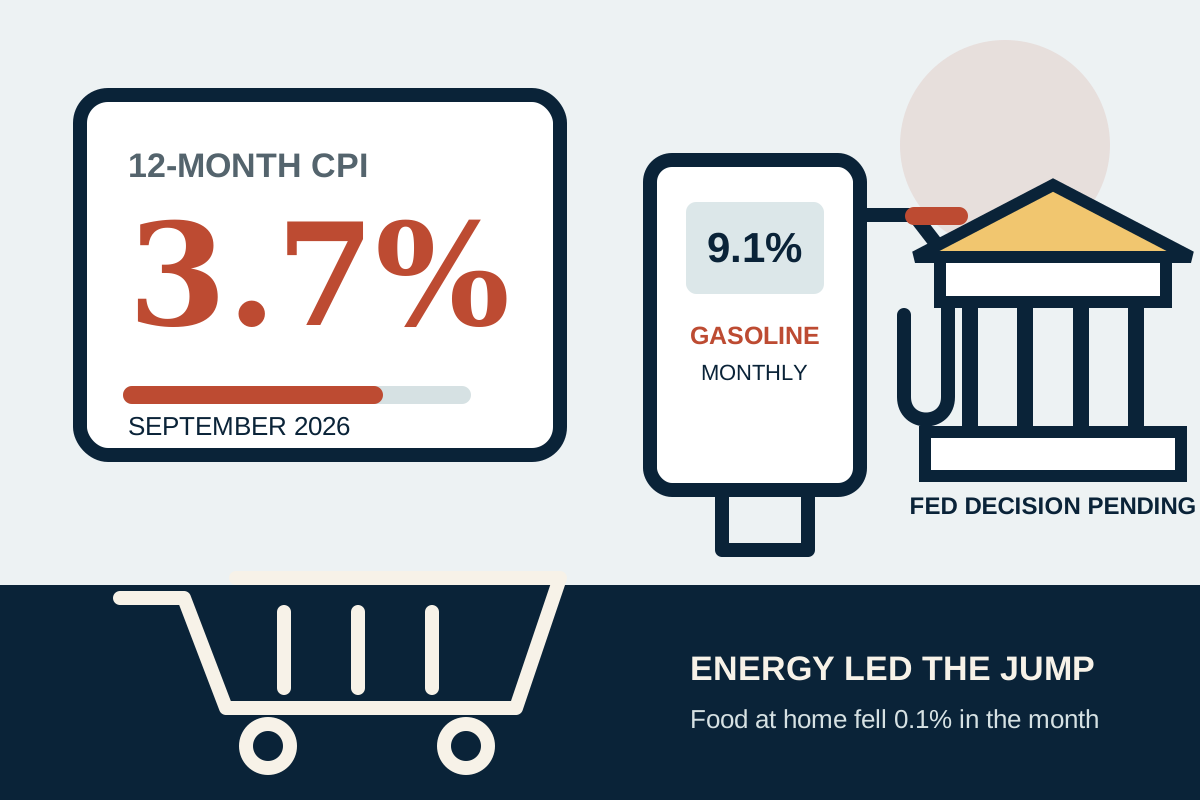
Prices rose 0.6% in September and 3.7% over 12 months
The Bureau of Labor Statistics reported Wednesday that the Consumer Price Index for All Urban Consumers increased 0.6% on a seasonally adjusted basis in September, after a 0.4% rise in August. The index was 3.7% higher than a year earlier, up from August's 3.4% annual rate.
Gasoline prices rose 9.1% during the month and accounted for more than half of the overall monthly increase. The broader energy index rose 5.2% in September and 20.4% over 12 months.
Prices excluding food and energy—the measure commonly called core CPI—rose 0.3% during the month and 2.6% from a year earlier. Verified fact: both headline and core inflation accelerated on a 12-month basis. Not established: that every household experienced a 3.7% increase, because spending patterns differ.
What Changed
Energy led the jump, but several service and goods categories also rose
Shelter prices increased 0.4% in September. Airline fares rose 1.2%, used cars and trucks 0.7%, education 0.6% and recreation 0.5%. Medical care increased 0.1%, including a 0.7% rise in hospital services, while prescription-drug prices declined 1.2%.
Food prices were unchanged overall. Food at home fell 0.1%, while food away from home rose 0.2%. Those averages can conceal large differences between individual items and locations, and they do not mean a household's grocery bill necessarily fell.
Analysis: energy explains most of the monthly headline shock, but the increases in shelter, travel and other categories make the report broader than a gasoline-only story. Core inflation's acceleration from 2.4% to 2.6% over 12 months reinforces that distinction.
Why It Matters
The report affects purchasing power, borrowing expectations and election debate
Higher fuel prices can reach households directly at the pump and indirectly through freight, airline, farm and business costs. The Federal Reserve's separate October Beige Book said contacts in multiple districts reported price pressure from fuel, other commodities, tariffs and insurance. That survey is anecdotal and was compiled from information gathered by October 5; it is not another inflation index.
Markets increased the probability they assign to another rate increase after the CPI release, and stocks fell Wednesday. Market pricing is a measure of investor expectations, not a Federal Reserve commitment.
The data arrived less than three weeks before the November 3 midterms, making cost-of-living claims politically prominent. Opinion: Health Politics Daily takes no position on candidates or the appropriate interest rate. Political explanations should be tested against the official category data and should distinguish the immediate energy shock from persistent underlying inflation.
Practical Implications
The national average is a benchmark, not a personal budget forecast
- Drivers and commuters: gasoline was the largest monthly contributor, but local prices and driving needs vary.
- Renters and homeowners: shelter remains a material source of inflation, though the CPI shelter measure moves with a lag and is not a current home-price index.
- Borrowers and savers: the report can influence bond yields and expectations, but mortgage, card and deposit rates do not mechanically change with one CPI release.
- Social Security recipients: the previously announced 3.6% 2027 cost-of-living adjustment uses the CPI-W formula and a three-month comparison; it is related to, but not identical with, September's CPI-U headline.
This is general economic information, not personalized financial advice.
What Comes Next
The Fed has not announced an October decision
The Federal Open Market Committee meets October 27–28. Policymakers will weigh the inflation report against employment, growth, financial conditions and evidence about whether energy costs are spreading into other prices.
Forecast: the report makes a rate increase more plausible than it appeared before Wednesday, but a hold remains possible. What remains uncertain: the duration of the energy shock, how much businesses will pass through to consumers, whether core inflation continues to rise and how policymakers balance price stability against labor-market risks.
Bias Lens: household pain, political responsibility and the energy shock
Headline CPI rose 0.6% in September and 3.7% over 12 months. Gasoline rose 9.1% during the month, while core CPI increased 0.3% monthly and 2.6% annually.
Left-leaning coverage: The Guardian foregrounds household pressure and potential political damage to Republicans before the midterms. Center coverage: Reuters emphasizes the gasoline shock, firmer core CPI and changed rate expectations, while Associated Press centers persistent living costs and the approaching election. Right-leaning coverage: Fox Business leads with energy-driven acceleration; a separate report presents both Democratic criticism and the White House's growth-focused response.
The framing differs over political responsibility and whether to lead with household hardship or the energy shock. The common baseline is the BLS release; no outlet can infer the Fed's eventual vote from CPI alone.
Principal Sources
Official data and corroborating reporting
- Bureau of Labor Statistics — September 2026 CPI release
- Federal Reserve — October 2026 Beige Book national summary
- Reuters — household, market and monetary-policy context
- Associated Press — household and election context
Fox Business provides a publisher-authorized video breakdown on its own page. It is linked rather than embedded because clear third-party embedding permission was not established.
Related Coverage