U.S. ECONOMY — INFLATION — BUSINESS COSTS
U.S. Wholesale Inflation Jumps 1.3% as Energy Costs Surge
Producer prices posted their largest monthly increase since March 2022. Energy was the main driver, but higher service costs and a firmer underlying measure show the pressure was not confined to fuel.
By Health Politics Daily News Desk · Published Thursday, October 15, 2026 at 10:00 a.m. America/New_York · Approximately 8 minutes
Verified Baseline
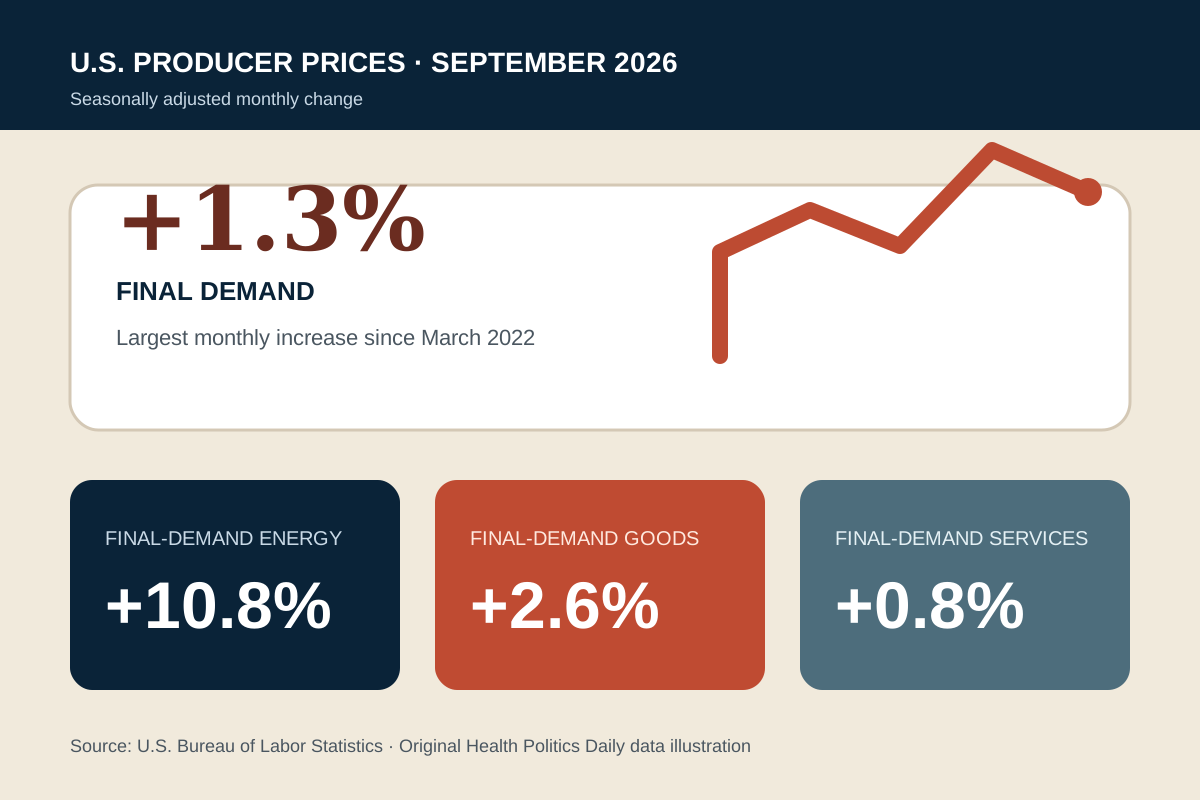
Producer prices rose 1.3% in September and 6.3% over 12 months
The Bureau of Labor Statistics reported Thursday that its producer price index for final demand increased a seasonally adjusted 1.3% in September, after gains of 0.5% in August and 0.2% in July. It was the largest one-month rise since March 2022. The index was 6.3% higher than a year earlier, the fastest annual increase since December 2022.
Producer prices measure what domestic producers receive for goods, services and construction. They are not the same as the consumer price index, and a change in the PPI does not pass through to store prices dollar for dollar or on a fixed timetable.
What Drove the Increase
Fuel dominated the goods increase, while service costs also accelerated
Final-demand goods prices rose 2.6%, the largest increase since that series began in 2009. More than 80% of the goods rise came from energy, which jumped 10.8%. Wholesale gasoline increased 20.3% and accounted for half of the goods increase; diesel, jet fuel, residential electricity and crude petroleum also rose. Food prices increased 1.2%, although egg prices fell sharply.
Final-demand services rose 0.8%. Trade margins increased 1.4%, transportation and warehousing services climbed 3.4%, and other services rose 0.3%. The index excluding food, energy and trade services—one measure intended to reduce volatile components—rose 0.5% for the month and 5.0% over the year.
Why It Matters
Businesses face a broader cost test after the energy shock
Higher producer prices can squeeze margins when companies absorb them, or contribute to consumer inflation when firms pass costs along. The scale of either effect depends on contracts, competition, inventories and demand. Thursday’s report therefore signals cost pressure, not an automatic forecast for any particular retail price.
Analysis: the energy surge explains much of the headline, but the increases in services and the less-food-energy-and-trade measure make the report harder to dismiss as a fuel-only event. Intermediate processed goods rose 2.5%, and unprocessed goods rose 8.4%, pointing to pressure earlier in supply chains as well.
Consumers and the Federal Reserve
Strong retail sales coexist with signs of uneven household demand
A separate Census Bureau release showed retail and food-services sales rose 0.8% in September. Reuters reported that higher gasoline prices boosted the headline and that the narrower group used to estimate consumer spending rose only 0.1% after a much stronger August.
That combination matters for the Federal Reserve: inflation pressure is elevated, but the composition of spending is less robust than the headline retail figure suggests. The Fed sets policy using a wider set of data and its preferred inflation measure is the personal consumption expenditures price index, not the PPI.
Practical Implications
What households and businesses may notice next
- Households: wholesale price data do not specify what any person will pay, but fuel and freight increases can reach transportation-intensive goods and services.
- Businesses: firms exposed to energy, shipping or wholesale margins may face renewed decisions about pricing, inventories and hedging.
- Borrowers and savers: the report can influence expectations for interest rates, but it does not determine a Fed decision on its own.
- Investors: a single release can move markets quickly; it is evidence about the economy, not personalized investment guidance.
What Remains Uncertain
Energy prices, pass-through and the policy response could all change
September’s PPI estimates are preliminary and may be revised. It is not yet known how long the fuel surge will last, how much businesses will absorb, or whether recent changes will appear in later consumer-price measures.
Forecast: if energy and transportation costs remain high, producer inflation is likely to stay elevated in the near term; if they reverse, the headline rate could cool quickly. Opinion: policymakers and businesses should focus on the report’s composition and subsequent data rather than treating one unusually large month as a complete economic verdict.
Bias Lens: inflation shock, energy story or policy signal?
BLS reported that final-demand producer prices rose 1.3% in September and 6.3% over 12 months. Energy led the goods increase, while services and an underlying measure also rose.
Center wire coverage: Reuters combines the producer-price report with retail sales, emphasizing the tension between headline strength and softer underlying consumer spending. Center general-news coverage: The Associated Press foregrounds the four-year-high monthly increase and its cost-of-living implications. Right-leaning and left-leaning coverage: no directly comparable, original report from a major outlet in either category was available at publication time. This lens does not substitute commentary or unrelated stories merely to create symmetry.
The main framing difference is emphasis: the breadth of business costs, the energy shock, or the implications for consumers and monetary policy. The official BLS release is the common factual baseline.
Principal Sources
Official data and independent reporting
- Bureau of Labor Statistics — Producer Price Indexes, September 2026
- U.S. Census Bureau — Advance Monthly Sales for Retail and Food Services
- Reuters — retail sales and producer-price context
- Associated Press — wholesale-inflation coverage
No directly relevant official or publisher-authorized video with clear embedding permission was available.
Related Coverage