Finance · European economy · Monetary policy
Lagarde Says Higher Borrowing Costs Will Restrain Euro-Area Growth and Inflation
The ECB president says tighter financing conditions complicate the energy-shock outlook. Her October 17 statement is an assessment, not a new rate decision.
By Health Politics Daily News Desk · October 17, 2026 at 9:58 p.m. ET
What happened
European Central Bank President Christine Lagarde said on October 17 that rising long-term interest rates would slow euro-area growth and reduce the transmission of higher energy costs into other prices more than staff had projected in September.
Her official statement to the International Monetary and Financial Committee describes tighter financing conditions alongside an energy shock that still requires a measured policy response. It announces no new change in ECB interest rates.
Reuters’ October 17 report, republished by Investing.com, frames the development around the bond selloff and more expensive borrowing, with France among the markets under pressure. That market development and a central-bank policy decision are related but separate events.
Why borrowing costs matter beyond bond markets
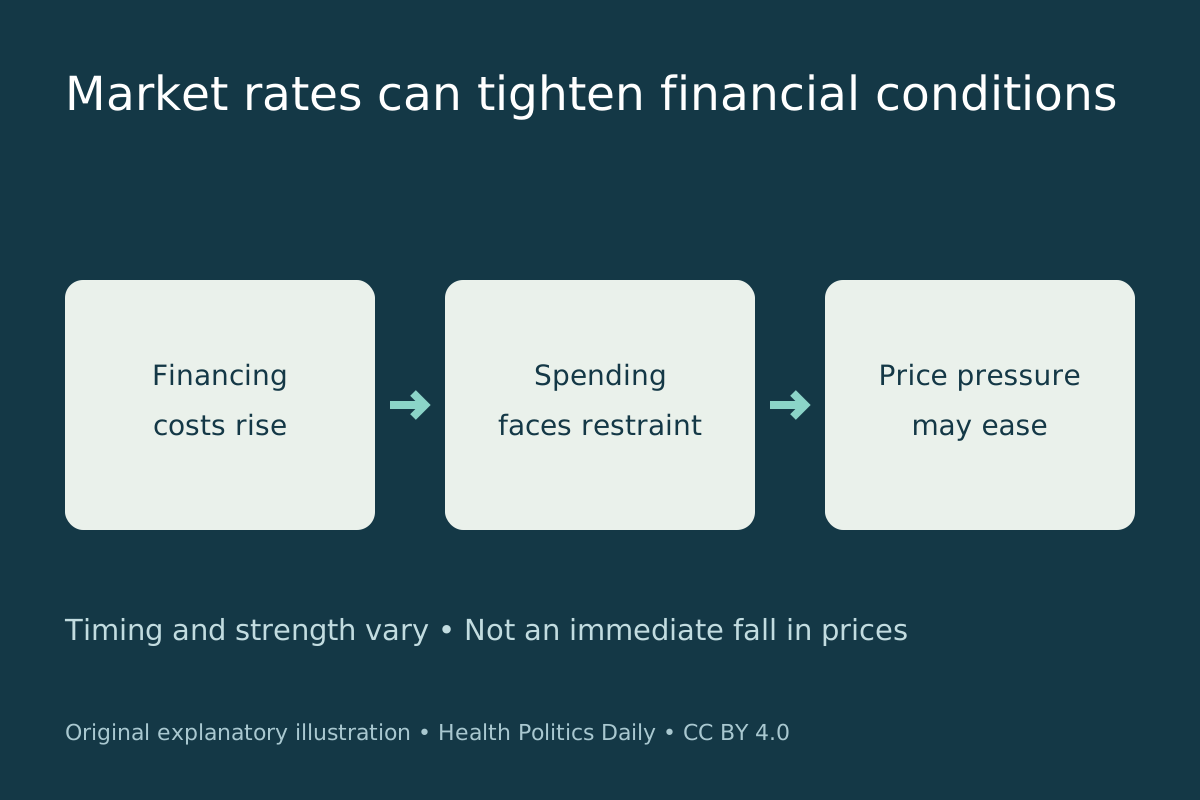
The ECB’s explanation of monetary transmission shows how interest rates affect saving, borrowing and investment. Higher financing costs can make a household purchase or business project less attractive. Weaker consumption and investment can, in turn, reduce demand relative to supply and ease pressure on prices.
The same explanation stresses that transmission has long, variable and uncertain delays. A change in financing conditions does not tell readers exactly when inflation will respond or by how much. It also does not mean that the price of an individual product must fall.
Analysis: This is the tradeoff behind Lagarde’s assessment: financial restraint can help limit inflation while also making it harder for borrowers to finance spending. Slower inflation and a stronger economy are not interchangeable outcomes.
What the statement does—and does not—signal
Lagarde says energy prices are expected to keep headline inflation above target into the first half of 2027. She reports no significant additional pass-through into other prices and wages beyond what the ECB has already incorporated into its projections. These are the institution’s current assessments, not guarantees.
Forecast versus decision: Reuters reports expectations for another rate increase in December. That is not a commitment announced by Lagarde. Her statement says future policy will depend on incoming data, the inflation outlook, underlying inflation and the strength of transmission.
Readers should therefore avoid converting “higher market rates may restrain inflation” into either “rate cuts are certain” or “another hike is already decided.” Neither conclusion follows from the published statement.
Practical implications and uncertainty
Analysis: Households and companies face the terms of their actual contracts, not a single headline market rate. An assessment of economy-wide conditions is not notice that every loan payment changes immediately. This article offers no personalised borrowing or investment recommendation.
The unresolved questions are how persistent the energy shock will be, how financing conditions evolve and how strongly prices and wages respond. The statement does not quantify a new growth revision attributable solely to the bond selloff.
For wider context, our IMF committee report covers the separate debate about public finances and household protection. Our IMF growth and financial-risk coverage explains broader international vulnerabilities.
Bias Lens: policy assessment versus market framing
Verified baseline: Lagarde identifies tighter financing conditions and a continuing inflation risk. The October 17 statement is not a new rate decision.
The primary ECB statement foregrounds the balance among inflation, growth and transmission. The center wire-service comparison, Reuters, foregrounds the bond-market channel.
A meaningful, directly comparable left-versus-right disagreement on this specific statement was not established in the coverage reviewed. We do not assign political positions to market forecasts or substitute unrelated opinion pieces to fill three slots. The useful framing distinction is between an official conditional assessment, a market expectation and an actual policy decision.
Sources and video
Primary sources are Lagarde’s October 17 statement and the ECB’s transmission explainer; Reuters provides corroborating reporting. No suitable directly relevant authorised video of this statement was identified, so none is embedded.