GLOBAL ECONOMY — PUBLIC FINANCE — ENERGY
IMF Committee Urges Fiscal Buffers and Protection for Vulnerable Households
The October 17 Bangkok statement calls for stronger public finances and support for countries facing financing strains. It is a policy agenda, not a new household benefit or blanket lending commitment.
By Health Politics Daily News Desk · October 17, 2026 at 8:01 a.m. ET
What officials agreed in Bangkok
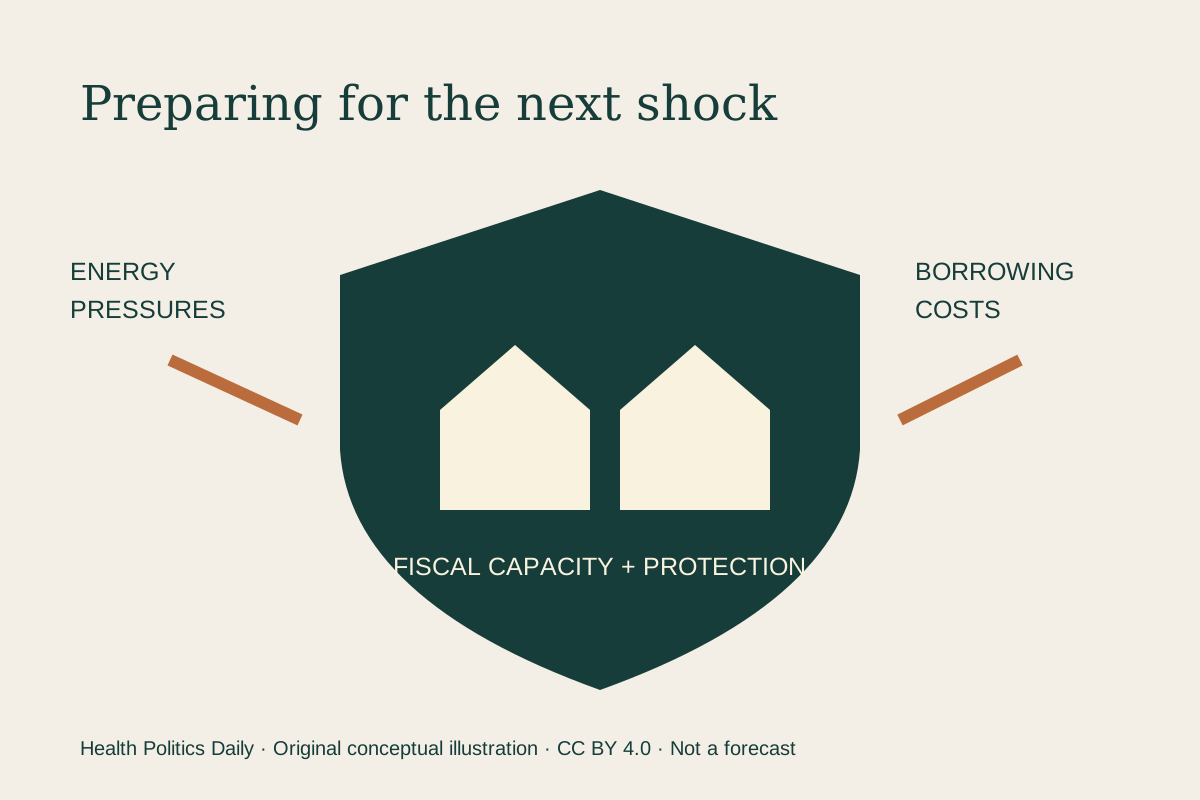
Verified fact: the International Monetary and Financial Committee’s October 17 chair’s statement, published by Japan’s Finance Ministry, calls for credible medium-term fiscal plans to rebuild financial buffers while protecting vulnerable people and priority investment. It warns that conflict, disrupted trade routes, energy costs and rising sovereign borrowing costs could worsen economic vulnerabilities.
The text encourages more support for countries with sustainable debt and strong reform plans that nevertheless face short-term financing difficulties. It also backs central bank independence and data-dependent policy. These are agreed priorities, not an announcement that every country will receive a new loan.
The IMF describes the committee as an adviser to its Board of Governors. Its statements guide the institution’s work; they are not national tax or spending laws.
Resilience is not the same as spare capacity
In the official October 17 press briefing, chair Mohammed Aljadaan said the global economy had remained resilient but faced mounting challenges. IMF Managing Director Kristalina Georgieva described both optimism about AI and concern about dependence on a single growth driver.
Analysis: an economy can keep growing while its government loses room to absorb another shock. A fiscal buffer means capacity to finance an emergency without making an already difficult debt position substantially worse. It is not necessarily a separate cash account, and no single debt ratio describes every country’s resilience.
The committee’s challenge is therefore two-sided: preserve the ability to respond later without withdrawing essential support now. Saying only that the IMF wants spending cuts would omit the statement’s explicit protection for vulnerable people and growth-enhancing investment.
Why energy and borrowing costs interact
Analysis: more expensive fuel can raise transport and production costs while increasing pressure for public assistance. If government financing also becomes more expensive, maintaining that assistance becomes harder. The same shock can affect households through prices and public budgets through financing needs.
Those channels are not equally strong everywhere. Import dependence, exchange rates, existing debt terms and the design of assistance matter. A global warning should not be converted into a prediction that every household’s bill will rise by the same amount.
Our U.S. fiscal 2026 deficit explainer distinguishes annual borrowing needs from accumulated debt. Earlier coverage of the IMF’s growth and financial-risk outlook examines the forecasts behind this week’s debate; today’s development is the closing policy agenda, not a new growth estimate.
A diplomatic dispute did not prevent agreement
Reuters reports that nearly half the delegates walked out during remarks by Russia’s finance minister. Aljadaan nevertheless said members ultimately supported the chair’s statement.
Analysis: agreement on economic language is narrower than agreement on the conflicts driving some of the risks. It should not be described as resolution of the diplomatic dispute or as a peace agreement.
What changes for readers—and what does not
The statement does not itself change eligibility for an energy subsidy, establish a tax rate or determine a central bank’s next interest-rate decision. Readers assessing a domestic proposal should look for the enacted rules, its beneficiaries, funding source and duration.
Forecast: implementation will depend on national decisions, financing arrangements and subsequent IMF work. The size and timing of assistance, the next energy-price move and whether AI productivity meets expectations remain uncertain. The statement identifies risks; it does not assign a date to a global crisis.
Bias Lens: protection, fiscal discipline and policy choices
Verified baseline: the committee pairs rebuilding fiscal capacity with protecting vulnerable people.
Left-leaning coverage: The Guardian’s October 17 feature stresses the fragility of resilience and limits of energy support. Center reporting: Reuters focuses on the agreed support agenda and downside risks.
Right-leaning contextual opinion: The Times’ October 16 editorial opposes higher UK bank taxes on growth grounds. It addresses a domestic policy choice, not today’s committee statement.
The difference is partly scope and genre: a global feature, a news report and an editorial do not make equivalent claims. None establishes which tax-and-spending mix is best for every country. Editorial orientation is context, not a reliability verdict or a substitute for the primary text.
Official video and sources
Watch the IMF’s October 17 briefing on its official media page, which links the full video. We link to the authorized publisher rather than download or rehost footage. Principal sources are the committee statement, IMF briefing and institutional documentation, corroborated by Reuters.