Middle East · Regional security
Egypt Pledges Defence Support for Saudi Arabia; Deployment Details Remain Unclear
Egypt’s National Defence Council backed assistance and diplomacy on October 18. The presidency’s public statement does not identify forces, a mission timetable or an actual deployment.
By Health Politics Daily News Desk · October 18, 2026 at 10:00 a.m. ET
Egypt’s National Defence Council pledged support for Saudi Arabia on October 18 as Houthi attacks on the kingdom raised the stakes of renewed fighting in Yemen. The announcement signals Cairo’s readiness to help a close regional partner, but its public wording leaves the form and timing of assistance unspecified.
In its official account of the meeting, Egypt’s presidency set out three commitments: solidarity with Saudi Arabia, assistance to defend its security and territory, and intensified political and diplomatic efforts to reduce regional tensions. President Abdel Fattah el-Sisi chaired the meeting at Al-Ittihadia Palace.
What the statement establishes
The council’s public position ties Saudi security to Egypt’s and the wider Arab region’s security. It combines support for the kingdom with a stated aim of peaceful crisis resolution. These are the government’s declared objectives, not independent findings about the likely results of any intervention.
The release does not name military units, troop numbers, equipment or deployment dates. It should therefore not be described as confirmation that Egyptian forces have already arrived in Saudi Arabia or entered combat.
Why reports about “troops” need careful attribution
Reuters reported that Sisi had requested an urgent parliamentary session to authorize military assistance if Saudi Arabia asked for it. Its account places the announcement amid Houthi attacks on Riyadh’s airport and Saudi Aramco.
Gulf News reported that MP Mostafa Bakry said the council had approved sending troops on a defensive mission. The same report explicitly distinguishes his account from the presidency’s statement, which did not announce a deployment. Those are different levels of evidence, not interchangeable descriptions of a completed operation.
The National explains the parliamentary authorization process and notes that approval would not itself mean troops would deploy. A final parliamentary voting result was not established in the material verified for this report. That limitation is not a claim that no vote has occurred.
Why the distinction matters to people
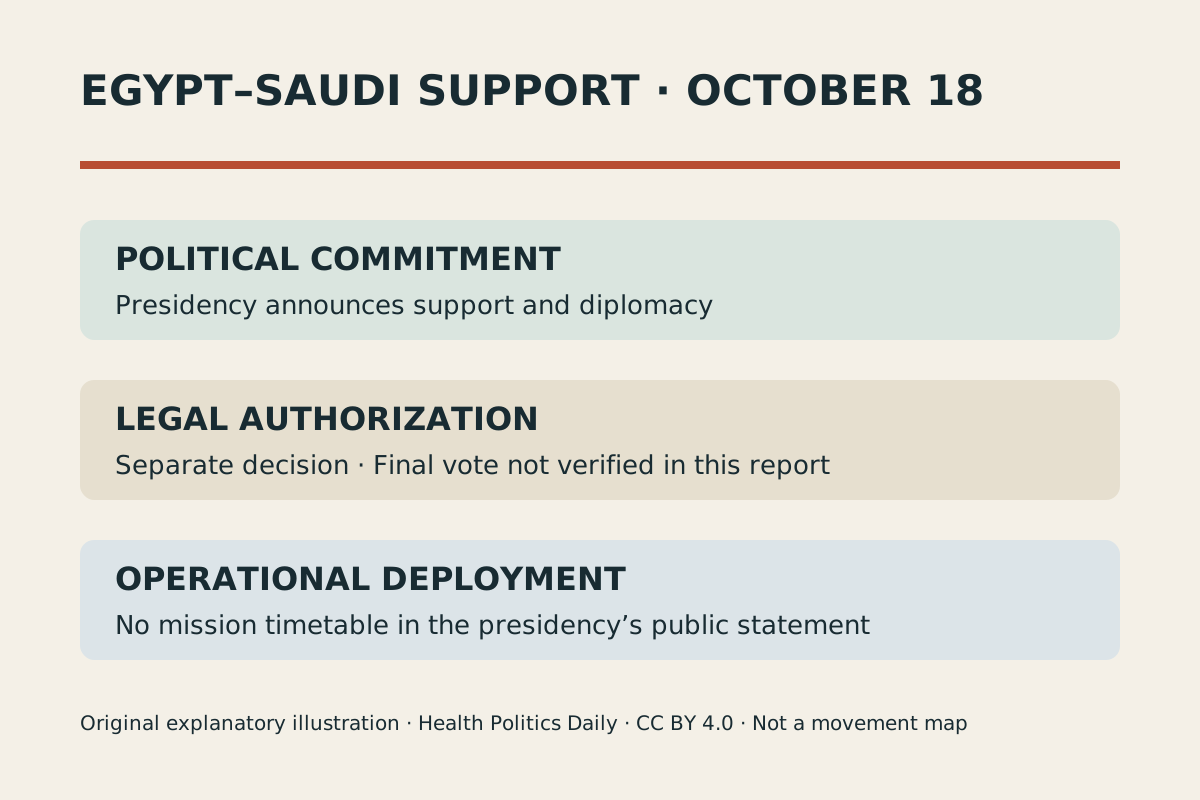
Analysis: A pledge, legal authorization and an operational deployment answer separate questions. The first signals a political commitment. The second can permit an action. The third determines where personnel and equipment actually go. Treating them as one event can overstate both the immediate military change and the risk faced by families, travellers or businesses.
The announcement matters because it puts another major regional state’s potential assistance into the conflict’s diplomatic calculation. It does not establish that a wider war is inevitable, nor that aid will prevent further attacks. Those are forecasts requiring evidence beyond a statement of intent.
Context without assuming the outcome
The National’s account places Egypt’s decision within both Gulf security ties and concern about becoming more deeply involved in Yemen. It also reports a warning against intervention from the Houthi-run legislature in Sanaa. That body’s position is an interested party’s response, not an authoritative prediction of what Egypt will do.
For readers tracking practical disruption, a defence announcement is not a flight-operation notice. Travellers should use their airline and airport’s current information for their own route rather than infer availability from a military headline. Our earlier reporting on Saudi airport attacks covers the separate aviation context.
What remains uncertain
The verified presidency release does not settle the scale, location, duration or rules of any future military role. It also does not establish whether a specific Saudi request has been made. Any subsequent parliamentary outcome, official mission announcement or confirmed movement of forces would be a further development, not something this article assumes. No assessment of likely casualties, victory or a timetable for de-escalation is offered.
Bias Lens: commitment, authorization and deployment
Verified baseline: Egypt’s presidency announced support and diplomacy. Its statement did not provide operational deployment details.
Left-leaning regional coverage: The Guardian’s October 17 report places Egypt’s position within wider coalition shifts and intervention concerns. It predates Sunday’s council statement.
Center coverage: Reuters foregrounds the support pledge and authorization request.
Gulf-focused coverage: Gulf News gives prominence to Bakry’s troop claim but retains the distinction from the official release. We do not equate a Gulf perspective automatically with a right-leaning political position; a clean left–right comparison of matching reports was not established.
These differences concern scope, timing and attribution. They do not prove that a deployment has happened or that diplomacy has ended. The primary statement should remain the baseline, while independent reports test what additional claims are actually supported.
Sources and media
Primary source: Egypt’s presidency, October 18. Corroboration and context: Reuters, Gulf News and The National. The original illustration distinguishes decision stages; it is not a map or depiction of military movements. No suitable directly relevant authorized video was verified, so none is embedded.