Global economy · Middle East · IMF
IMF Forecasts 1.3% Contraction Across Middle East, North Africa and Pakistan
War-related damage to energy production, shipping, tourism and trade has reversed regional growth. A sharp rebound is possible in 2027, but only under assumptions that remain highly uncertain.
By Health Politics Daily News Desk · October 22, 2026 at 6:00 a.m. ET

Watch in this article
Pumpjack operating at the Kern River Oil Field
A short CC0 field video provides visual context for reporting on oil production and fuel supply.
Thomas Farley / Wikimedia Commons · CC0 1.0 · License and source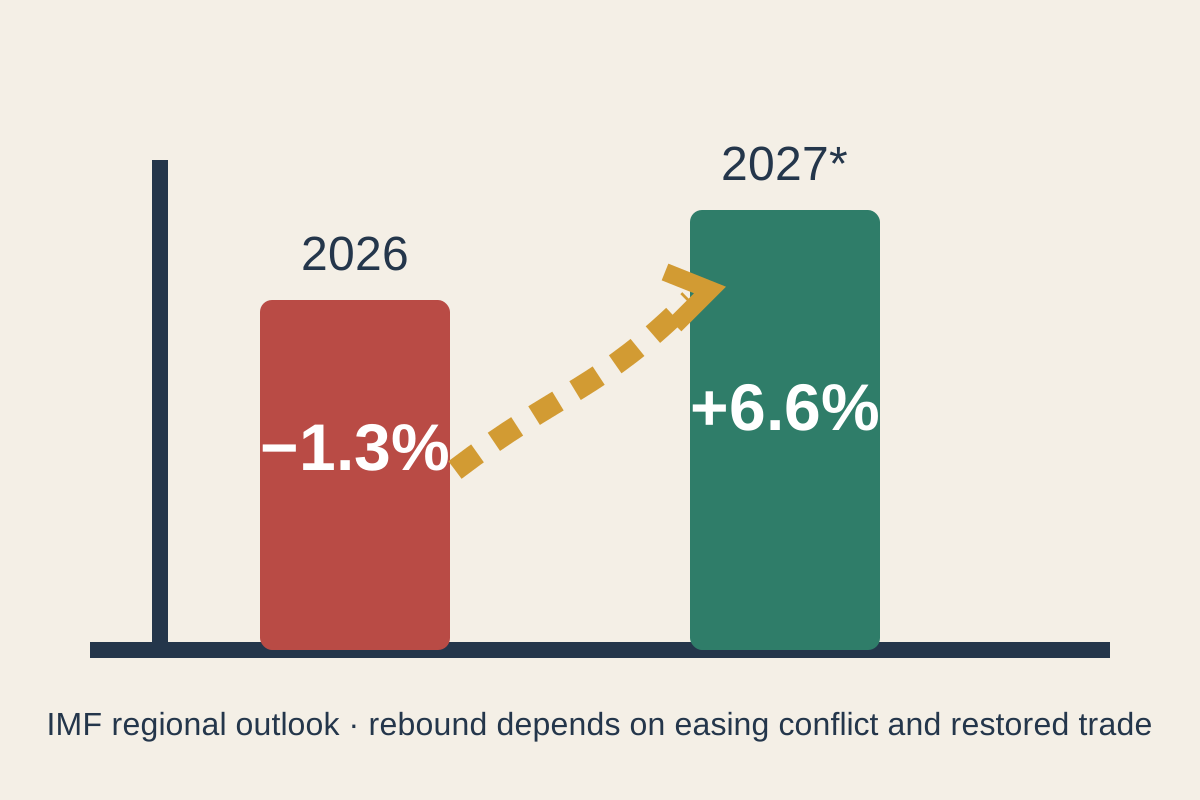
The International Monetary Fund forecasts that output across the Middle East, North Africa and Pakistan will contract 1.3% in 2026, reversing 3.3% growth in 2025. In its regional outlook, the IMF tied the downturn to the Iran war's effects on energy production, shipping, tourism, trade and confidence.
The Fund projects 6.6% growth in 2027, but that baseline assumes the conflict eases early in the year and trade gradually normalizes. Even then, output would generally remain below pre-war projections.
Why it matters to households and businesses
A regional contraction can mean weaker hiring, tighter government budgets and reduced business investment. Shipping and energy interruptions can also raise transport, electricity and food costs beyond the region. The burden is uneven: the IMF says oil exporters directly affected by production and shipping disruptions have been hit harder, while many oil importers have been supported by remittances, tourism and policy measures.
For additional context, see our coverage of Brent oil moving above $110 and the IMF's global growth and financial-risk assessment.
Fact, analysis, forecast and opinion
Verified fact: the IMF published a 1.3% contraction estimate for 2026. Analysis: the forecast shows how a security shock is transmitting through production, trade and confidence rather than remaining confined to battle zones. Forecast: the 6.6% rebound is conditional on easing conflict and normalization; renewed disruption could make it weaker. Opinion: Health Politics Daily takes no position on fiscal or monetary choices in individual countries.
Practical implications
- Businesses exposed to fuel, freight or tourism should treat the 2027 rebound as a scenario, not settled demand.
- Governments face pressure to protect households while preserving fiscal room for a longer shock.
- Consumers should distinguish regional output forecasts from a prediction for their own wages or prices.
Bias Lens: recession headline or conditional recovery?
Verified baseline: the IMF forecasts a 1.3% contraction in 2026 and 6.6% growth in 2027 under assumptions that conflict eases and trade normalizes. The second figure does not erase the loss relative to the pre-war path.
A forced left-center-right comparison is not useful here because early coverage is dominated by the same IMF release and wire reporting rather than distinct ideological arguments. Reuters leads with the contraction and disruption risks; Financial Express similarly emphasizes the downturn; the IMF gives more weight to policy buffers and the conditional rebound. Those are framing differences, not evidence of partisan disagreement.
What remains uncertain
The conflict's duration, restoration of energy output and shipping routes, inflation, interest rates and investor confidence could all change the path. The IMF specifically warns that further disruption to energy production or trade routes could drive prices higher.
Principal sources
- International Monetary Fund regional outlook
- Reuters report, October 22, 2026
- Financial Express corroboration
No suitable directly relevant official or publisher-authorized video with verified embedding permission was available, so none was embedded.