Global events · United Arab Emirates · Environment
UAE Oil Spill Closes Beaches Across Three Northern Emirates
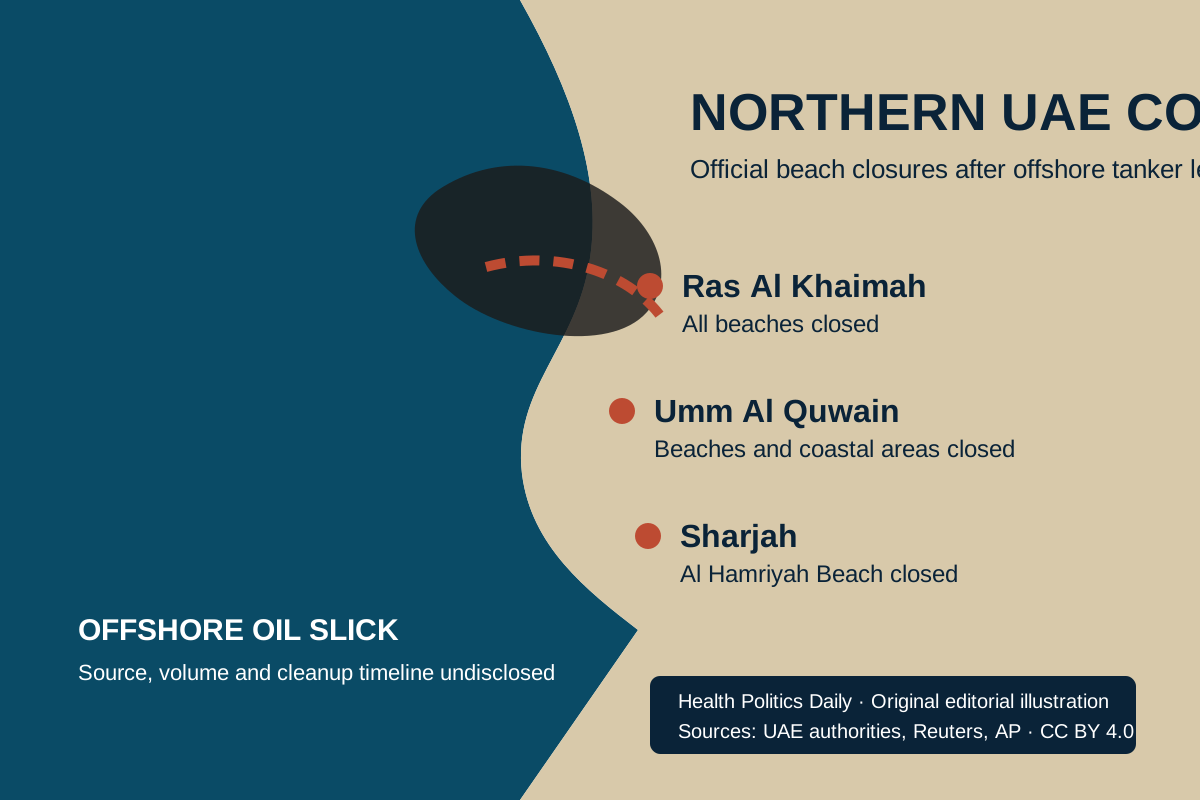
Ras Al Khaimah closed all beaches after a tanker spill already shut coastal areas in Umm Al Quwain and part of Sharjah. Authorities are assessing the damage, but the vessel, spill volume and reopening date remain undisclosed.
By Health Politics Daily News Desk · October 24, 2026 at 9:56 a.m. ET
Verified baseline
Ras Al Khaimah authorities said Saturday that every beach in the emirate would remain closed until further notice. The order widened restrictions that began Friday, when the UAE Ministry of Climate Change and Environment closed beaches and coastal areas around Umm Al Quwain and Sharjah temporarily closed Al Hamriyah Beach.
The ministry said oil was leaking from a tanker offshore, containment work had begun and an environmental assessment was underway. It advised fishers and other sea users to avoid affected waters and follow local instructions. Reuters and the Associated Press reported the widening closures.
What residents, visitors and fishers should do
The closures are official safety measures, not a general evacuation order. People should stay off closed beaches, avoid swimming and fishing in affected areas, and use emirate and ministry channels for reopening notices. Residents who smell petroleum odors should follow official health guidance; the ministry said reported odors in Sharjah, Ajman and Umm Al Quwain did not pose a health risk, but that statement does not establish that direct contact with contaminated water or oil is safe.
Travelers should check hotels and local authorities before making beach plans. Cleanup work, water testing and changing currents can produce different restrictions from one shoreline to another.
Why the spill matters beyond recreation
Northern UAE coastlines support marine habitats, fishing, tourism, ports and industrial facilities. The country also relies heavily on desalinated seawater. Reuters reported that analysts warned currents could move pollution toward coastal infrastructure, but UAE authorities had not announced contamination at desalination intakes.
That distinction matters: proximity creates a risk that agencies must monitor; it is not proof that drinking-water supplies have been affected. Earlier site coverage explains how maritime incidents around the Strait of Hormuz have increased uncertainty for shipping, while our report on changing Gulf attack tactics separates confirmed events from attribution claims.
What is known about the tanker—and what is not
UAE authorities had not publicly named the vessel or stated what caused the leak. Reuters cited independent analysts who identified the tanker as Gem No. 2 and estimated a large slick from satellite imagery. Those assessments are relevant evidence but are not an official identification or a measured government spill total.
Shipping sources previously said a tanker with that name was struck by an unidentified projectile on October 9. No group claimed responsibility. Linking the present pollution conclusively to that event requires evidence about the damaged vessel, cargo and leak path that officials had not released.
Fact, analysis, forecast and opinion
Verified fact: beach closures now cover Ras Al Khaimah, Umm Al Quwain and Al Hamriyah Beach in Sharjah, while containment and assessment continue. Analysis: expanding closures indicate that authorities are treating the pollution as a multi-emirate coastal problem. Forecast: restrictions could change as currents move and sampling results arrive, but no reliable reopening timetable has been published. Opinion: Health Politics Daily takes no position on regional belligerents; public claims about the spill’s source, size and health effects should be labeled according to the evidence behind them.
Bias Lens: environmental emergency, maritime-security incident or local closure?
Verified baseline: a tanker is leaking oil offshore; three northern emirates have closed beaches or coastal areas, containment is underway, and officials have not identified the vessel, cause or spill volume.
Center coverage — Reuters and the Associated Press: Reuters emphasizes environmental and infrastructure exposure while clearly labeling the tanker identification and slick estimate as analyst findings; AP places the closures within a broader day of Gulf security developments. Reliable left- and right-leaning outlets did not add distinct, well-sourced reporting sufficient for a meaningful three-way comparison at publication, so this lens does not force false symmetry. The main framing difference here is between verified local safety orders and still-unconfirmed attribution.
What remains uncertain
Officials have not published the amount or type of oil released, the leak rate, a complete contamination map, wildlife impacts, water-test results or a cleanup schedule. They also have not confirmed the tanker’s identity or the spill’s cause. Until those facts are available, precise claims about ecological damage, drinking-water consequences or responsibility remain provisional.
Principal sources
- Reuters — Ras Al Khaimah closure and official response
- Reuters — containment, analyst assessment and coastal-infrastructure risks
- Associated Press — beach closures and Gulf context
No suitable directly relevant official or publisher-authorized video with clear embedding permission was available, so none was embedded.