International · Natural disasters · Public safety
Tibet Magnitude-7 Earthquake Kills at Least 16 as Rescues Continue
Authorities say at least 65 people were injured and more than 12,000 relocated after the powerful earthquake struck a remote part of the Tibet Autonomous Region. Casualty and damage figures remain provisional.
By Health Politics Daily News Desk · October 23, 2026 at 1:58 a.m. ET

Watch in this article
Pumpjack operating at the Kern River Oil Field
A short CC0 field video provides visual context for reporting on oil production and fuel supply.
Thomas Farley / Wikimedia Commons · CC0 1.0 · License and source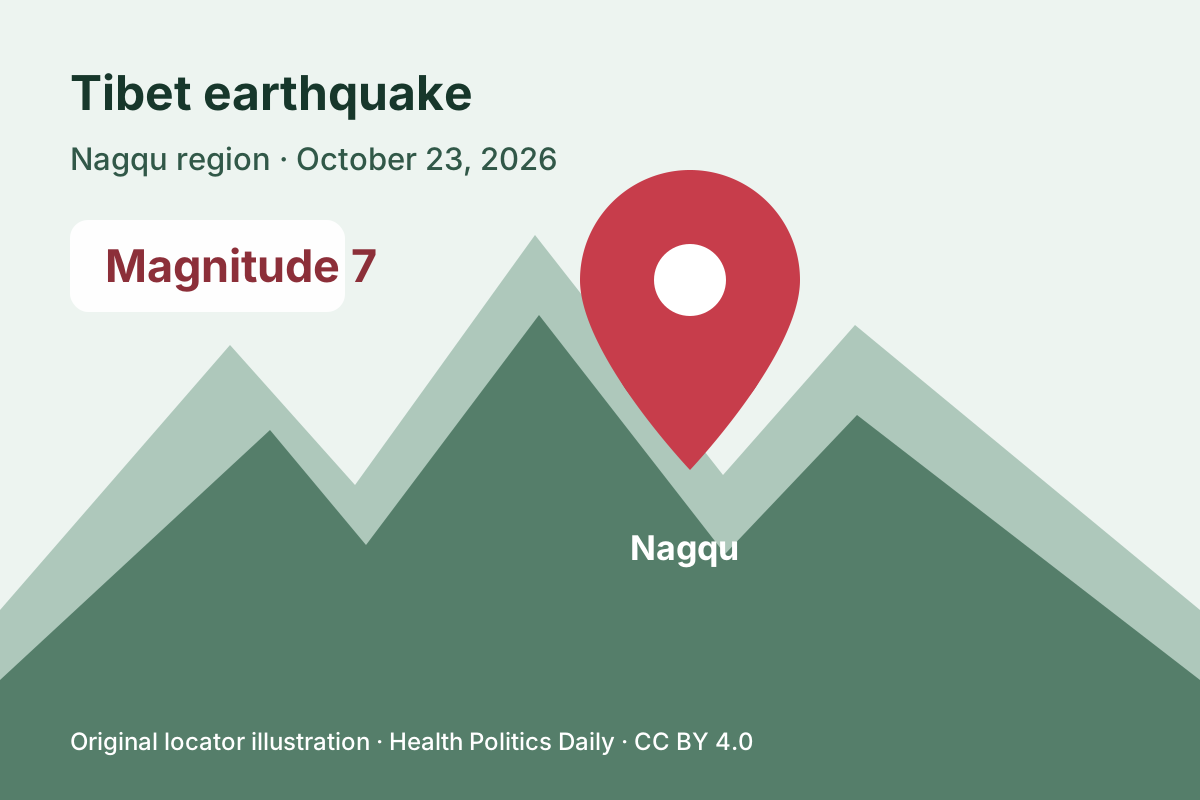
A magnitude-7 earthquake struck the Nagqu region of China's Tibet Autonomous Region early Friday, killing at least 16 people and injuring 65, according to figures carried by Reuters from local authorities. More than 12,000 residents had been relocated as rescue crews searched damaged communities.
Chinese authorities reported more than 400 aftershocks and sent hundreds of police and emergency personnel to the area. The Associated Press reported that hundreds of homes had collapsed and that travel restrictions affected a section of National Highway 317. Cold conditions and snow complicated access in the high-altitude region.
What happened
Verified fact: China's earthquake monitoring agency measured the main shock at magnitude 7.0, and independent news organizations reported the same official reading. The epicentral area is sparsely populated but difficult to reach, making a rapid, complete assessment challenging. The death, injury and relocation totals are official figures that may change as teams reach additional settlements.
Magnitude measures energy released at the source; it does not by itself determine local damage. Depth, distance, construction quality, terrain and aftershocks all affect what communities experience. A current earthquake catalog is available from the U.S. Geological Survey, while regional notices are posted by the Tibet earthquake authority.
Why this matters for people in the region
The immediate priorities are finding survivors, treating injuries, keeping roads open and providing warm shelter, food and water. Relocation can protect residents from unsafe buildings and aftershocks, but it also creates health risks when cold-weather shelter, sanitation or medicine is limited.
Practical implication: people in affected areas should follow local emergency instructions, stay away from visibly damaged buildings and expect aftershocks. Families outside the region should rely on official channels before sending money or sharing names of presumed victims. This is general safety information, not individualized medical advice.
Fact, analysis, forecast and opinion
Verified fact: at least 16 deaths, 65 injuries and more than 12,000 relocations had been reported by early Friday. Analysis: the remote terrain and winter weather make rescue logistics unusually difficult and can delay reliable totals. Forecast: aftershocks and updated casualty figures are likely, but their severity and timing cannot be predicted precisely. Opinion: public agencies and newsrooms should label changing numbers with timestamps and distinguish confirmed access problems from broader claims about the disaster zone.
For context on emergency response and regional disruption, see our coverage of floods in India and Nepal, China's latest economic data and flooding and travel disruption in Bangkok.
Bias Lens: verified baseline and differences in disaster framing
Verified baseline: a magnitude-7 earthquake struck the Nagqu region, and authorities reported at least 16 deaths, 65 injuries and more than 12,000 relocations. Those figures are provisional.
A conventional left-center-right comparison is not meaningful for this fast-moving natural-disaster report. Official/state coverage — Xinhua: emphasizes mobilization, rescue resources and government response. Independent wire coverage — Associated Press: foregrounds casualties, collapsed homes and transport restrictions. Independent wire coverage — Reuters: leads with the updated injury and relocation figures. These are differences in sourcing and emphasis, not evidence that the earthquake itself is politically disputed.
What remains uncertain
Authorities have not yet published a final village-by-village damage assessment. The number of people still missing, the full condition of roads and utilities, and the long-term housing need may take days to establish. Early reports also cannot show whether every reported death or injury was directly caused by building collapse, exposure or another consequence of the quake.
Principal sources
- Reuters — updated casualties, relocations and aftershocks
- Associated Press — damage, access and weather context
- U.S. Geological Survey — earthquake catalog
- Tibet earthquake authority — official notices
No suitable directly relevant official or publisher-authorized video with clear embedding permission was available, so none was embedded.