Nigeria · Public safety · Human rights
Nigeria Village Attack Kills at Least 40, Amnesty Says
Police confirm gunmen attacked Binnari village in Taraba State. Amnesty International says at least 40 people were killed, but authorities’ initial count was lower and key facts remain unresolved.
By Health Politics Daily News Desk · October 24, 2026 at 6:00 p.m. ET

Watch in this article
Pumpjack operating at the Kern River Oil Field
A short CC0 field video provides visual context for reporting on oil production and fuel supply.
Thomas Farley / Wikimedia Commons · CC0 1.0 · License and source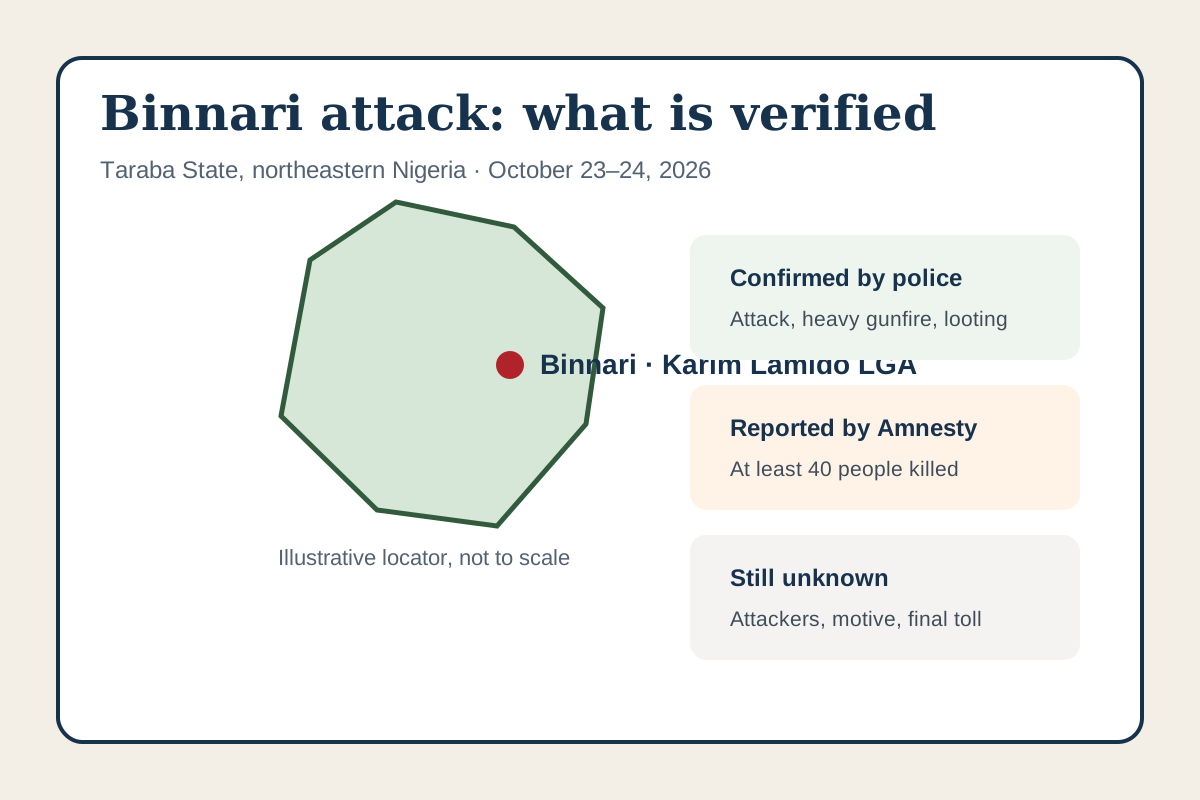
Verified baseline
A large group of gunmen attacked Binnari village in the Karim Lamido area of Nigeria’s northeastern Taraba State on Friday afternoon, October 23, police said in a statement reported by Reuters. Police said the attackers fired heavily, raided shops and took food.
Amnesty International Nigeria said at least 40 people were killed. Police had initially confirmed 10 deaths; Reuters reported that Amnesty said more bodies were recovered Saturday. That gap makes the 40-person figure a credible rights-group report, not yet a final government count.
Why this matters
The attack is a severe loss for one rural community and another test of Nigeria’s ability to protect civilians across a wide security landscape. Northern Nigeria faces overlapping threats from criminal gangs, communal violence and Islamist insurgents, but no public evidence reviewed for this report establishes who carried out the Binnari attack or why.
Early reports sometimes use labels such as “bandits” or assign ethnic or religious identities before investigators have produced evidence. Health Politics Daily is not repeating those claims as fact.
Practical implications
Residents may face disrupted movement, delayed farming and market activity, and pressure on local clinics and relief networks. People seeking information about relatives should rely on Taraba authorities, hospitals and established humanitarian organizations; graphic or identity-based social-media claims may be incomplete or manipulated.
For travelers, governments’ official Nigeria advisories—not a single breaking-news report—are the appropriate source for current regional guidance. This article is general public information, not personalized travel or security advice.
Fact, analysis, forecast and opinion
Verified fact: police confirm an armed attack, and Amnesty reports at least 40 deaths. Analysis: the conflicting early counts reflect the difficulty of documenting casualties after attacks in remote communities. Forecast: the toll and attribution may change as recovery and investigation continue; no responsible forecast can identify the attackers from the evidence now public. Opinion: Health Politics Daily takes no position on Nigerian political factions and believes casualty and identity claims should remain explicitly sourced.
Bias Lens: verified deaths, uncertain attribution
Verified baseline: police confirmed the Binnari attack; Amnesty International Nigeria says at least 40 people were killed, while the first police count was 10.
A conventional left-center-right comparison is not meaningful yet because ideologically distinct major outlets have not produced substantial original coverage. International wire coverage — Reuters: foregrounds the Amnesty toll and police statement. Nigerian national coverage — The Nation: earlier used a 26-person count and called the attackers suspected bandits. Local reporting — Daily Trust: emphasized eyewitness accounts, women and children among the victims, and stolen property. The difference is mainly timing, sourcing and specificity—not a clean ideological divide.
What remains uncertain
Authorities have not publicly established the attackers’ identities, motive, number, route or affiliations. The final number of dead and injured, the number of missing people, the scale of property loss, arrests and the security response also remain unclear.
Related coverage
- Hebron Closures Displace Hundreds of Families After Attack
- Jordan Church Funeral Shooting Kills Seven and Injures 34
- South Africa Confronts a Wave of Mass Shootings
Principal sources
- Amnesty International Nigeria statement
- Reuters report citing police and Amnesty
- Daily Trust local reporting
No suitable directly relevant official or publisher-authorized video with clear embedding permission was available, so none was embedded.