WORLD — SOUTH AFRICA
South Africa Mass Shootings Kill 27: What Is Known
Police are pursuing suspects after two separate attacks within hours of each other. The casualty totals are confirmed; the motives and any connection between the shootings are not.
By Health Politics Daily News Desk · Published Sunday, September 27, 2026 at 6:00 a.m. America/New_York · Approximately 6 minutes
Verified Baseline
Two attacks killed 27 people and injured 26
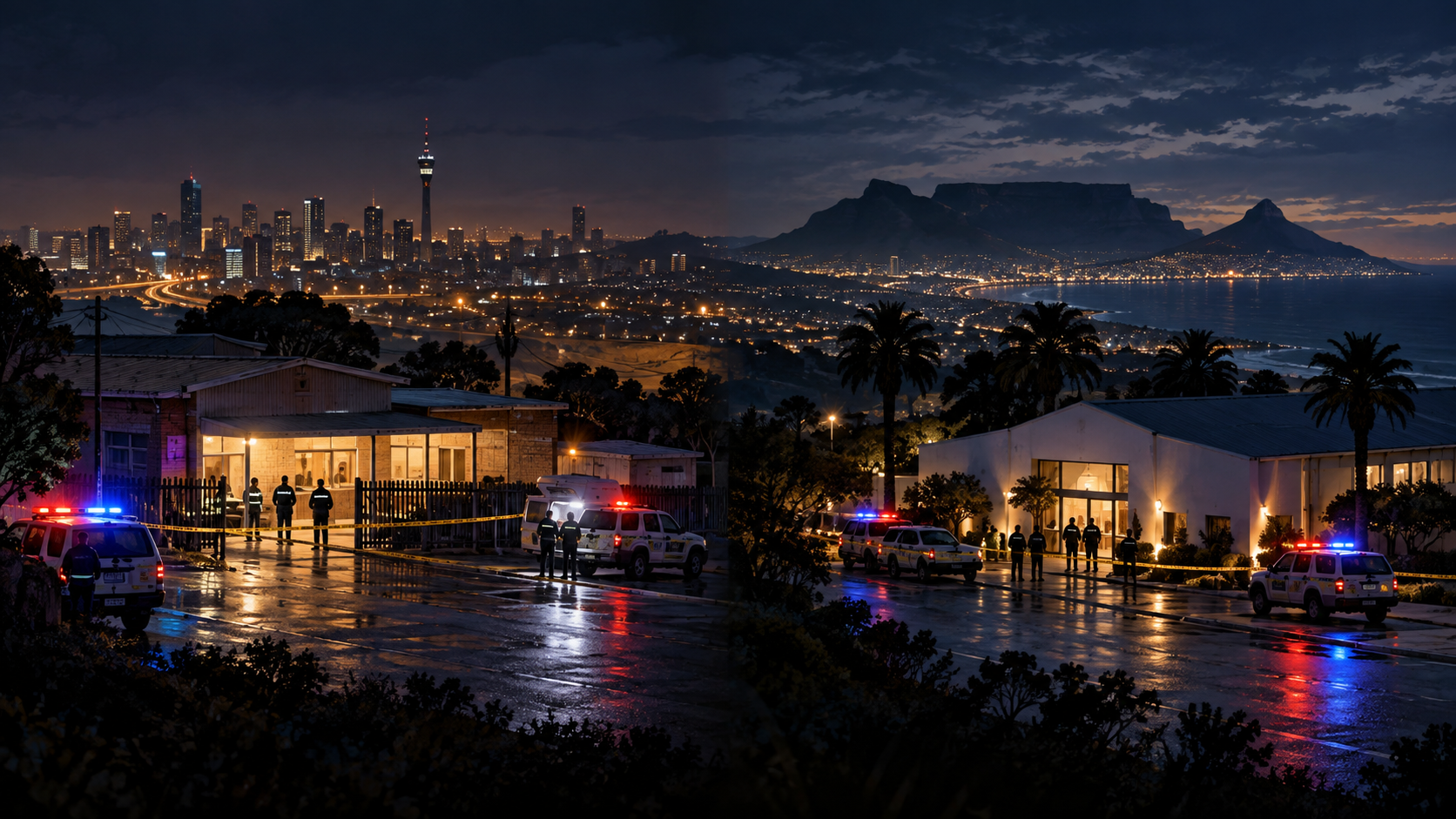
South African police said 17 people were killed and 15 injured at a tavern in Wedela township, roughly 80 kilometers west of Johannesburg, after attackers armed with rifles opened fire at about 9:30 p.m. Saturday. Hours later, gunmen attacked a venue selling grilled meat in Lwandle, outside Cape Town, at about 2 a.m. Sunday, killing 10 people and injuring 11.
The combined toll is 27 dead and 26 injured. Police were treating the scenes as separate investigations, and no arrests had been announced when this article was published. Reuters reported the two police accounts; South African outlet Eyewitness News separately reported the Lwandle toll and the creation of a multidisciplinary investigative team.
What Happened
The locations and timelines are distinct
Wedela is in Gauteng province, near Johannesburg. Police said gunmen opened fire on tavern patrons; investigators also documented two burned vehicles outside the venue. Lwandle is in the Western Cape, near Cape Town. Police said attackers entered an entertainment venue and fired on patrons, with five victims dying at the scene and five later dying after reaching medical facilities.
The fact that both attacks occurred during the same night does not establish that they were coordinated. No public police statement cited by the reporting identified the same suspects, weapons, organization or motive across both scenes.
What Is Not Known
No motive or verified connection has been announced
Investigators have not publicly identified the perpetrators or established whether gang activity, organized crime, a personal dispute or another motive drove either attack. Reporting that places the shootings within South Africa’s wider gun-violence problem provides context; it is not proof of who committed these particular crimes.
Authorities have also not announced a final casualty breakdown by age or identity. Early counts can change as hospitals update patients’ conditions and forensic identification proceeds. Names should come from authorities or families, not social-media speculation.
Why It Matters
The attacks intensify pressure over illegal firearms and violent crime
South Africa has one of the world’s highest murder rates, and illegal firearms are frequently associated with organized, gang-related and other violent crime. The two attacks follow other recent mass killings, including a house-party shooting near Durban, adding urgency to questions about gun trafficking, intelligence, local policing and protection at nightlife venues.
Crime is also a major public issue before municipal elections in November. Political leaders may propose enforcement or firearms measures, but any forecast about the electoral effect is analysis—not a verified consequence of the shootings.
Practical Information
What residents should rely on now
- Use South African Police Service and established local-news updates for suspect descriptions, road closures and verified casualty information.
- Do not approach or attempt to identify possible suspects from unverified posts; send relevant evidence directly to police.
- Avoid sharing graphic images or unconfirmed victim names, which can harm families and compromise investigations.
- People seeking relatives should use official hospital or police channels rather than relying on circulating lists.
Police had not announced an ongoing public threat tied to either scene at publication, but that does not mean the perpetrators had been located.
Bias Lens: how coverage frames the shootings
Separate shootings in Wedela and Lwandle killed 27 people and injured 26. Police announced no arrests, confirmed motive or verified link between the attacks by publication time.
Reuters, used as the center baseline, combines the two events and emphasizes national gun violence and the coming local elections. Eyewitness News, a South African outlet, focuses more closely on the Lwandle scene, medical outcomes and the provincial police response. This is breaking public-safety coverage rather than a developed left-right policy dispute; no comparably detailed mainstream right-leaning report added independent facts at publication. A forced partisan comparison would obscure the more important distinction between confirmed police information and speculation.
What Comes Next
Investigators must establish who acted and why
The next material developments would be arrests, verified suspect descriptions, ballistic or vehicle evidence, revised casualty counts, and any police finding that connects—or explicitly separates—the attacks. Until then, claims of coordination, political motivation or responsibility by a particular group remain unverified.
Principal Sources
Evidence and reporting used
- Reuters — police accounts, casualty totals and national context
- Eyewitness News — Lwandle police response and hospital deaths
- South African Police Service — official public-information portal
No suitable directly relevant authorized video with clear embedding permission was available.