Australia · Public safety · Democratic access
Helen Haines Critically Injured After Vehicle Strike; Motive Remains Unclear
Police arrested a man after the Australian MP was struck outside her Wangaratta office on October 19. What is confirmed, why it matters and what remains unknown.
By Health Politics Daily News Desk · October 19, 2026 at 7:58 a.m. ET
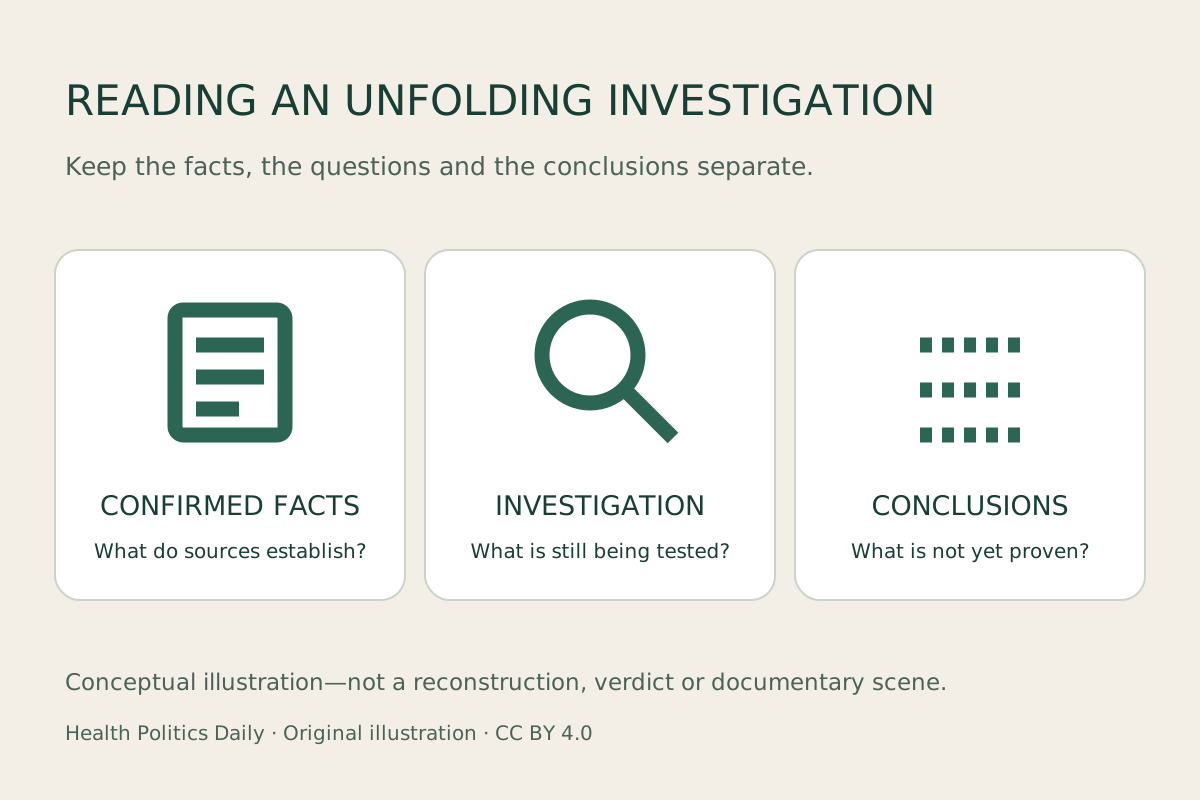
Australian independent MP Helen Haines was critically injured after being struck by a vehicle outside her electorate office in Wangaratta, Victoria, on October 19. Police arrested a man, and Prime Minister Anthony Albanese described an apparent deliberate act. The motive has not been established in the evidence reviewed for this edition.
What police have confirmed
Victoria Police’s published statement, issued at 6:48 p.m. local time, says a vehicle struck a 65-year-old woman outside an office on Murphy Street at about 3:35 p.m. A passerby detained the driver, a 43-year-old man from Tarrawingee, and the woman was taken to hospital with critical injuries.
The release says police seized a knife from the vehicle. It expressly leaves open whether the act was intentional and whether the two people knew each other. The presence of an object is not, by itself, evidence establishing how it was used or a motive.
Reuters’ subsequent reporting identifies Haines and records Albanese’s statement that a counter-terrorism taskforce would investigate. It also reports his caution that it was too early to determine motive. An investigation by specialist agencies should not be read as a completed terrorism finding.
What Albanese said—and what that does not establish
The ABC’s publisher-hosted 7.30 interview provides the prime minister’s public account alongside discussion with MP Allegra Spender and political editor Jacob Greber. It is a source for what those speakers say, not a replacement for the police investigation.
Analysis: Official remarks and an earlier police release can reflect different stages of an unfolding event. The careful response is to preserve who said what and when, not silently turn a description into a proven explanation. Arrest, investigation, charge and conviction are distinct stages; this report does not declare criminal guilt.
Why the incident matters beyond Parliament
Analysis: An electorate office is a point of contact between residents and their representative. An incident there affects a person receiving emergency care, her family and colleagues, and the community’s ability to engage with public life. Those consequences do not depend on knowing a suspect’s ideology.
Security and accessibility can create difficult practical choices: staff and visitors need protection, while constituents need ways to seek assistance and speak with elected officials. Evaluating any proposed security response requires its actual terms and evidence. This edition does not infer a nationwide threat or recommend closing offices from one incident.
For a separate example of reporting allegations without treating them as a verdict, see our Mall of America investigation explainer. Our French preparedness-review report examines another public-safety accountability process. These are related reporting themes, not evidence of a connection between the events.
What witnesses and readers can usefully do
The police statement asks people with information, CCTV or dashcam footage to contact Crime Stoppers through the official channel linked in that release. Relevant material should go to investigators rather than being used online to identify or accuse strangers.
Readers seeking constituency assistance should check the office’s current official notices rather than assume normal access or a closure. This article does not supply operational security details, unverified medical claims or graphic footage.
What remains uncertain
The reviewed sources do not establish a motive, the complete circumstances or Haines’s prognosis. This edition does not speculate about a suspect’s health, identity beyond the verified arrest details, affiliations or online activity. A statement about the wider political climate cannot establish what caused this particular event.
Bias Lens: investigation, uncertainty and security
Verified baseline: Police report a vehicle strike, critical injuries and an arrest. Their initial release leaves intent under investigation; later official remarks do not establish motive or guilt.
Left-leaning—The Guardian: Its explainer separates known facts from unresolved intent and motive.
Center—Reuters: The linked report foregrounds specialist investigators while retaining Albanese’s caution on motive. The headline’s agency focus should be read with that qualification.
Right-leaning—The Australian: Its publicly retrievable headline places the event in the context of threats and security funding. The full article was not accessible for this review, so we make no claim about its complete argument.
These are bounded observations about linked coverage, not stereotypes about publishers or their audiences. Security concerns and caution about attribution are compatible. No framing establishes the result of an investigation.
Sources and video
The primary written source is Victoria Police’s release. The ABC interview carries the prime minister’s public remarks; Reuters corroborates the incident and investigation. Watch on the ABC’s official video page; it is linked, not embedded, downloaded or rehosted. The original conceptual illustration is licensed CC BY 4.0 and does not depict the incident.