France · Public policy · Civil unrest
Macron Orders Unrest Review and Calls Talks on Protesters’ Demands
The October 18 address sets out next steps after the unrest. A review, aid coordination and consultation are not yet findings, payments or an agreed reform package.
By Health Politics Daily News Desk · October 18, 2026 at 10:06 p.m. ET
French President Emmanuel Macron used his Sunday evening address to announce a government response to the unrest, combining security scrutiny with planned dialogue. The immediate test is what follows the speech—not whether an announcement alone resolves the grievances or establishes responsibility for the violence.
What the address actually announced
The Élysée’s published October 18 transcript says the prime minister will chair a crisis meeting on October 19 to coordinate rapid assistance. Macron also asked for lessons on intelligence and anticipation, and for the government to convene students, teachers, unions, employers, local authorities and lawmakers during the week to develop proposals.
Reuters corroborated the review and consultation announcements. Its account notes that detailed proposals were not provided. That makes this a statement of process and intent, rather than a completed settlement.
Three tracks, with different tests of delivery
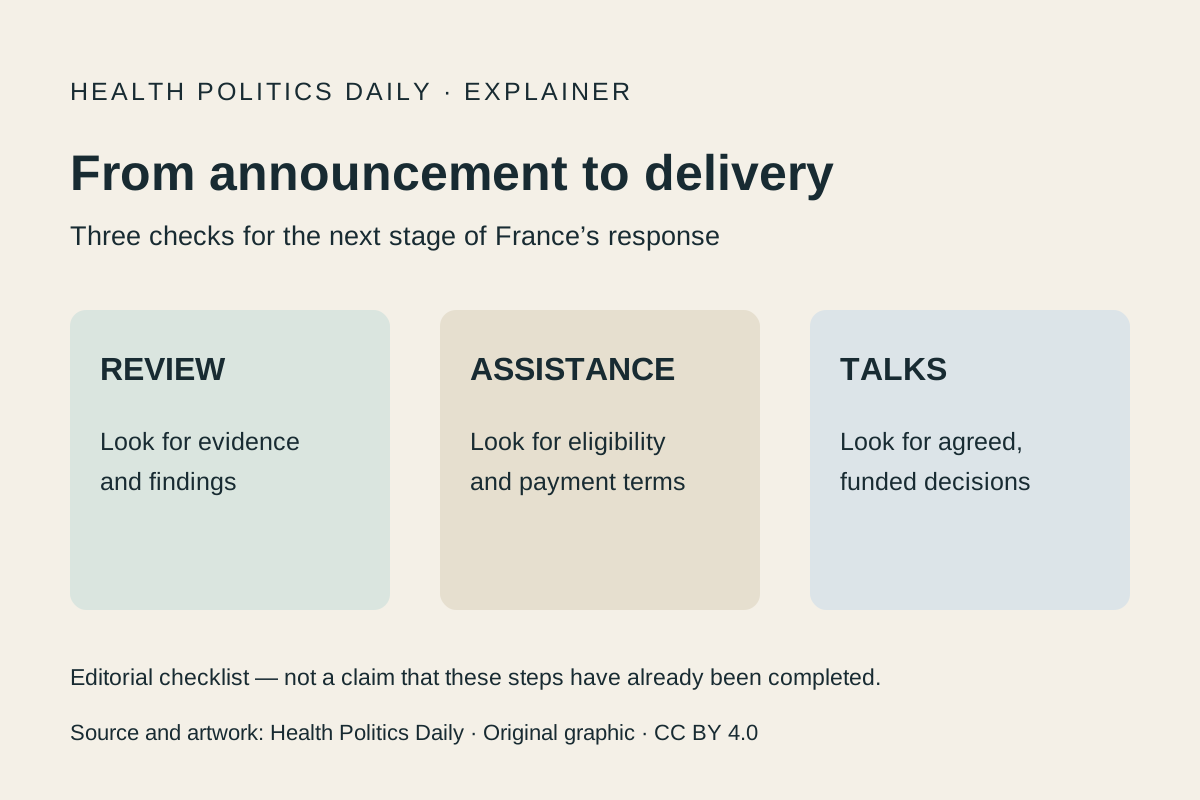
Analysis—security review: A request to examine preparedness can identify questions without answering them. Readers should look for the review’s remit, who conducts it, what evidence is considered and whether findings are published. An instruction to learn lessons is not itself proof that a particular official failed.
Analysis—assistance: Coordination can help an affected business find support, but a meeting does not establish the amount, eligibility rules or timing of a payment. Practical delivery would require identifiable administering bodies and published terms. Owners should not infer that every loss will be reimbursed from the speech alone.
Analysis—talks: Bringing groups together is different from agreeing on a remedy. A useful next account would identify participants, proposals, funding and implementation dates. A promise to listen should be judged separately from a measurable change in school conditions or household costs.
Protest, public order and accountability
The official transcript distinguishes legitimate demonstrators from people who destroyed or looted property. It also says prefects, working with mayors, may prohibit some gatherings where necessary. This article does not treat that statement as a nationwide ban or provide an interpretation of the legality of any individual restriction.
Analysis: The distinction matters for both accountability and public debate. Investigating criminal acts does not determine whether a policy grievance is justified; acknowledging a grievance does not excuse violence. Claims about an individual’s conduct require evidence about that individual, rather than assumptions based on a crowd’s appearance or a political label.
For the scale and recovery context, see our earlier report on arrests and recovery. For the preceding mobilisation, see the October 17 demonstrations and transport report. Those editions retain their original timestamps and should not be mistaken for live closure notices.
What residents and businesses should watch next
Check current prefectural, municipal and transport-operator notices for a specific destination. A national speech cannot establish whether an individual road, public counter or shop is open. Likewise, a local restriction should be checked in the relevant authority’s actual notice, including its place and duration.
For assistance, the useful document will be the administering authority’s instructions—not a social-media promise of an automatic payout. This is general information, not individualized legal or financial advice.
What remains uncertain
The reviewed announcements do not establish the review’s conclusions, final assistance arrangements or a negotiated reform package. Whether the planned meetings reduce tensions is uncertain. This edition makes no prediction of government collapse, universal reopening or a guaranteed end to disruption.
Bias Lens: preparedness, enforcement and delivery
Verified baseline: Macron delivered the address and announced a response process. Implementation and findings must be checked separately.
Left-leaning—The Guardian: Its updated report foregrounds scrutiny of preparedness and policing alongside the address.
Center—Reuters: Its speech report emphasizes the announcements and the lack of detailed proposals.
Center-right—The Times: Its report leads with Macron’s demand that rioters be held accountable.
These are observations about the linked articles, not fixed descriptions of every journalist or reader. A call for accountability and scrutiny of state preparedness are not mutually exclusive; neither establishes the outcome of an investigation.
Primary source and video
The official Élysée page includes the transcript and replay. The replay is linked on its official page, not downloaded, rehosted or embedded. Reuters corroborates the principal announcements. The original illustration is licensed CC BY 4.0 and does not depict protest events.