France · Public safety · Cost of living
France Reports More Than 2,000 Arrests After Unrest as Recovery Begins
Sunday’s provisional arrest count and business-recovery response mark a new phase after October 17 demonstrations. The government’s security claims and protesters’ grievances require separate scrutiny.
By Health Politics Daily News Desk · October 18, 2026 at 2:03 p.m. ET
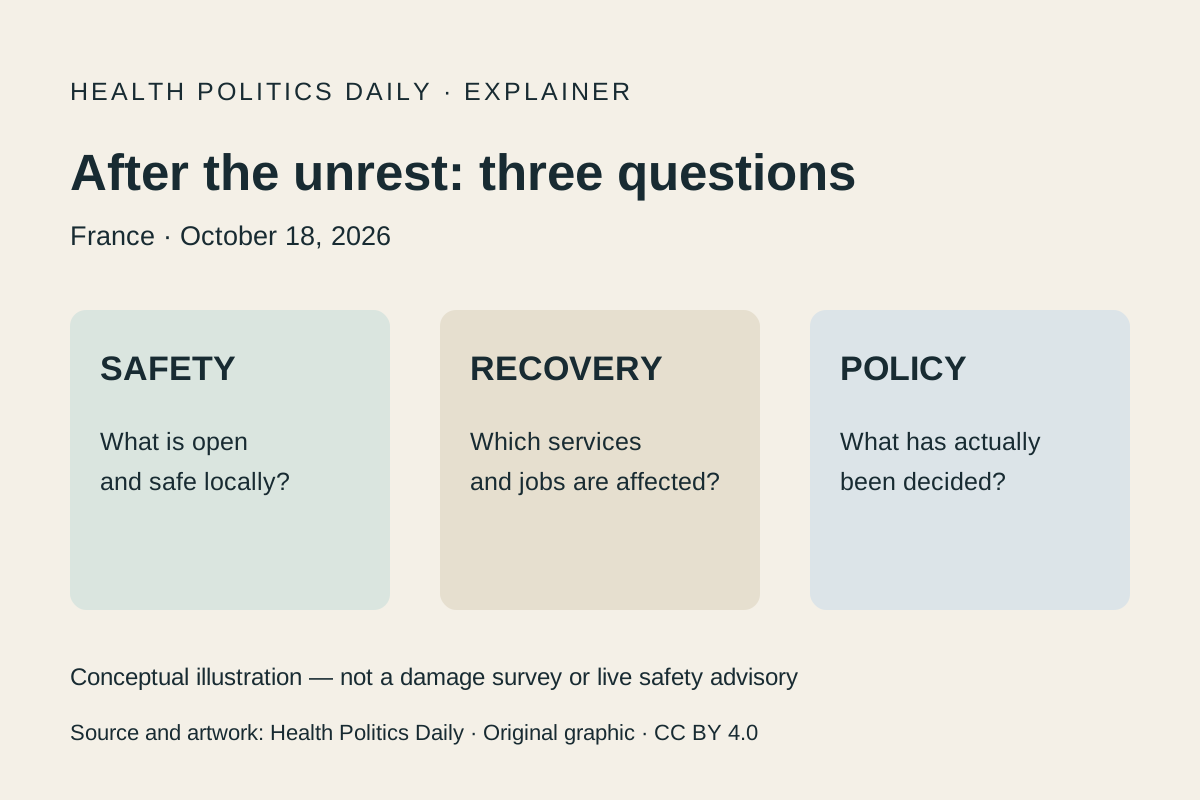
French authorities reported more than 2,000 arrests after Saturday’s nationwide demonstrations were marred by arson, looting and clashes. On Sunday, October 18, attention shifted to damaged businesses and public buildings, investigations and the government’s response—not just the routes and turnout of the previous day’s marches.
The Élysée announced a national address by President Emmanuel Macron for 8 p.m. in France, equivalent to 2 p.m. Eastern Time. At this edition’s source check, the official page contained an announcement and viewing destination, not a transcript. This report does not assume what Macron said or announce measures that have not been verified.
What is confirmed—and why counts differ
Reuters’ October 18 update attributes the figure of more than 2,000 arrests to Interior Minister Laurent Nuñez. AFP’s earlier Sunday account carried an estimate of 1,800. These are provisional snapshots, not totals to add together. An arrest also does not establish a conviction or the conduct of every person detained.
AFP reports that one person died during the main Paris march, with officials describing the death as health-related rather than caused by the protest violence. That distinction matters: a death during a demonstration is not automatically evidence of a killing by police or protesters.
The unrest included a destructive fire at Limoges town hall and damage to shops. It should not erase the distinction between people marching peacefully and people committing violence. Our October 17 report on demonstrations and transport disruption describes the earlier phase of the mobilisation; today’s article focuses on its aftermath.
What recovery means for residents and workers
The National’s report describes Economy Minister Roland Lescure’s pledge of support for affected business owners and emergency assistance announced in Marseille. A promise of assistance is not a published eligibility schedule, a guaranteed payment or a verified estimate of every business’s losses.
Analysis: A damaged shop can affect employees’ shifts, deliveries and nearby residents even when they took no part in a demonstration. Damage to public buildings creates a different problem: restoring access to local services while repairs and investigations proceed. Neither the national arrest count nor dramatic footage can establish whether a particular workplace or municipal counter is open.
Residents and visitors should check current local authority and transport-operator notices for their specific destination. Yesterday’s closure list is not a live travel advisory. Business owners seeking assistance should look for the administering authority’s actual terms before assuming a political pledge applies to them.
Grievances and responsibility are separate questions
The National traces the mobilisation from concerns about school conditions and teacher shortages into broader objections to living costs and spending cuts. It also reports that Prime Minister Sébastien Lecornu blamed the violence on far-left groups and criminals. That is the government’s attribution, not a judicial finding identifying everyone responsible.
Analysis: Addressing affordability and public services is a policy question; determining responsibility for arson, theft or excessive force requires evidence about specific acts. One cannot resolve the other. The fiscal tradeoffs are discussed in our report on the IMF’s call to protect vulnerable households while rebuilding budget buffers; it is international context, not a newly adopted French policy.
What remains unresolved
A final national arrest total, a consolidated damage assessment and verified details of assistance remain incomplete in the reviewed sources. The effect on negotiations, future mobilisation and government policy is uncertain. This edition makes no forecast of government collapse or of nationwide disruption continuing indefinitely.
Bias Lens: accountability, official response and destruction
Verified baseline: peaceful demonstrations and violent incidents both occurred; authorities are investigating, and provisional counts changed during Sunday.
Left-leaning—The Guardian: Its Sunday report foregrounds scrutiny of government preparedness and policing.
Center—Reuters: Its aftermath report emphasizes official counts, damage and the state response.
Right-leaning—Fox News: Its October 17 Limoges report emphasizes destruction and far-left attribution. Its narrower scope and earlier timestamp limit direct comparison.
These are observations about specific reports, not claims that every journalist or reader shares one view. Political blame needs verification; legitimate grievances do not justify violence, and violence does not disprove the existence of grievances.
Sources and video
The primary presidential announcement is linked above. Reuters, AFP and The National provide corroborating aftermath reporting; some official figures were available through their reporting rather than a directly retrieved ministry bulletin. The official Élysée address page is the video destination. No footage is downloaded, rehosted or embedded. The illustration is an original CC BY 4.0 explanatory graphic, not a photograph of the unrest.