Canada · Military training · Public safety
Canada Confirms Four Deaths in Wainwright Fire; 39 Hospitalized
Sunday’s briefing establishes a casualty count after the October 17 training-area fire. Officials describe rapid wind-driven spread, but the ignition cause and responsibility remain under investigation.
By Health Politics Daily News Desk · October 18, 2026 at 8:02 p.m. ET
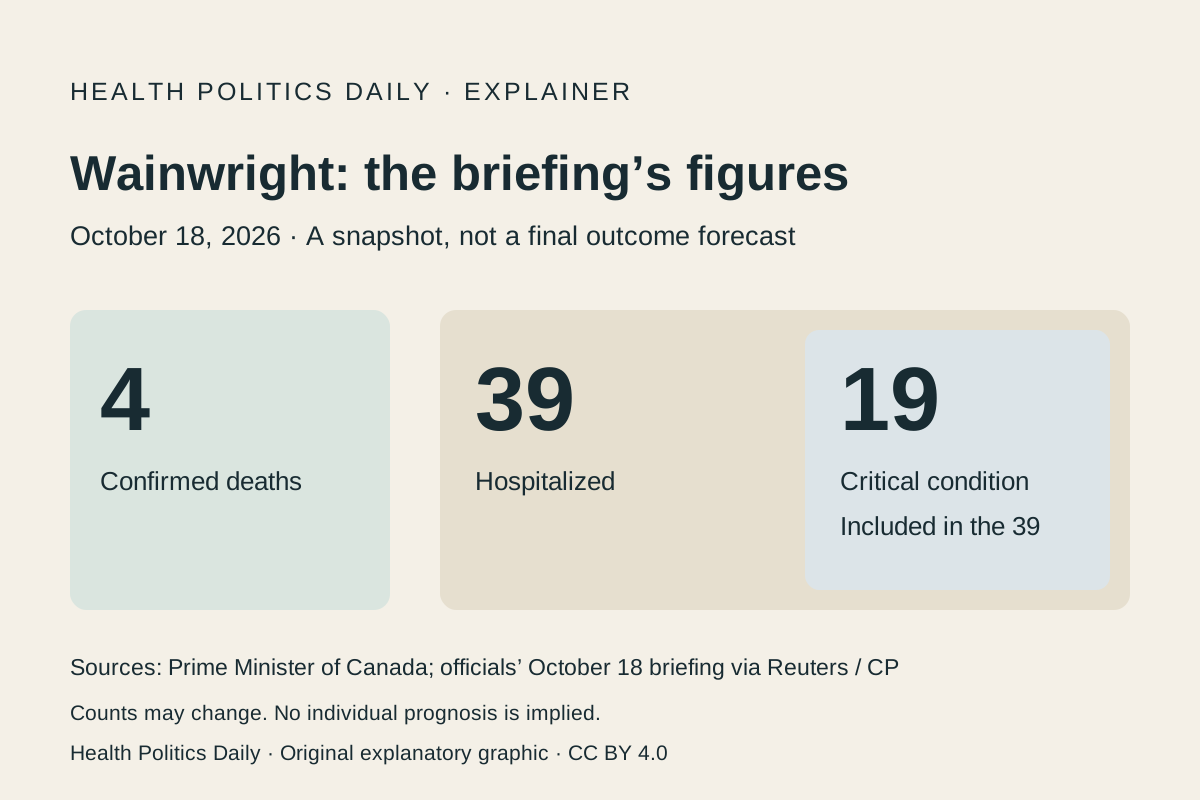
Canada has confirmed that four service members died in the fire at Canadian Forces Base Wainwright in Alberta. Officials’ Sunday briefing also reported 39 people in hospital, including 19 in critical condition—a substantial update from the earlier military statement that acknowledged deaths and injuries without a numerical toll.
What changed in the official account
In his October 18 remarks, Prime Minister Mark Carney confirmed four deaths and said next of kin had been notified. He also pledged continuing support for the families and injured. That is a direct official confirmation, not a total inferred from anonymous reports.
The hospitalization and critical-condition figures were reported from the subsequent briefing by Reuters and The Canadian Press. The 19 critically injured people are included in the 39 hospitalized; the two numbers must not be added together. The figures describe the briefing’s snapshot and may change as patients’ conditions evolve.
Our earlier Wainwright report preserves what was known before this confirmation. This follow-up focuses on the new toll, the account of the fire’s movement and the questions investigators still need to answer.
What officials say about the fire’s spread
The initial National Defence release dates the fire to approximately 4 p.m. local time on October 17 in the base’s training area. Military and civilian emergency services responded.
AP’s account of Sunday’s briefing says Maj.-Gen. Wade Rutland described a grass fire that had been considered sufficiently contained for training to continue, before a wind shift drove flames rapidly toward soldiers. AP reports that the activity involved live-fire combat training.
Evidence limit: Describing the training and the wind-driven spread does not establish exactly what ignited the grass or whether any person breached a safety rule. This edition does not adopt unverified explanations involving a particular munition or assign negligence.
Why the new details matter
Analysis: Confirmation changes the task facing families, colleagues and public institutions. Alongside immediate treatment, there are bereavement needs and questions about how to support those whose recovery may be prolonged. A critical-condition classification signals seriousness; it is not a prediction of an individual patient’s outcome.
The preliminary timeline also identifies questions for an investigation: how the fire was monitored, what information reached exercise commanders, how changing conditions were assessed and how personnel could move to safety. Those are questions, not findings that a particular decision caused the deaths.
For the surrounding community, casualty information and access restrictions answer different questions. A confirmed hospital count does not establish that a road has reopened or that an affected area is safe. Residents should consult the municipal district and the town’s current notices, rather than treating this article as a live fire or evacuation bulletin.
Our coverage of California’s Norte Fire evacuation orders illustrates that separate public-safety distinction. It is a different event, not evidence about the cause or response at Wainwright.
What remains unresolved
A final ignition finding, a complete reconstruction of decisions before the fire reached personnel, and any conclusions about responsibility remain unresolved in the material reviewed. The public briefing is an important starting account, not a completed investigation. No forecast of the final toll or recovery outcomes is warranted here.
Bias Lens: confirmed toll, human impact and preliminary explanation
Verified baseline: Carney confirmed four deaths; officials reported 39 hospitalized, including 19 critically injured. The cause still requires investigation.
Left-leaning—The Guardian: Its updated report foregrounds human loss and pressure on hospitals.
Center—Reuters: Its briefing report emphasizes casualty figures and the preliminary grass-fire account.
Right-leaning—Fox News: Its October 18 report emphasizes Carney’s confirmation and the scale of the tragedy.
These are differences of emphasis in specific reports, not proof of a partisan dispute. Updates published at different times may carry different levels of detail. None of these editorial frames establishes the ignition cause or individual responsibility.
Sources and official briefing video
Primary references are Carney’s published remarks, National Defence’s release and the officials’ briefing carried by CPAC. CPAC’s publisher-hosted video is linked, not embedded, downloaded or rehosted. Reuters, AP and The Canadian Press corroborate the developing account. The illustration is original, licensed CC BY 4.0, and does not depict victims or the scene.