International Politics · South Africa · Public Safety
South Africa Deploys 510 Soldiers to KwaZulu-Natal After Anti-Migrant Violence
The military will support police through November 30 after violence linked to false claims about a Constitutional Court asylum ruling. The order defines a standby and law-enforcement support role; it does not suspend asylum rights or declare martial law.
By Health Politics Daily News Desk · October 27, 2026 at 8:00 p.m. ET
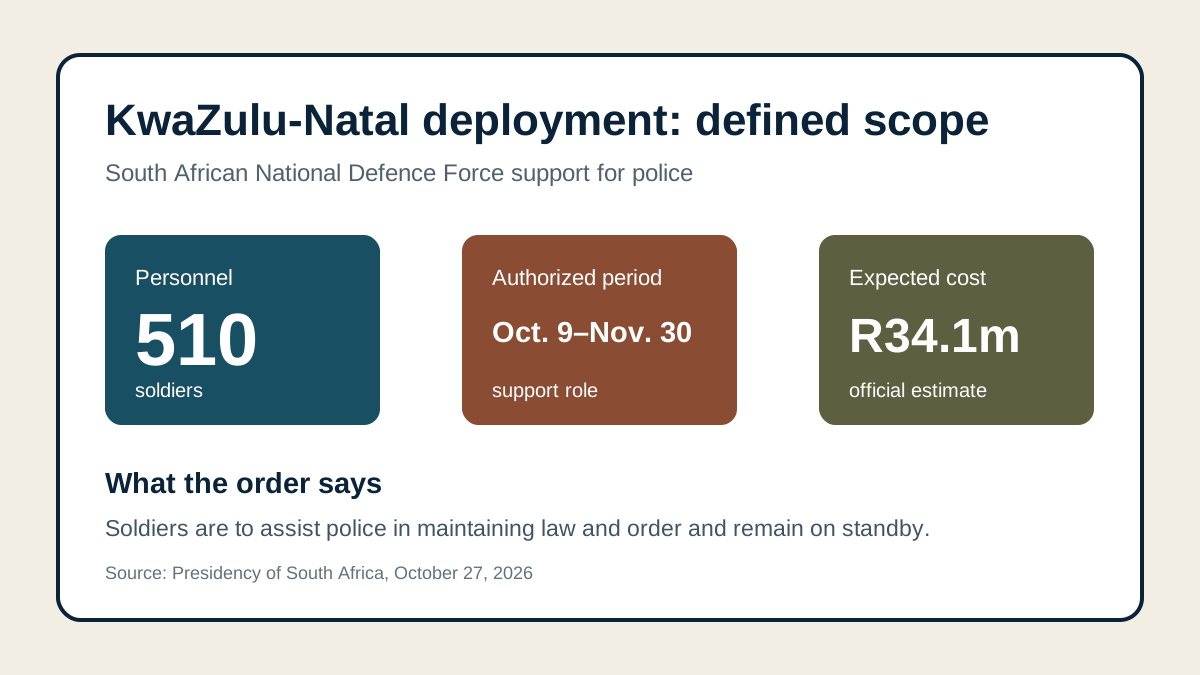
Verified baseline
President Cyril Ramaphosa authorized 510 members of the South African National Defence Force to support police in KwaZulu-Natal under Operation Prosper, the presidency announced Tuesday. The authorization runs from October 9 through November 30 and carries an expected cost of 34,082,720 rand, about $2 million.
The order says soldiers will assist the South African Police Service in maintaining law and order and remain on standby. It cites recent violence arising from misinformation about a Constitutional Court judgment on the Refugees Act. The presidency notified both houses of Parliament and invoked Section 201(2)(a) of the Constitution.
What happened before the deployment
Anti-immigrant protests in KwaZulu-Natal and Gauteng turned violent this month. The Associated Press reported that shops owned by foreign nationals were looted in Durban and that police said a foreign national was beaten to death by a crowd during a march. Reuters reported that vehicles were torched and thousands of African foreign nationals had fled South Africa amid months of demonstrations.
Those reports provide context, but responsibility for individual crimes belongs to the people who committed them and must be established through investigation and due process. Legal immigration status, nationality or participation in a peaceful protest is not evidence of criminal conduct.
What the asylum judgment actually says
In July, the Constitutional Court unanimously ruled that asylum seekers cannot be excluded from a merits-based refugee determination solely because of procedural violations such as entering outside a designated port or missing a reporting deadline. The court grounded its decision in non-refoulement—the protection against returning someone to persecution or serious harm before a claim is properly decided.
The judgment did not grant every applicant refugee status, erase all immigration enforcement or prevent the government from rejecting claims after an individual assessment. Claims that it automatically legalized all undocumented migration misstate the ruling.
Why the timing matters
The deployment continues through South Africa’s November 4 local elections. That overlap raises legitimate questions about proportionality, political neutrality and civilian oversight, but it does not by itself prove electoral interference. Soldiers have previously supported police under Operation Prosper against gang violence and illegal mining.
For residents and businesses, the immediate practical effects may include a larger security presence, temporary access controls around demonstrations and faster police reinforcement. People should rely on official police and municipal notices for closures or safety instructions, and should not circulate unverified claims about migrants, court orders or troop activity.
Fact, analysis, forecast and opinion
Verified fact: 510 soldiers are authorized to support police in KwaZulu-Natal through November 30 at an expected cost of R34.1 million. Analysis: the deployment increases state capacity during a tense election period while making clear rules, restraint and oversight more important. Forecast: the troop presence may deter some violence, but there is not enough evidence to predict whether protests or attacks will decline. Opinion: Health Politics Daily supports equal protection, lawful peaceful protest and transparent accountability for any abuse by protesters, police or soldiers.
Bias Lens: security response, migrant protection and election timing
Verified baseline: the presidency authorized a time-limited support deployment after violence it linked to misinformation. The Constitutional Court required merits-based consideration of asylum claims; it did not eliminate immigration law.
A meaningful left-center-right comparison was not available across responsible, directly relevant reporting at publication, so this lens does not force ideological symmetry. The presidency emphasizes maintaining order and its constitutional authority. Reuters foregrounds the anti-migrant protests, violence and election timing. AP adds the death, looting and history of military support to police, while SABC centers the official operational details.
These are differences in source role and emphasis, not competing versions of the order. The official notice establishes authorization; independent reporting supplies consequences and context; the court record establishes what the asylum judgment means.
What remains uncertain
The presidency has not publicly detailed the soldiers’ locations, equipment, rules for crowd-control support or specific measures for protecting peaceful demonstrators and foreign nationals. The effect on public safety, protest activity and voter access cannot yet be measured. Investigations and court proceedings, not generalized claims about communities, must determine responsibility for violence.
Principal sources
- Presidency of South Africa — deployment authorization
- Constitutional Court — judgment and media summary
- Reuters — violence, displacement and election context
- Associated Press — local impact and Operation Prosper context
No suitable directly relevant official or publisher-authorized video with clear downstream embedding permission was available, so no video was embedded.