International politics · West Bank · Civilian movement
Hebron Closures Displace Hundreds of Families After Attack Kills Two Israeli Soldiers
Israeli forces closed roads into Hebron and ordered residents from several neighborhoods after two Palestinian gunmen killed two soldiers. The attack is verified; the operation’s duration and full civilian impact are not yet known.
By Health Politics Daily News Desk · October 24, 2026 at 8:02 a.m. ET
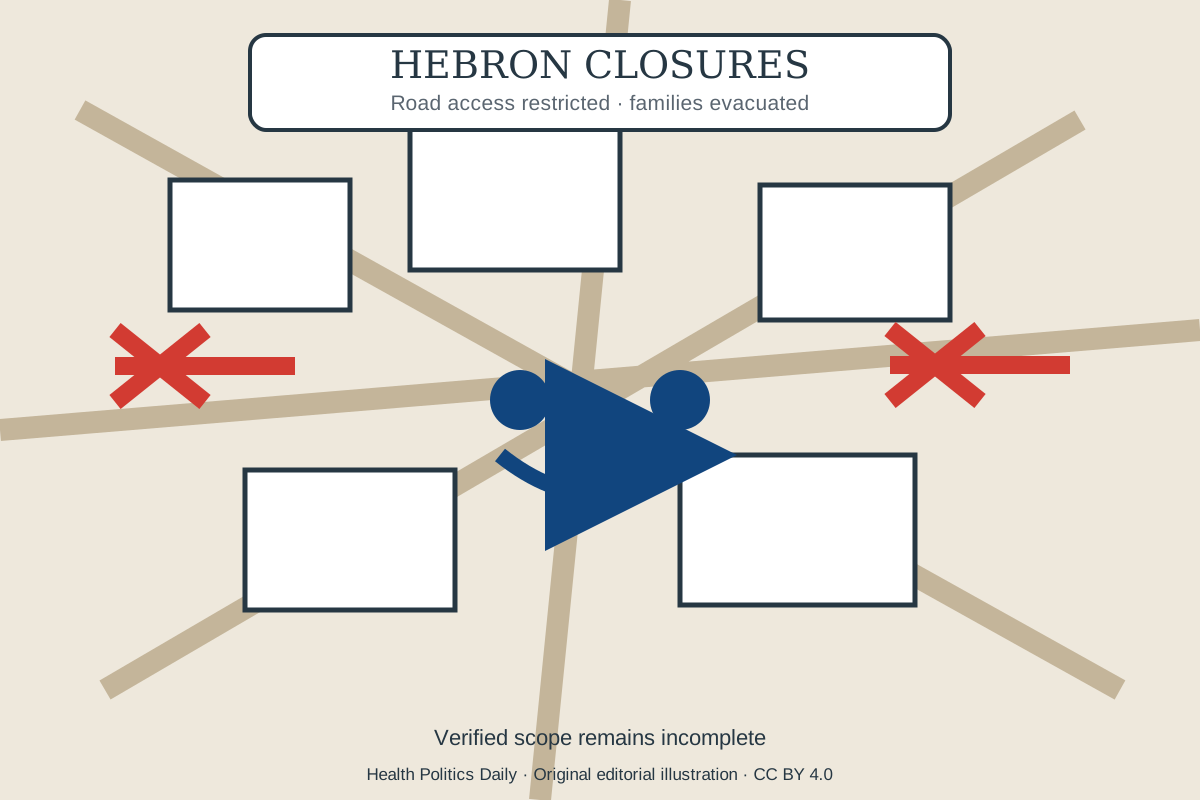
Verified baseline
Two Palestinian gunmen killed two Israeli soldiers and wounded three others near Hebron on Friday before Israeli troops killed both attackers, according to the Israeli military and reporting by Reuters and the Associated Press.
By Saturday, gates leading into and out of Hebron were closed to vehicles. AP reporters observed residents crossing on foot and an evacuated home being used by soldiers. Hebron’s municipality counted up to 300 families who had left Deir Baha and two neighboring areas. The Israeli military said it was conducting targeted searches but did not answer AP’s questions about the reported evacuations.
What the closures mean for residents
Vehicle closures can interrupt work, school, medical appointments, food deliveries and emergency response even when pedestrians can pass. Families forced to leave also need temporary shelter, medication and access to belongings. The municipal count is an early operational figure, not a final displacement total.
Hebron is the largest Palestinian city in the occupied West Bank and includes areas under different Israeli and Palestinian administrative arrangements. Security restrictions around the city can therefore affect both urban neighborhoods and surrounding villages.
Israel’s stated security rationale
Prime Minister Benjamin Netanyahu said forces would search homes, seize weapons and dismantle militant infrastructure in the attackers’ neighborhood. Israeli officials described the measures as a response to the deadly attack and preparation for a broader operation.
That stated purpose does not establish that every evacuated family or blocked road has a connection to the attackers. The identity of any alleged accomplices, the evidence supporting individual arrests and the criteria for returning residents had not been publicly detailed.
Legal and political context
United Nations Secretary-General António Guterres expressed alarm over sweeping closures and displacement after the attack. Under international humanitarian and human-rights law, security operations must distinguish individuals from the wider population and consider necessity and proportionality. Whether particular orders or demolitions violate those rules depends on facts that remain disputed and may require independent review.
The operation began days before Israel’s October 27 election, where security policy is a central issue. Timing is relevant political context, but it does not by itself prove that military decisions were made for electoral reasons.
Fact, analysis, forecast and opinion
Verified fact: two soldiers and both gunmen were killed; vehicle access was closed and the municipality reported up to 300 families leaving affected areas. Analysis: the operation combines a search for weapons and suspects with measures affecting many residents not publicly accused of involvement. Forecast: displacement and travel disruption may grow if closures widen, but no reliable end date was announced. Opinion: Health Politics Daily takes no position on the conflict; official security claims and Palestinian civilian-impact accounts should both be tested against observable evidence.
For regional context, read our reporting on the deadly church attack in Jordan and expanding Gulf maritime threats.
Bias Lens: targeted security operation or collective punishment?
Verified baseline: Palestinian gunmen killed two Israeli soldiers; Israel responded with searches and broad movement restrictions, and Hebron’s municipality reported hundreds of families leaving affected neighborhoods.
Center coverage — Associated Press and Reuters: AP leads with the closures and observed civilian disruption, while Reuters emphasizes the attack and Netanyahu’s threatened operation. Left-leaning coverage — The Guardian: foregrounds legal criticism and calls the measures collective punishment. Reliable right-leaning coverage adding materially distinct verified reporting was not available at publication, so this lens does not force a three-way symmetry.
What remains uncertain
Authorities had not published the operation’s duration, geographic limit, arrest total or return conditions. The number of displaced families may change, and claims about planned demolitions or a wider West Bank offensive were not yet matched by a complete operational order available to the public.
Principal sources
- Associated Press — closures, observations and municipal displacement count
- Reuters — attack and Israeli response
- United Nations — secretary-general’s response
No suitable directly relevant official or publisher-authorized video with clear embedding permission was available, so none was embedded.