Finance · Artificial intelligence · Technology
SpaceX Commits to Roughly $40 Billion Apollo GPU Finance Lease
An Apollo-managed entity would buy GPUs and related equipment and lease them to SpaceX. The commitment is binding, but the transaction has not yet closed and equipment deliveries are expected to begin in 2027.
By Health Politics Daily News Desk · October 27, 2026 at 4:04 a.m. ET

Watch in this article
Pumpjack operating at the Kern River Oil Field
A short CC0 field video provides visual context for reporting on oil production and fuel supply.
Thomas Farley / Wikimedia Commons · CC0 1.0 · License and source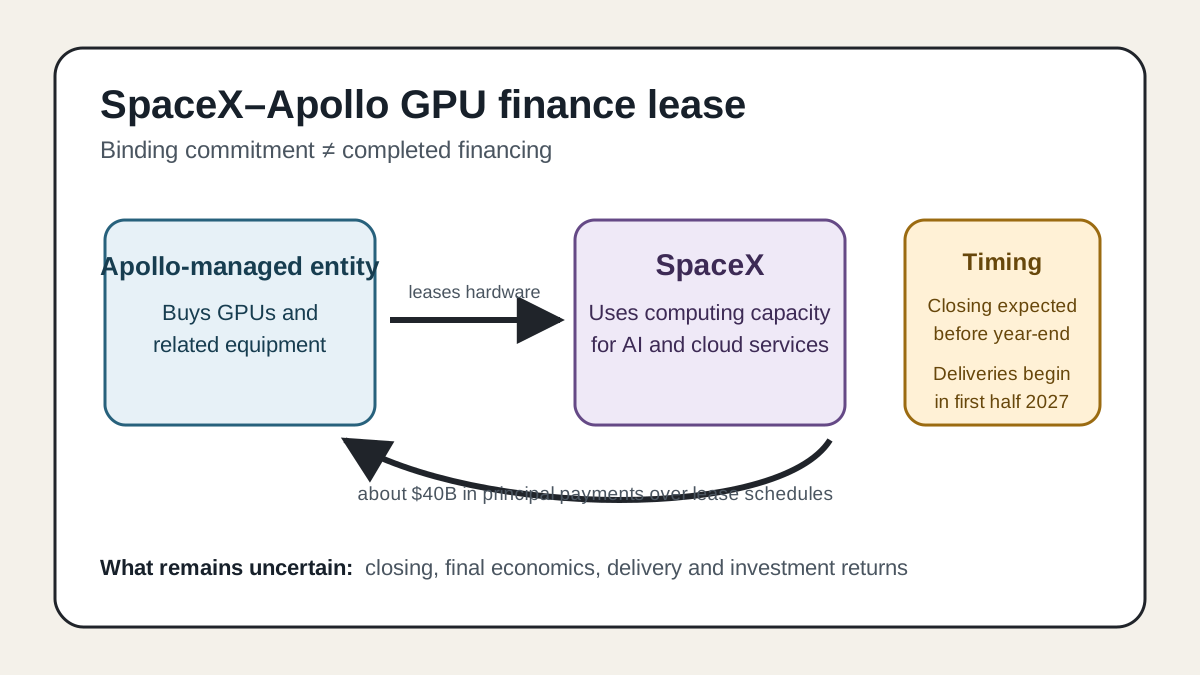
Verified baseline
SpaceX said on October 26 that it reached a binding commitment to enter an approximately $40 billion master finance lease for graphics processors and related equipment with an entity managed by Apollo Global Management.
Apollo's announcement says the transaction remains subject to specified closing conditions and is expected to close before the end of 2026. Lease schedules are expected to begin when equipment is delivered in the first half of 2027. A commitment is therefore not the same as completed funding or installed computing capacity.
How the finance lease works
The Apollo-managed entity would purchase GPUs and associated server equipment, then lease those assets to SpaceX. Reuters reported that individual leases would run slightly more than five years from equipment delivery and that principal payments across the arrangement total about $40 billion.
A finance lease spreads payments over time while giving the user long-term control of equipment. It is economically different from SpaceX paying the entire purchase price upfront, but it still creates a large contractual obligation. The $40 billion figure describes principal payments under the planned lease structure, not new revenue or cash already received by SpaceX.
Why it matters
AI training and cloud services require expensive processors, servers, power and cooling. SpaceX says the financing will expand computing capacity used for Grok and cloud customers while diversifying its funding sources. The company also operates Starlink and launch businesses, giving lenders revenue streams beyond AI infrastructure.
SpaceX Chief Financial Officer Bret Johnsen said the company is seeing payback periods of less than one year on recent AI infrastructure investments. That is a company assessment, not a guaranteed future return. Equipment utilization, customer demand, electricity constraints, pricing and technological obsolescence could all change the economics.
Practical implications for investors and the AI market
For SpaceX shareholders, the arrangement may accelerate expansion without an immediate common-stock sale, but lease liabilities and future payments still affect financial flexibility. Investors should evaluate the final filed terms, delivery schedule and cash-flow effects rather than treat the headline amount as completed capital spending.
For the wider AI market, the transaction shows how private-credit and asset-finance structures are being used to fund equipment at a scale once associated mainly with factories, aircraft or energy projects. It also concentrates risk: the lessor depends on the equipment retaining value, while SpaceX depends on demand and pricing remaining strong enough to cover payments.
Fact, analysis, forecast and opinion
Verified fact: SpaceX and an Apollo-managed entity announced a binding commitment for an approximately $40 billion master finance lease, subject to closing conditions. Analysis: the structure broadens SpaceX's access to capital while converting hardware purchases into multi-year obligations. Forecast: closing, delivery, utilization and returns remain uncertain. Opinion: Health Politics Daily favors clear disclosure of AI-financing dependencies and does not recommend any security.
Bias Lens: financing milestone, unfinished deal or AI-debt risk?
Verified baseline: the commitment is binding, but closing conditions remain and the first lease schedules are expected to begin with equipment delivery in 2027. The announced $40 billion is not proof that all hardware has been purchased or deployed.
Left-leaning coverage: The Guardian places the deal within a day of enormous AI fundraisings and highlights the distinction between claims that financing was “closed” and the disclosed commitment. Center wire coverage: Reuters foregrounds the lease mechanics, delivery timetable and SpaceX's capital spending. Right-leaning coverage: the New York Post's adjacent SpaceX coverage emphasizes rapid revenue growth and management's expansion case rather than the Apollo transaction itself.
Those differences reflect story selection and emphasis, not separate sets of transaction facts. The Post item is contextual rather than direct deal coverage, so it should not be treated as a symmetrical account of the lease.
What remains uncertain
The parties have not publicly demonstrated that all closing conditions are satisfied. Final economics, equipment specifications, delivery timing and the allocation of residual-value risk may become clearer in filings or closing documents. Even after closing, the central question will be whether new computing capacity produces enough durable revenue and cash flow to justify the multi-year obligation.
Principal sources
- SpaceX — financing announcement
- Apollo Global Management — transaction statement
- Reuters — lease mechanics and business context
- Associated Press — market context
No suitable official or publisher-authorized video with clear downstream embedding permission was available, so no video was embedded.