Finance · Artificial intelligence · Technology
Meta Plans Up to $95 Billion in Stock Sales to Fund AI Expansion
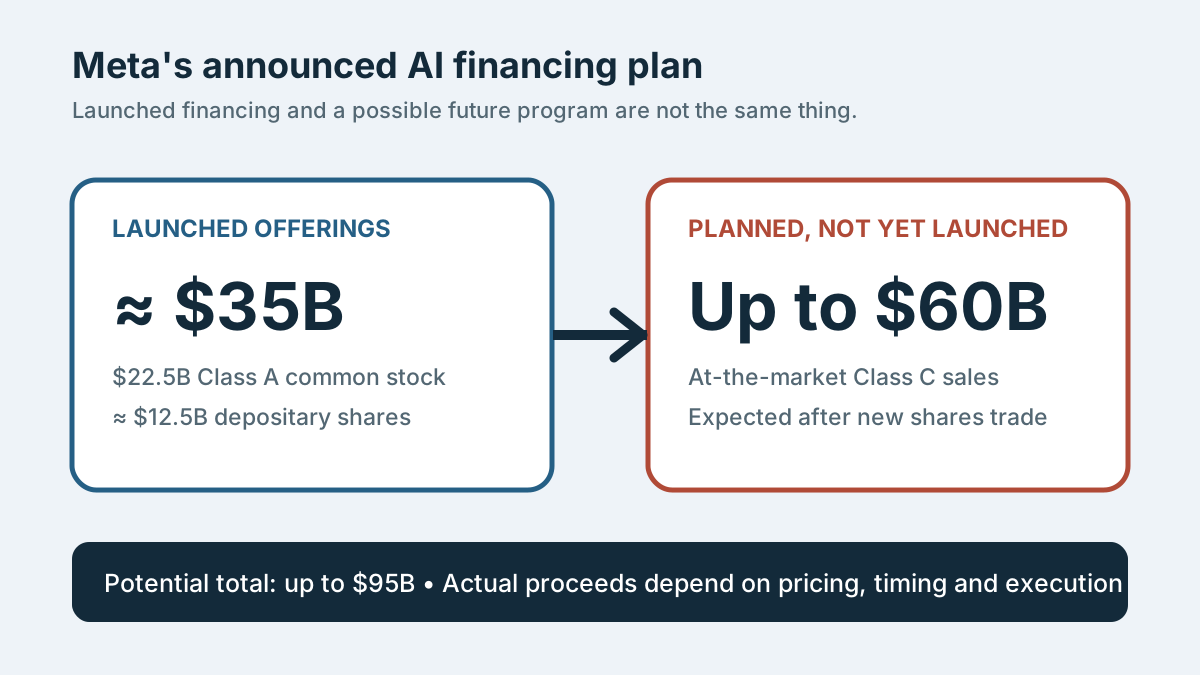
The Facebook parent launched about $35 billion in common and preferred equity offerings and outlined a separate future program of up to $60 billion. The maximum headline figure is not money already raised.
By Health Politics Daily News Desk · October 27, 2026 at 2:00 a.m. ET

Verified baseline
Meta announced concurrent underwritten offerings totaling about $35 billion: $22.5 billion of Class A common stock offered through forward-sale arrangements and approximately $12.5 billion of depositary shares representing mandatory convertible preferred stock.
The company also said it intends to establish an at-the-market program of up to $60 billion after its new nonvoting Class C shares begin trading, expected in the first quarter of 2027. That later program has not launched, and Meta is not obligated to sell the full amount.
How the financing is structured
The common-stock transaction uses forward-sale agreements. Financial institutions borrow and sell shares to underwriters now; Meta expects to receive proceeds when it later settles the agreements, subject to pricing adjustments and other terms. The SEC prospectus filing contains the detailed offering documents.
The depositary shares represent fractional interests in mandatory convertible preferred stock. Unless converted earlier, that preferred stock is designed to convert into common shares under specified conditions. The final dividend rate, conversion terms and market pricing determine the economics for purchasers.
The planned at-the-market program would let Meta sell shares gradually at prevailing market prices rather than in one fixed block. “Up to $60 billion” is a ceiling, not a forecast of actual proceeds.
Why Meta is raising equity
Meta has sharply increased spending on data centers, chips and computing capacity for artificial intelligence. Its third-quarter results put 2026 capital expenditures at $135 billion to $145 billion. The company reported $82.45 billion in cash, cash equivalents and marketable securities at September 30.
Reuters reported that Meta generated negative free cash flow of $2.12 billion in the third quarter, its first quarterly cash burn in more than a decade. Equity financing gives the company additional capacity without relying solely on operating cash flow or new debt.
What this means for shareholders
Issuing additional common shares can dilute an existing investor's percentage ownership and earnings per share unless business growth offsets the larger share count. Preferred securities can create future common shares through conversion and may carry dividend obligations. Actual dilution will depend on how much Meta sells, the prices received and the conversion terms.
The Class C shares are designed without voting rights. That structure can raise capital while limiting changes to voting control, but it also separates economic ownership from governance power. Investors should evaluate the filed terms and their own circumstances rather than treat the $95 billion maximum as a recommendation to buy or sell.
Supplier interest and circular-financing questions
Meta said Nvidia, AMD and Broadcom expressed nonbinding interest in buying an aggregate of up to $5 billion of the Class A offering at the public price. Interest is not a completed purchase. Because those chipmakers also sell hardware used in AI data centers, their possible participation has prompted questions about whether suppliers are helping finance a major customer's expansion.
That relationship does not by itself prove artificial demand or improper conduct. The relevant questions are whether investments close on disclosed terms, whether Meta's spending produces durable revenue and whether financial dependencies are explained clearly.
Fact, analysis, forecast and opinion
Verified fact: Meta launched about $35 billion of offerings and described a separate future program of up to $60 billion. Analysis: the plan shows that even a highly profitable technology company is broadening its financing sources to support unusually capital-intensive AI development. Forecast: the eventual proceeds, dilution and returns remain unknown because pricing, execution and future AI demand can change. Opinion: Health Politics Daily favors clear disclosure of financing relationships and does not recommend any security.
Bias Lens: strategic investment, dilution risk or AI spending race?
Verified baseline: approximately $35 billion of offerings have launched; the separate $60 billion program is planned but not yet active. The combined $95 billion is a maximum potential amount, not cash already received.
Left-leaning technology coverage: The Verge emphasizes the nonvoting share structure, rising AI costs and preservation of Mark Zuckerberg's control. Center wire coverage: Reuters foregrounds financing scale, cash burn and possible supplier participation. Right-leaning coverage: the New York Post stresses the size of the spending push and investor concern.
The differences are primarily about emphasis: corporate control, financing mechanics or spending risk. None changes the filed transaction structure, and political labels do not substitute for evaluating each report's evidence.
What remains uncertain
Meta had not finalized all pricing and timing when the offerings were launched. The company may use less than the full at-the-market authorization, and market conditions could change the number of shares sold. It is also too early to know whether higher AI-related revenue will justify the capital spending or whether competitors and suppliers will alter their own financing plans.
Principal sources
- Meta — offering announcement and structure
- SEC EDGAR — prospectus filings
- Meta — third-quarter financial results
- Reuters — financing context and market response
No suitable official or publisher-authorized video with clear downstream embedding permission was available, so no video was embedded.