Finance · Energy · U.S. natural gas
EQT Agrees to Buy Range Resources in $50 Billion-Plus Gas Deal
The all-stock agreement would create a much larger Appalachian producer, but regulators and both companies’ shareholders still must approve it.
By Health Politics Daily News Desk · October 26, 2026 at 8:01 a.m. ET

Watch in this article
Pumpjack operating at the Kern River Oil Field
A short CC0 field video provides visual context for reporting on oil production and fuel supply.
Thomas Farley / Wikimedia Commons · CC0 1.0 · License and source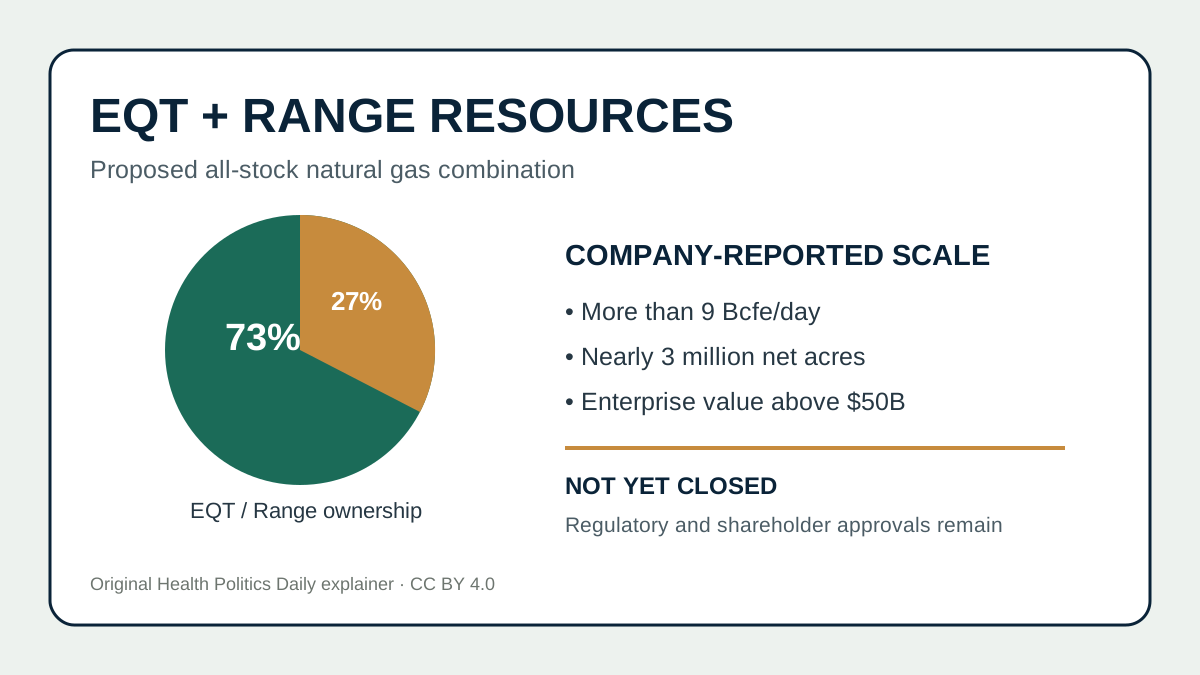
Verified baseline
EQT and Range Resources said Monday that they signed a definitive agreement for EQT to acquire Range in an all-stock transaction. Each Range share would be exchanged for 0.987 EQT shares. Existing EQT shareholders are expected to own about 73% of the combined company and Range shareholders about 27%.
The companies place the combined enterprise value above $50 billion. Reuters calculated Range’s equity value at about $12.83 billion, based on outstanding shares, and an implied offer price of $54.91 per share—about 20.6% above Range’s Friday close. Enterprise value includes debt and is not the same as the amount paid directly to shareholders.
What the combined company would look like
The companies say the combined business would produce more than 9 billion cubic feet equivalent of natural gas per day, control nearly 3 million net acres in the Appalachian Basin and operate more than 3,700 miles of midstream infrastructure. EQT’s management would lead the business from Canonsburg, Pennsylvania.
Those scale figures are based on company disclosures. The deal has not closed, and projected performance should not be treated as an accomplished result.
Why it matters
The agreement concentrates more Appalachian gas production and transportation infrastructure under one company as producers anticipate stronger demand from liquefied-natural-gas exports, power generation and data centers. Scale may lower some operating and marketing costs, but it can also increase regulatory scrutiny over competition, infrastructure access and regional market power.
EQT forecasts $325 million in annual savings within two years and approximately $20 billion of cumulative free cash flow over five years at recent market pricing. Those are forward-looking estimates that depend on integration, commodity prices, production performance and financing conditions.
Practical implications
Range shareholders would receive EQT stock rather than cash, so the eventual value of the consideration will move with EQT’s share price. Shareholders of both companies will vote, and regulators must grant required clearances. The companies target a first-quarter 2027 closing, but timing can change or the transaction can fail.
For households and businesses, a merger announcement does not by itself determine natural-gas bills. Retail prices also reflect weather, storage, pipeline constraints, utility regulation, export demand and local distribution costs. This report does not provide individualized investment advice.
Fact, analysis, forecast and opinion
Verified fact: the boards approved and signed an all-stock merger agreement with a 0.987 exchange ratio. Analysis: the combination would deepen EQT’s control of production and midstream assets in the Appalachian Basin. Forecast: projected savings and cash flow may not materialize at the stated level or timetable. Opinion: Health Politics Daily takes no position on the securities and favors a transparent review of competition and consumer effects.
Bias Lens: scale, price and deal risk
Verified baseline: the companies signed an agreement; the transaction remains subject to shareholder votes, regulatory clearances and other closing conditions.
Center-oriented wire coverage: Reuters emphasizes the exchange ratio, market reaction, production scale and demand from data centers. Center-right business coverage: The Wall Street Journal foregrounds the nearly $13 billion equity value, premium and shareholder economics. Left-leaning comparison: no major left-leaning outlet had published a directly comparable original report at publication time. Rather than force political symmetry onto a corporate filing, this lens identifies the gap. The company release is a primary source for terms, but its claimed benefits are advocacy for the transaction.
What remains uncertain
Regulators have not announced their conclusions, shareholders have not voted and the companies have not yet integrated operations. The eventual value transferred to Range holders, any remedies demanded by regulators, realized savings, employment effects and consumer impact remain uncertain.
Principal sources
- EQT and Range Resources — joint transaction announcement and conditions
- Reuters — valuation calculation, market reaction and industry context
- Financial Times — transaction scale and approval context
The companies scheduled an investor webcast, but it is promotional investor material rather than an independently reported video. No video was embedded.