Health · Finance · Drug development
Merck KGaA Agrees to Buy Silence for $1.3 Billion; Divesiran Remains Experimental
The October 19 agreement backs a rare-blood-cancer drug developer. What the deal means, why two valuations appear and what patients still need to know.
By Health Politics Daily News Desk · October 19, 2026 at 10:08 a.m. ET
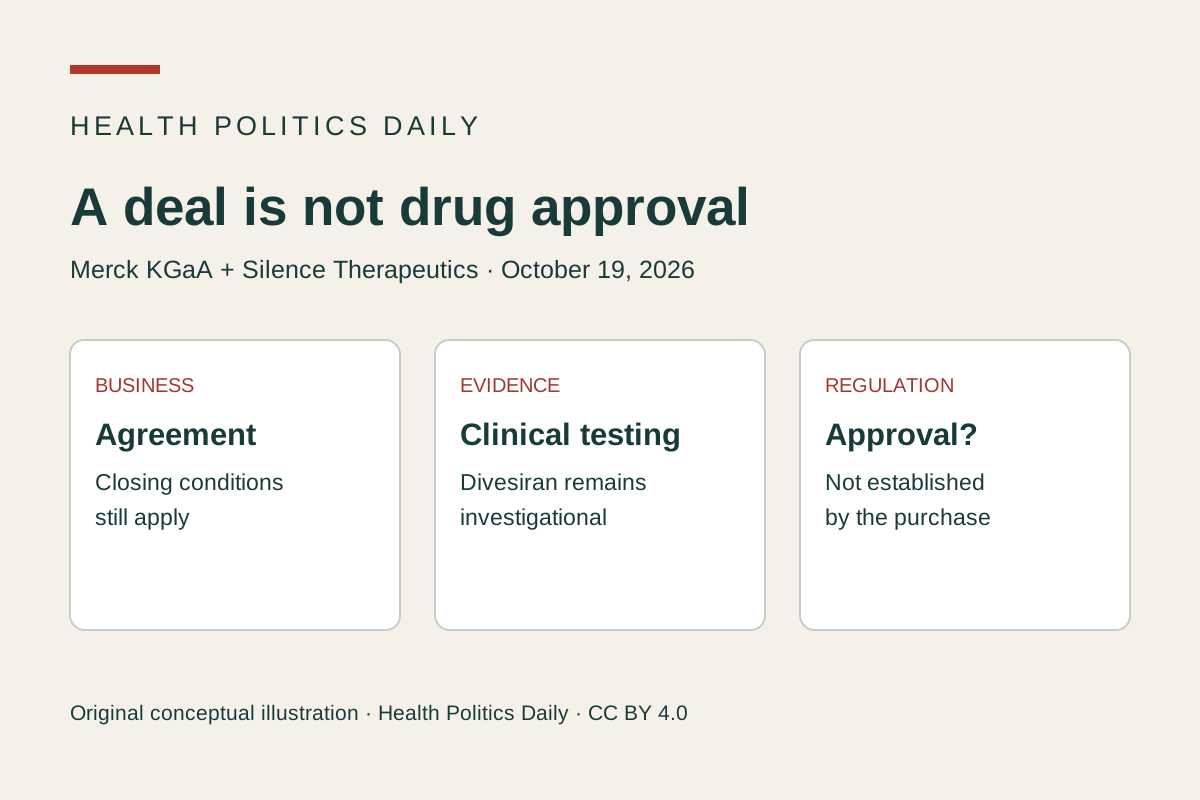
Germany’s Merck KGaA agreed on October 19 to acquire London-based Silence Therapeutics in a cash transaction with an approximately $1.3 billion equity value. The proposed purchase gives a larger pharmaceutical company a route to an experimental treatment for polycythemia vera, but it does not make that medicine approved or available through ordinary prescribing.
What has been agreed—not completed
Silence’s announcement sets the cash consideration at $20 per American depositary share, each representing three ordinary shares. Completion is expected in the first quarter of 2027, conditional on shareholder and regulatory approvals, court sanction and other closing requirements. That timetable is an expectation, not a completed transaction.
The buyer is Merck KGaA of Darmstadt, not the separate U.S. company Merck & Co. The German group says new debt will fund the acquisition.
Why both $1.1 billion and $1.3 billion appear
The companies report an enterprise value of $1.1 billion and an equity value of approximately $1.3 billion. These are different measures, not necessarily conflicting accounts of the same price. Equity value concerns shareholders’ stake; enterprise value generally also adjusts for items such as debt and cash. This report does not independently reconstruct those adjustments.
Silence says the offer is 130% above its October 16 closing ADS price and 82% above its 30-day volume-weighted average. The comparison period explains the different premiums. Neither percentage predicts the deal’s completion or future investment returns.
The patient stake: fewer treatment visits, if evidence holds
The National Cancer Institute’s patient guide explains that polycythemia vera involves excess red blood cells and can increase clotting risks. Treatment can include phlebotomy—removing blood to reduce excess cells—and medicines. Repeated procedures make the burden of treatment relevant alongside laboratory measurements.
Merck identifies divesiran as the lead acquisition asset. The investigational siRNA treatment targets TMPRSS6, aiming to alter iron regulation and limit the iron available for red-cell production. The intended effect is not the same as an established clinical benefit for every patient.
What the trial results do—and do not—show
In its August 10 trial release, Silence described a randomized, blinded, placebo-controlled Phase 2 study involving 48 phlebotomy-dependent patients. It reported an 88% response rate for divesiran versus 19% for placebo. Response concerned avoiding phlebotomy and maintaining hematocrit below 45% during weeks 18–36; it was not a cancer-cure rate.
The company reported two investigator-assessed Grade 1 anemia cases and no new safety findings. These are sponsor-reported topline results from a small study, not a guarantee of long-term safety. Silence’s August plan anticipated a Phase 3 trial beginning in the first half of 2027; that remains a forward-looking development milestone.
Analysis: A larger owner could provide development resources, but the purchase price does not validate a drug. Larger trials, regulatory assessment and eventual access decisions remain separate hurdles. The reviewed announcements establish neither a commercial launch date nor a patient price or coverage commitment.
For related evidence questions, see our Roche divarasib trial-preview report. Our India cancer-drug pricing explainer examines the separate issue of medicine affordability. Neither concerns the same drug.
Bias Lens: transaction value versus patient evidence
Verified baseline: There is an acquisition agreement with closing conditions, and divesiran remains investigational. Commercial enthusiasm is not regulatory approval.
Center—Reuters: Its report leads with the deal and gene-silencing pipeline. The Wall Street Journal’s news report similarly emphasizes price and the experimental rare-disease asset; its news coverage should not be equated with its right-leaning opinion pages.
Specialist framing—Fierce Biotech: Its coverage places more emphasis on clinical development and competition. This is a subject-focus difference, not evidence of a partisan dispute.
No directly relevant left-leaning and right-leaning pair was verified for this edition. We do not manufacture a three-way political comparison. Both companies have a financial interest in the transaction; their predictions require attribution and independent scrutiny.
What readers can conclude now
The ownership proposal is concrete; the medicine’s future is conditional. This article is general reporting, not a treatment recommendation or advice to buy, sell or vote securities. No suitable directly relevant authorized video was verified, so none is embedded or rehosted. The original illustration is licensed CC BY 4.0.