India · Medicine affordability
India Caps Trade Margins on 137 Cancer Drugs; New Prices Start November 9
The pricing authority’s order targets distribution mark-ups on identified cancer medicines. Reductions of up to 70% are an official expectation—not a uniform discount on every drug or an immediate change today.
By Health Politics Daily News Desk · October 18, 2026 at 8:03 a.m. ET
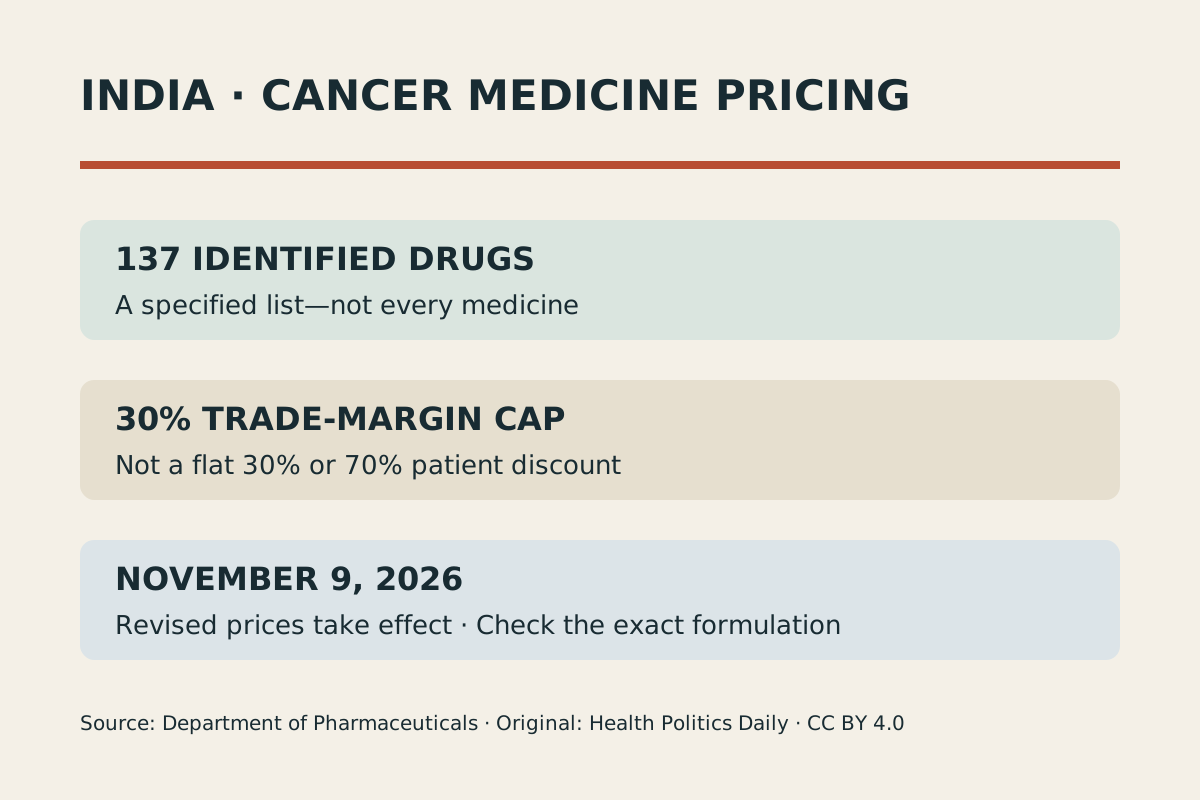
India has capped trade margins on 137 identified non-scheduled anti-cancer drugs, with revised prices due to take effect on November 9, 2026. The measure targets a component of medicine costs that can add to families’ financial burden during cancer care.
The Department of Pharmaceuticals’ October 17 official release says the National Pharmaceutical Pricing Authority, or NPPA, set the margin at 30% of maximum retail price. It expects reductions of up to 70%, depending on existing price structures. Reuters reported the wider controls on October 18.
What the cap changes
This is a trade-margin intervention for a specified list, not an announcement that every cancer medicine has one new national selling price. “Non-scheduled” refers to formulations outside the usual scheduled-drug ceiling-price system, as Business Standard explains. The intervention uses Paragraph 19 of the Drugs (Prices Control) Order, 2013.
A margin expressed as a share of retail price is different from a mark-up on the distributor’s cost. The Indian Express’ examination of the notification explains the calculation and says an existing MRP below the calculated maximum must remain at that lower level. A maximum is not an instruction to raise a cheaper product’s price.
Why “up to 70%” needs qualification
Analysis: A ceiling on a distribution margin does not translate into the same percentage saving for every buyer. The result depends on the starting price and mark-up. It also does not mean that the whole cost of cancer treatment—consultations, diagnostics, procedures, travel and other care—falls by that percentage.
The Indian Express reports that access advocates welcome the intervention but question whether expensive patented medicines will become affordable for many patients. That is an assessment of the policy’s limits, not evidence that it has already failed or delivered its projected savings. The important test is the revised price for each covered formulation and what patients are actually charged after implementation.
Dates and price information to watch
The official release requires manufacturers to report revised prices to NPPA within seven days of the Gazette notification. Retailers and hospitals must apply the reduced prices from November 9 and display updated lists; hospitals must also publish them online. Consumers are directed to the NPPA website and Pharma Sahi Daam app to check prices.
Practical implications: When discussing a bill with the treating institution or pharmacy, the useful comparison is the exact medicine, strength, formulation, pack and effective price list—not a generic promise of a 70% discount. Keep the quotation or invoice so any discrepancy can be clearly described. This is a way to check pricing information, not advice to change a prescription or postpone treatment.
Supply and implementation remain part of the story
Business Standard reports that the notification requires production and supply levels to be maintained and provides for action on overcharging. A legal requirement and its enforcement are distinct from observed availability at an individual hospital.
Uncertainty: The full pattern of actual price reductions and access after November 9 is not yet measurable. This report does not provide a verified price for any particular brand, promise that a medicine is stocked locally, or forecast a household’s savings. The NPPA notification portal could not be retrieved directly during verification; the official departmental release and independent reporting on the notification provide the source basis, rather than a claim that we inspected every listed formulation.
Bias Lens: affordability claims versus implementation
Verified baseline: The order covers 137 identified drugs; November 9 is the stated implementation date. The maximum projected reduction is not a universal patient discount.
Reuters’ center-oriented report foregrounds the expansion of price controls. The Indian Express gives more attention to the calculation and remaining affordability barriers. Business Standard emphasizes regulatory mechanics, compliance and supply.
A meaningful, verified left-versus-right split was not established in the reviewed coverage. We do not turn different reporting priorities into opposing political camps or substitute the government’s own release for independent scrutiny. The useful question is whether a story separates an announced rule, a projected saving and an observed patient outcome.
Sources and media
Primary source: the Department of Pharmaceuticals’ October 17 release. Corroboration and implementation context: Reuters, The Indian Express and Business Standard, linked above. The image is original explanatory artwork, not a product label. No suitable directly relevant authorized video was verified; none is embedded.
Related Coverage
- India’s infant-food sugar proposal: why draft and effective rules differ
- U.S. pharmaceutical holdings and Medicare policy scrutiny — separate U.S. policy context, not a rule governing Indian prices.