HEALTH POLICY — DISCLOSURES — GOVERNMENT ETHICS
Trump Pharma Holdings Rose to as Much as $56.2 Million, Democratic Report Says
The Joint Economic Committee minority links the president’s disclosed holdings to drugmakers benefiting from expanded Medicare negotiation exemptions. The White House says Trump cannot direct the independently managed portfolio.
By Health Politics Daily News Desk · Published Friday, October 16, 2026 at 12:00 p.m. America/New_York · Approximately 8 minutes
Verified Baseline
The report analyzes public disclosures and Medicare policy
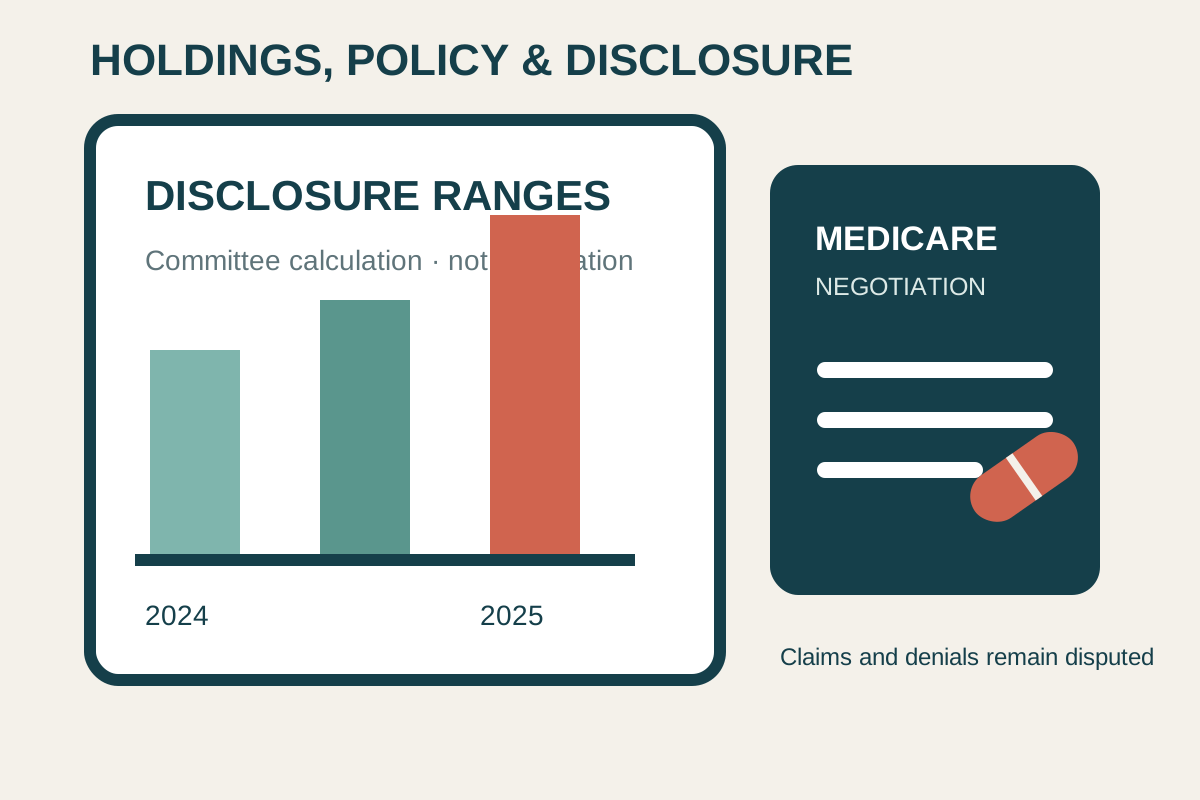
The Democratic staff of Congress’s Joint Economic Committee says the maximum reported value of President Donald Trump’s pharmaceutical stock holdings increased from $1.72 million in 2024 to $56.206 million at the end of 2025. Its five-page report says up to $39.1 million was held in companies with drugs benefiting from expanded exclusions from Medicare price negotiation.
Those figures are committee calculations using maximum values from disclosure ranges. They are not precise account balances, present-day valuations or proof that Trump personally selected a trade. The committee is controlled by Democrats in its minority arm, and its conflict-of-interest conclusion is a political and ethical allegation—not a court or agency finding.
The White House Response
The administration denies that Trump controls the investments
A White House spokesperson told the Associated Press that Trump’s stock and bond portfolio is independently managed by third-party financial institutions and that neither Trump nor his family can direct or influence purchases and sales. The White House denied a conflict of interest.
Independent management is central to the administration’s defense because ownership and trading control are different questions. The committee argues that continued ownership can still create an appearance of conflicting interests when government policy affects companies in the portfolio. Public documents cited so far do not establish that Trump ordered the identified transactions or acted on nonpublic information.
What the Medicare Rule Changed
The 2025 law broadened the rare-disease exclusion
Medicare’s negotiation program originally excluded drugs approved for a single rare disease or condition. The 2025 tax and spending law expanded that treatment, delaying or excluding negotiation for additional medicines. Supporters say the broader exclusion protects incentives to develop rare-disease therapies; critics say highly profitable drugs can avoid prices that would otherwise be negotiated downward.
The committee identifies 19 Part B and Part D drugs affected by statutory or related administrative carveouts. Its cost estimates for nine physician-administered medicines assume a 33% negotiated reduction based on averages from earlier rounds. That is a counterfactual estimate, not an invoice sent to every patient.
Why It Matters
Drug-policy benefits and personal holdings now overlap in public debate
The report says companies tied to the affected drugs recorded at least $54 billion in U.S. sales from those products in 2025. It also says Trump’s portfolio bought up to $2.55 million in shares of benefiting drugmakers on three dates before he signed the law and as much as $1 million in AbbVie shares afterward.
Analysis: the documented overlap creates a legitimate transparency question even without proof of personal trading control or corrupt intent. Disclosure ranges make the scale visible but also imprecise. Opinion: Health Politics Daily takes no position on wrongdoing; the relevant standards should be control, disclosure, recusal and documented policy rationale rather than assumptions based only on timing.
Practical Implications
The report does not immediately change anyone’s Medicare coverage
No medication lost coverage because of the report, and no beneficiary automatically owes the committee’s estimated annual increases. Actual out-of-pocket costs depend on the drug, coverage pathway, supplemental insurance and program rules. Medicare beneficiaries can compare current options during open enrollment and use official counseling resources, but should not stop or change treatment without a clinician.
The policy question is broader: drugs excluded or delayed from negotiation can cost Medicare and some patients more than they might under a negotiated price. That difference cannot be known precisely until eligibility, negotiated terms and utilization are established.
What Remains Uncertain
Current holdings, exact values and decision-making are not public
Financial disclosures report value bands rather than exact values. September 2026 transactions had not yet been disclosed when the committee completed its analysis. It also remains unresolved whether Congress will revisit the rare-disease provision or impose stronger presidential divestment and blind-trust requirements.
Forecast: the report is likely to intensify oversight demands and campaign scrutiny, but it does not itself trigger penalties or reverse Medicare policy. Any formal ethics, securities or criminal conclusion would require evidence and authority beyond a committee minority report.
Bias Lens: holdings, drug prices and ethics
The Democratic committee calculated that the maximum disclosed value of Trump’s pharmaceutical holdings rose sharply and overlapped with companies benefiting from Medicare negotiation exemptions. The White House says the investments are independently managed and denies a conflict.
Center coverage: AP presents the committee’s figures, the White House denial and competing arguments about rare-disease incentives. Left-leaning institutional framing: the Joint Economic Committee Democrats frame the overlap as profiteering and foreground projected patient costs. Right-leaning policy framing: Fox News, in related coverage of Medicare negotiation rules, emphasizes bipartisan concern that aggressive pricing policy can discourage improved cancer treatments.
The sources are not equivalent: one reports this investigation, one authored it and one provides the policy rationale favored by exemption supporters. Comparing them clarifies the dispute without implying that Fox independently validated or rebutted the committee’s calculations.
Principal Sources
Committee data, underlying policy and response
- Joint Economic Committee Democratic staff — full report and methodology
- Joint Economic Committee Democrats — release and headline calculations
- Associated Press — White House response and policy context
- CMS — Medicare Drug Price Negotiation Program
No suitable directly relevant official or publisher-authorized video with clear embedding permission was available.
Related Coverage