International politics · Ukraine · Humanitarian access
White House Says Oleshky Ceasefire Will Begin October 29 for Aid and Evacuation
The announced pause is limited to one Russian-controlled Ukrainian city and is intended to permit aid and prepare a safe passageway—not to halt the wider war.
By Health Politics Daily News Desk · October 23, 2026 at 9:57 a.m. ET
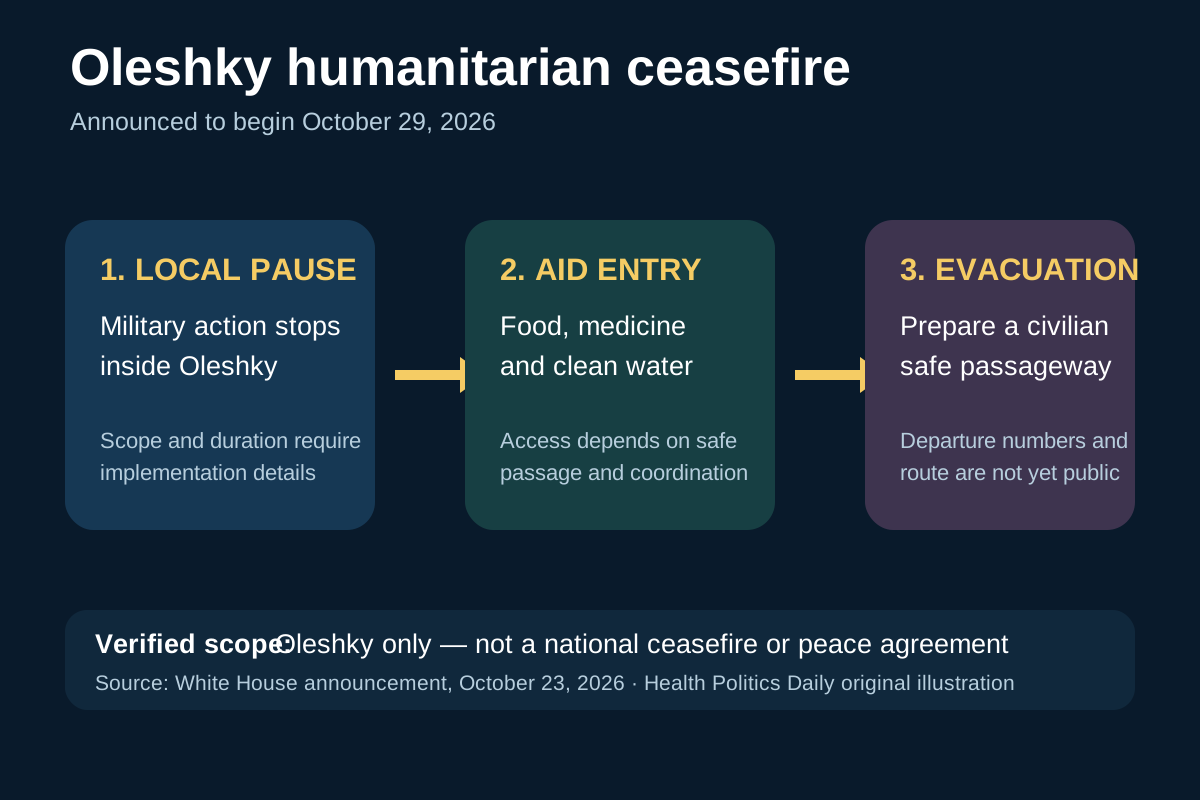
The White House said Russia and Ukraine have agreed to stop military action temporarily in Oleshky beginning October 29, allowing humanitarian aid into the occupied southern Ukrainian city and preparations for a civilian evacuation through a designated safe passageway.
The announcement credited first lady Melania Trump with securing the arrangement. Reuters independently reported the White House statement, but Russia and Ukraine had not immediately published their own detailed terms. The public statement did not specify the pause's duration, monitoring mechanism, route, number of civilians expected to leave or organizations that will operate the corridor.
Why Oleshky needs a humanitarian corridor
Oleshky lies in Ukraine's Kherson region and has been controlled by Russian forces since the full-scale invasion began in 2022. Reporting from the city has described severe shortages of food, medicine, clean water, electricity and heating, with many of the remaining residents elderly or medically vulnerable.
Ukraine, aid organizations and religious leaders had pressed for a localized pause to reach civilians. The announced agreement is narrower than the separate effort to restart U.S.-Russia-Ukraine negotiations: it addresses one humanitarian emergency and does not settle territorial control, security guarantees or the terms of a national ceasefire.
What the announcement changes—and what it does not
If implemented, the pause could create a safer window to deliver supplies, identify residents who want to leave and coordinate transport across a mined, actively contested area. It does not itself guarantee that aid will arrive, that every civilian can leave or that military activity outside Oleshky will stop.
Practical implication: families seeking information should rely on Ukraine's official coordination channels and participating humanitarian organizations once routes and timing are published. Unverified social-media evacuation instructions could expose civilians to mines, shelling, detention or fraud.
Fact, analysis, forecast and opinion
Verified fact: the White House announced a localized ceasefire scheduled for October 29 to permit aid and prepare an evacuation route. Analysis: the arrangement could be a meaningful humanitarian confidence-building measure even though it does not resolve the war. Forecast: successful implementation may help later local agreements, but there is not enough evidence to predict broader negotiations. Opinion: coverage should judge the announcement by whether aid reaches civilians safely, not by the prominence of the officials involved.
For wider context, see our reporting on Russia's agreement in principle to resume trilateral talks, Russian missile strikes during renewed diplomacy and the release of American Stephen Hubbard.
Bias Lens: diplomatic credit, civilian need and verification
Verified baseline: the White House says both countries agreed to a localized October 29 pause for aid and evacuation preparation. Public operational details and separate full statements from Moscow and Kyiv were not immediately available.
Left-leaning — Le Monde: foregrounds civilian deprivation and the effects of Russian occupation. Center — Reuters: leads with the White House announcement, its attribution to Melania Trump and the stated October 29 start. Center-right — The Times of Israel: presents the agreement as a concise diplomatic development. These frames emphasize different parts of the same event; none substitutes for public implementation terms from the parties and aid operators.
What remains uncertain
The parties have not publicly detailed how the pause will be monitored, who will guarantee the route, which aid organizations will participate or how civilians will cross lines of control. Fighting before October 29, a dispute over sequencing or new security conditions could change the plan. The number and condition of residents still inside Oleshky also remain difficult to verify independently.
Principal sources
- White House — localized Oleshky ceasefire announcement
- Reuters — announcement and Oleshky context
- Associated Press — earlier humanitarian negotiations and war context
No suitable directly relevant official or publisher-authorized video with clear embedding permission was available, so none was embedded.