Health policy · U.S. politics · Medical research
Trump Orders New NIH Women’s Health Division Within 90 Days
The October 19 order creates a White House task force and directs a new NIH division. Its deadline is concrete; funding and patient outcomes need scrutiny.
By Health Politics Daily News Desk · October 19, 2026 at 12:04 p.m. ET
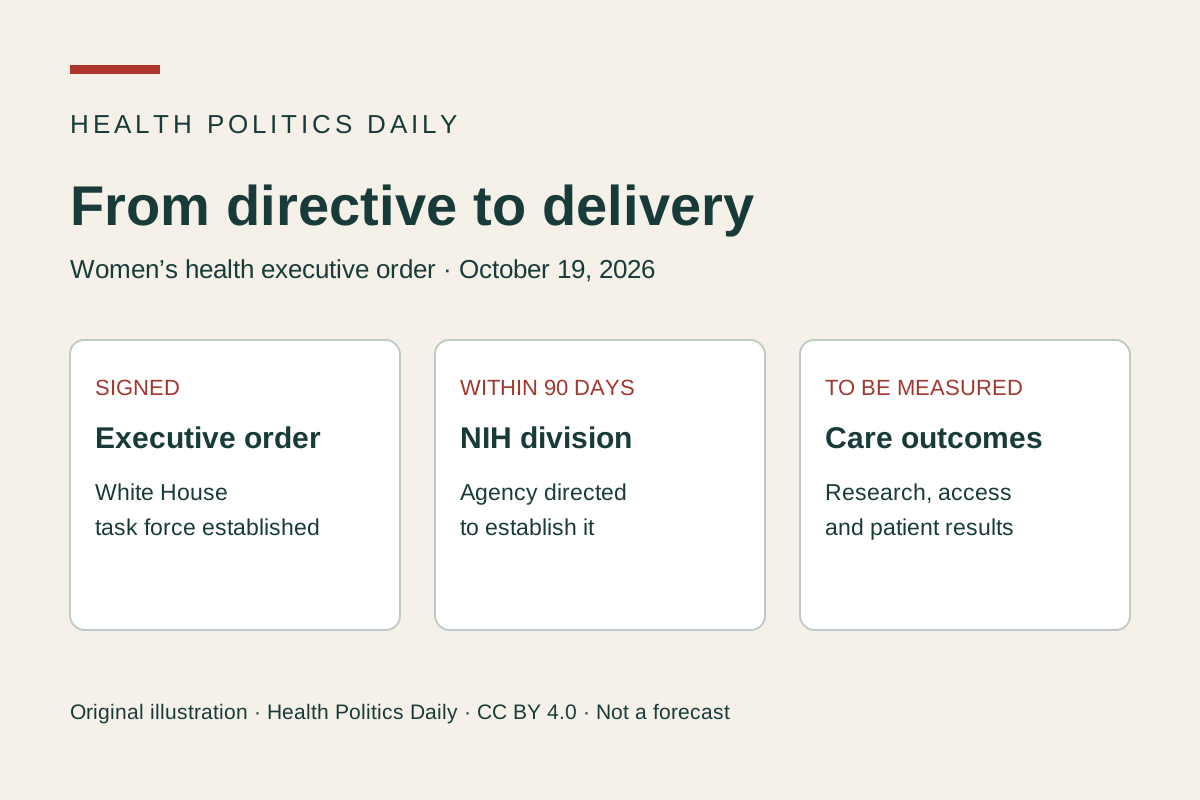
President Donald Trump signed an executive order on October 19 directing the creation of a Women’s Health Division at the National Institutes of Health within 90 days and establishing a White House Women’s Health Task Force. For women waiting for better evidence and care, the immediate change is a federal coordination directive—not a new treatment, insurance benefit or guaranteed research breakthrough.
What the signed order actually requires
The published executive order tells the health secretary, acting through the NIH director, to establish the division within an appropriate NIH institute or center. It does not name that host institution. The task force is co-chaired by the health secretary and White House chief of staff.
HHS’s announcement identifies those officials as Robert F. Kennedy Jr. and Susie Wiles and credits first lady Melania Trump with helping shape the initiative. It describes a lifespan approach, including maternal health, menopause and aging, rather than a program confined to reproductive health.
The existing women’s-health office is not disappearing
NIH already has an Office of Research on Women’s Health, established in 1990 and affirmed in statute in 1993. It works across NIH’s institutes and centers on research priorities, women’s inclusion in studies and sex-related differences in health.
The new division is directed to coordinate with that office. A new organizational label should therefore not be mistaken for the start of federal women’s-health research. The operational question is how the two bodies will divide responsibilities without duplicating work.
Why the research-to-care gap matters
ORWH explains that historical underrepresentation of women in clinical trials left evidence gaps: findings from male participants were sometimes used without sufficient evidence that they applied to women. That history makes study design and inclusion consequential, not merely administrative details.
HHS says the new division will address conditions including cardiovascular disease, cancer, autoimmune conditions, chronic pain, endometriosis, fibroids and osteoporosis. Its stated work includes better research methods, greater inclusion of women and girls in trials, collaboration across disciplines and moving findings into clinical practice.
Analysis: A useful test is whether research eventually changes timely diagnosis, access or outcomes—not simply whether a new office opens. For someone managing a chronic condition, an announcement matters only if it produces reliable evidence and usable services. This report does not infer that any particular treatment works because the administration prioritizes research into it.
Funding: a directive is not a new appropriation
The order makes implementation subject to available appropriations and assigns HHS the task force’s administrative costs. It does not specify a new research-funding total. AP’s advance report likewise noted the absence of specific funding goals.
Analysis: It would be premature either to count the announcement as a funded expansion or to conclude that no resources will follow. Watch for the host institute, leadership, staffing, grant notices and budget allocations. Those records will help distinguish changes in organization from changes in research capacity.
What happens to earlier initiatives?
The order revokes the March 18, 2024 women’s-health research executive order and the November 13, 2023 memorandum creating a White House initiative. The White House fact sheet presents this as broadening the effort beyond research toward clinical care. That is the administration’s rationale, not proof that the new structure will outperform its predecessor.
For related distinctions between a health announcement and delivered access, see our maternal and child health supply agreement report and Merck–Silence drug-development explainer. These are separate programs, not funding sources for this order.
Bias Lens: a new structure, not yet a measured result
Verified baseline: The signed text sets a 90-day division deadline, establishes a White House task force and retains coordination with the existing NIH office. Outcomes remain to be demonstrated.
Left-leaning—The Washington Post: Its accessible opening emphasizes the joint appearance and proximity to the midterms. This comparison is limited to that opening, not the inaccessible full report.
Center—Reuters: Its report explains the new bodies while placing the initiative alongside earlier administration research-funding and workforce decisions. That context raises implementation questions; it does not resolve the new effort’s outcome.
Right-leaning—New York Post: Its publicly retrievable headline and summary emphasize Melania Trump’s leadership and promised modernization. The full page was unavailable for this review, so no broader argument is attributed to it.
These are observations about specific accessible coverage, not fixed descriptions of publishers or readers. Election timing and policy ambitions can both be relevant; neither substitutes for the signed text, funding records or evidence of results. The task force is at the White House; the division is at NIH.
What patients and researchers should watch next
No new patient application process, benefit entitlement or treatment recommendation is established by this report. Researchers should look for actual agency notices before assuming a grant opportunity exists. Patients should not infer that the organizational deadline is a deadline for new care to become available.
The key uncertainties are the division’s placement and resources, its relationship with existing programs, and how results will be measured. Claims of faster cures or improved affordability remain goals until supported by evidence.
Sources and video
The signed order is the controlling primary text; HHS and the White House fact sheet describe the implementation plans. NIH provides institutional history; AP and Reuters supply independent reporting. AP’s publisher-hosted signing video page is linked rather than embedded: no protected footage is downloaded or rehosted. The original explanatory illustration is licensed CC BY 4.0.