Health policy · India · Infant nutrition
India Proposes Ban on Added Sucrose and Fructose in Infant Foods
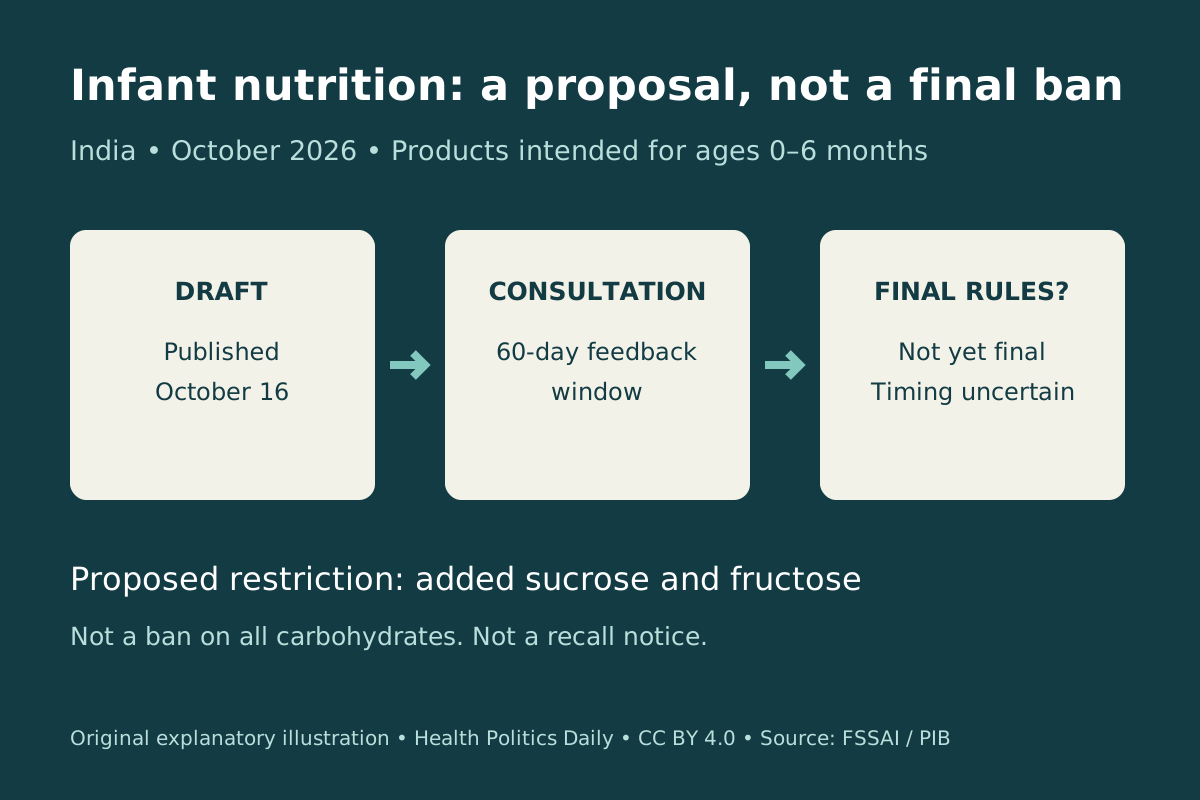
The draft covers products intended for infants up to six months. It opens a consultation, not an immediate recall or a ban on every carbohydrate.
By Health Politics Daily News Desk · October 17, 2026 at 4:05 p.m. ET
What happened
India’s food-safety regulator has proposed prohibiting added sucrose and fructose in food products intended for infants up to six months of age. The Health Ministry’s October 17 announcement says the draft amendment was published in the Gazette on October 16 and is open for public comments before finalisation.
The distinction matters for families reading headlines about a sugar “ban”: the Food Safety and Standards Authority of India, or FSSAI, has proposed a change to product-composition rules. This announcement does not itself say that a particular brand has been recalled or that every product currently on sale is unlawful.
What would change—and what would not
According to the ministry, existing rules prefer lactose and glucose polymers as carbohydrate sources. They allow sucrose or fructose when required, within prescribed limits. The proposal would add an age-specific prohibition on adding the latter two sugars. It is not a prohibition on all carbohydrates, nor does it apply the new restriction to every food marketed for older children.
The ministry describes reducing early exposure to added sugars and supporting healthy development as the policy’s aims. Those aims are not measured results from this amendment: there is no implementation outcome yet to evaluate.
The consultation and unresolved details
The draft, identified as notification RCD-09002/3/2026-Regulatory-FSSAI, inserts a proviso into regulation 3(6) of the 2020 infant-nutrition regulations. The published Gazette transcription specifies a 60-day comment window starting when Gazette copies are made publicly available. FSSAI must consider representations received in that period before finalising the amendment.
The ministry links the official Gazette PDF; that file could not be retrieved during our review, so the scope is checked against the ministry’s release and corroborating reporting rather than an independently downloaded PDF. The announcement does not establish a final commencement date or a detailed transition timetable for manufacturers. Consultation is an opportunity for feedback, not a guarantee that the wording will remain unchanged.
Why it matters for families and manufacturers
Analysis: The proposal’s practical importance is the formulation standard it could create for the youngest age group. Manufacturers would need to examine ingredients and age targeting if the restriction becomes final. Reformulation costs, changes to availability and any price effects remain uncertain; none should be treated as an announced consequence.
For caregivers, this is policy news rather than a reason to improvise a feeding change. Questions about an infant’s nutritional needs belong with a qualified health professional. The WHO’s general feeding guidance recommends exclusive breastfeeding for the first six months and complementary foods from six months, with continued breastfeeding. It also stresses support for families; a national product standard is not a personalised feeding plan.
Related policy questions include both nutritional quality and reliable access. Our coverage of WHO childhood-obesity guidance examines the wider prevention context; our maternal and child-health supply report addresses access to essential supplies.
Bias Lens: a shared factual baseline, different emphasis
Verified baseline: FSSAI has issued a draft restriction for two added sugars in products intended for infants up to six months, with consultation before finalisation.
Using Ground News’s broad outlet classifications as a navigation aid—not a verdict on individual articles—the left-leaning comparison is The Indian Express, the center comparison is Reuters, republished by MarketScreener, and the right-leaning comparison is The Times of India.
The Indian Express explains the formula-rule change and age boundary. Reuters places it within India’s wider food-safety enforcement and labelling debate. The Times of India foregrounds the proposed safeguard and comment process. These are differences in emphasis, not evidence of opposing positions on infant nutrition. All describe a proposal; none supplies evidence that the restriction is already a final, effective ban.
Sources and video
The primary announcement is the Health Ministry release via PIB; WHO supplies general health context. Reuters, The Indian Express and The Times of India corroborate the proposal. No suitable directly relevant video with clearly verified authorisation was identified, so none is embedded.