Global economy · Trade policy
Vietnam Signs EFTA Free-Trade Deal: Tariff Cuts Await Entry Into Force
Vietnam and four European countries signed a trade agreement on October 18. Exporters gain a clearer path to lower duties, but signing is not the start of every tariff reduction.
By Health Politics Daily News Desk · October 18, 2026 at 2:08 a.m. ET
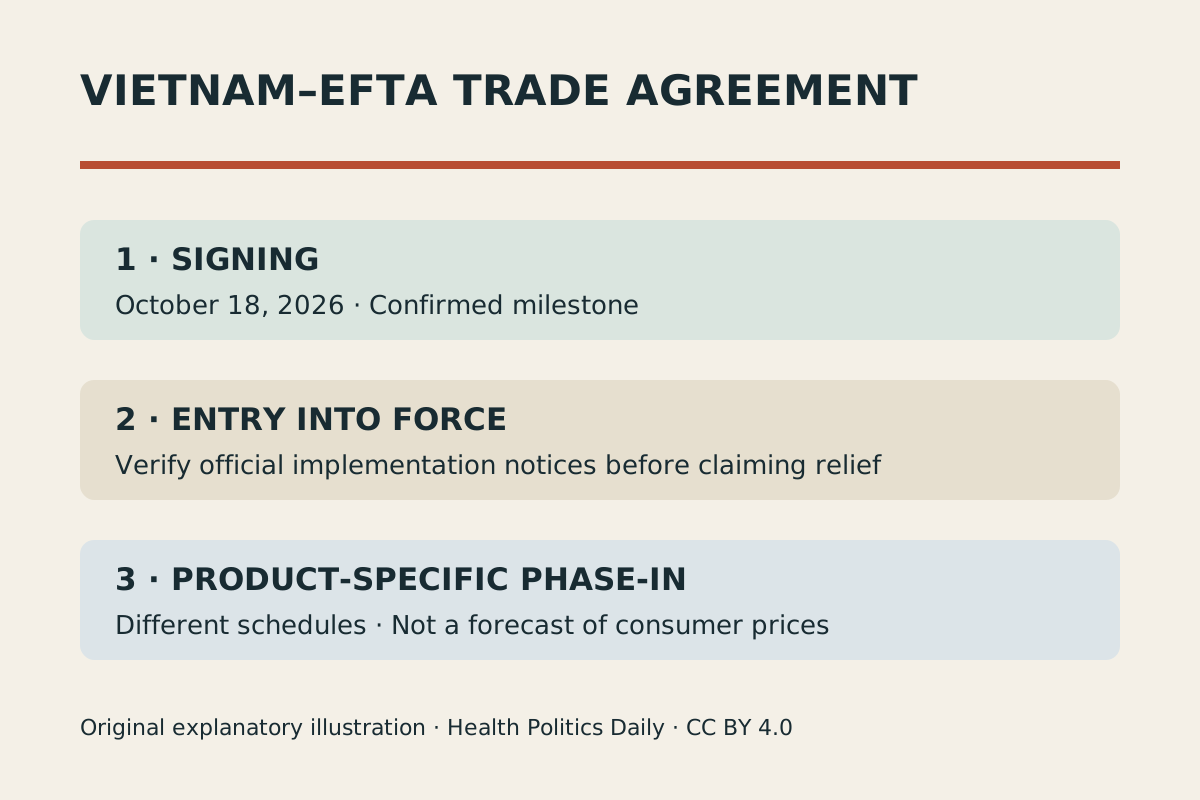
Vietnam and the European Free Trade Association’s four members—Norway, Switzerland, Iceland and Liechtenstein—signed a free-trade agreement in Hanoi on October 18. The agreement opens another route for trade diversification, with consequences for businesses selling goods ranging from seafood to machinery.
Norway’s government confirmed the signing, as did Vietnam Economic News, the Vietnamese trade ministry’s publication. Reuters independently reported the announcement. The central qualification for buyers and sellers: the signing itself is not confirmation that preferential duties can already be claimed.
What has changed
The parties have moved from completing negotiations to signing the agreement. EFTA’s July 2 announcement documented the conclusion of talks following their September 2025 relaunch. Its description covers goods and services, investment, intellectual property, procurement and sustainable development, alongside customs and origin rules.
EFTA is a four-country association, not the European Union. This agreement therefore should not be read as a new EU-wide tariff arrangement. The participating countries and the product-specific commitments matter more than the shorthand description of a European trade deal.
The clearest tariff example: Norwegian seafood
Norway says around half its exports to Vietnam will be tariff-free when the agreement enters into force, rising to more than 98% within seven years. Those figures describe Norwegian exports; they are not a blanket timetable for every product traded by all five countries.
The government gives a concrete example: Vietnamese tariffs on Norwegian salmon and mackerel currently reach up to 15%. Salmon is to become tariff-free at entry into force, while mackerel duties are to be removed over three years. The distinction shows why even an eligible shipment’s treatment will depend on both its product category and the implementation date.
Why workers, businesses and consumers may notice
Vietnam’s trade ministry publication identifies seafood, footwear, clothing and electronics among its exports to EFTA, with industrial machinery, chemicals, pharmaceuticals and production inputs among imports. The pact is consequently broader than a single commodity deal.
Analysis: Lower border duties can change sourcing decisions and competition between suppliers. They may reduce a business’s costs, help an exporter compete or support investment decisions. None of those channels guarantees an immediate reduction in a household’s shopping bill: freight, exchange rates, distribution costs and commercial pricing still intervene.
For workers, the important question is where new orders or competitive pressures actually emerge, not simply whether officials describe the agreement as beneficial. For smaller firms, eligibility paperwork and access to understandable customs guidance can determine whether a nominal preference becomes usable.
What to check before relying on a preference
Practical implications: Businesses should look for the relevant customs authority’s entry-into-force notice, the tariff schedule for their goods and the required origin documentation before pricing a shipment on the assumption of lower duties. A product shipped from a partner country is not necessarily entitled to every preference merely because of the shipping location. EFTA’s chapter-by-chapter factsheet describes product-specific origin rules and different proofs of origin for EFTA and Vietnamese exporters.
The same factsheet describes commitments on existing labour and environmental obligations. Those provisions are relevant to assessing the agreement beyond export growth, but a written commitment is not evidence that every workplace or environmental outcome has improved.
Uncertainty: The signing releases reviewed for this report do not establish an effective date on which all participating countries’ preferences become available. Nor do they establish actual changes in retail prices, exports or employment. These are outcomes to measure after implementation, not verified gains already delivered. The agreement also does not, by itself, change U.S. tariff treatment.
Bias Lens: verified signing, different institutional priorities
Verified baseline: Vietnam and the four EFTA countries signed the agreement on October 18. Norway’s announced reductions are tied to entry into force and phased implementation.
Reuters’ center-oriented wire report emphasizes the signing and tariff timetable. Norway’s official release stresses exporter opportunities, particularly seafood. Vietnam’s trade-ministry publication foregrounds investment and market diversification. The latter two are participant perspectives, not independent assessments of realized benefits.
No sufficiently distinct, verified left-leaning and right-leaning reports on this fresh signing were identified in the coverage reviewed. We do not label government releases as political substitutes or manufacture opposing narratives. The useful comparison here is official expectations versus the narrower confirmed legal milestone; none proves a household price saving.
Sources and media
Primary sources are Norway’s October 18 release, Vietnam’s trade-ministry publication and EFTA’s July negotiating announcement, linked above. Reuters provides independent corroboration. The illustration is original explanatory artwork, not an image of the signing ceremony. No directly relevant, suitable authorized video of the new signing was verified; none is embedded.
Related Coverage
For wider trade and economic-policy context: