Health · Cancer research · Clinical evidence
Roche Says Divarasib Beat Lung-Cancer Rivals; Full Trial Details Due at ESMO
Roche’s October 19 preview reports a positive lung-cancer comparison. What patients should distinguish from full results, regulatory decisions and access.
By Health Politics Daily News Desk · October 19, 2026 at 4:06 a.m. ET
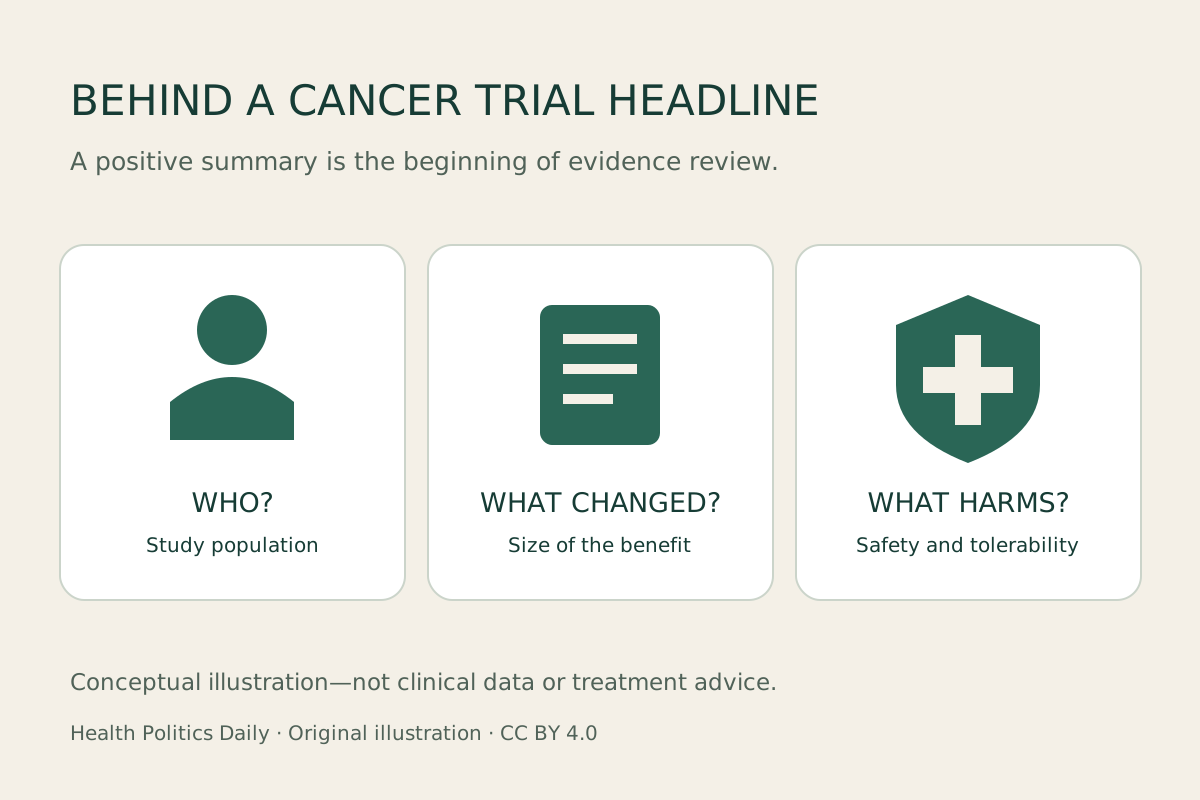
Roche says its drug divarasib outperformed first-generation KRAS G12C inhibitors in a phase III lung-cancer study. The October 19 announcement is a reason to examine the forthcoming evidence—not a basis for assuming every person with lung cancer could benefit or that treatment access has changed.
What was announced—and for whom
The company’s official ESMO preview identifies Krascendo 1 as a comparison with sotorasib or adagrasib in previously treated, locally advanced or metastatic non-small cell lung cancer with a KRAS G12C mutation. That describes a specific biological and treatment setting, not all lung cancers.
Roche lists the main presentation for October 25 during the ESMO meeting in Madrid, which runs October 23–27. Reuters’ October 19 report corroborates that Roche announced plans to present the data. It does not independently reproduce the trial analysis.
The company also previews patient-reported findings from the lidERA breast-cancer study of giredestrant. That is a separate drug, cancer setting and evidence package; its findings should not be combined with the lung-cancer comparison into a general claim of a cancer “cure.”
Why the head-to-head comparison matters
The National Cancer Institute explains that phase III trials compare a treatment with current standard therapy and assess side effects as well as effectiveness. Trial eligibility can depend on prior treatment and a tumour’s genetic changes.
Analysis: A comparison against an active treatment can answer a more immediately useful clinical question than an uncontrolled account of patients receiving a new medicine. But the word “superior” alone does not tell readers the size of the difference, how long people were followed or what trade-offs accompanied it.
A careful assessment should identify the prespecified outcome, the absolute results in each group, the uncertainty around the estimate, serious adverse events and treatment discontinuations. It should also distinguish the main planned analysis from exploratory findings. Those questions are an evidence checklist, not a finding that this trial has failed any of them.
What patients should not infer
Analysis: A positive company summary, a scientific presentation, a regulator’s decision and routine availability are different events. One does not establish the others. Nor can a result from a biomarker-defined trial identify whether an individual has the relevant mutation, meets eligibility criteria or would experience the average study outcome.
This preview does not provide a patient-level treatment recommendation. People considering a research headline can ask their oncology team which cancer subtype and treatment setting it concerns, whether the detailed evidence has been reviewed and whether any relevant regulatory or access decision exists in their country. No treatment change should be inferred from this article.
Our FDA evidence-framework explainer discusses a separate regulatory initiative, not a divarasib decision. Our India cancer-drug pricing report covers another distinction: evidence of benefit is not the same question as affordability or access.
What remains uncertain
The reviewed preview does not supply the complete numerical efficacy and safety results needed for this desk to assess the magnitude of benefit. This edition therefore does not estimate extra months of life, quote an unverified risk reduction or forecast approval. The next useful milestone is the detailed presentation and accompanying critical assessment, not an assumed commercial outcome.
Bias Lens: company claims versus independent assessment
Verified baseline: Roche issued a trial-results preview. The full numerical analysis is not reproduced in the reviewed announcement.
Commercial framing—Roche: The sponsor’s release emphasizes superiority and potential leadership. Its interest in the programme makes attribution essential, without making its results automatically wrong.
Center—Reuters: The linked wire report summarizes the announcement and attributes it to Roche; corroborating an announcement is different from independently validating a clinical dataset.
Right-leaning media context—SRN News: Its linked item carries the Reuters report with its reporting credit. That is the same reporting chain, not a second independent confirmation or a distinct conservative interpretation.
Left-leaning comparison: No directly relevant mainstream left-leaning report was verified for this edition. A political three-way disagreement would be artificial here. The meaningful comparison is between sponsor promotion, attributed news and the detailed evidence needed for clinical assessment—not stereotypes about publishers.
Sources and media
The primary announcement is Roche’s October 19 release; NCI supplies general trial-method context. Reuters corroborates the announcement. The original conceptual illustration is licensed CC BY 4.0 and does not depict a tumour, participant or trial result. No directly relevant authorized video was verified, so none is embedded.