FDA — RARE DISEASE — DRUG DEVELOPMENT
FDA Opens Overhaul of Rare-Disease Drug Reviews
The agency says evidence expectations should reflect the realities of very small patient populations. The initiative could reshape reviews, but it is not a new approval, final rule or promise of faster access.
By Health Politics Daily News Desk · Published Thursday, October 15, 2026 at 2:00 a.m. America/New_York · Approximately 8 minutes
Verified Baseline
The FDA has begun a framework process, not completed a regulatory change
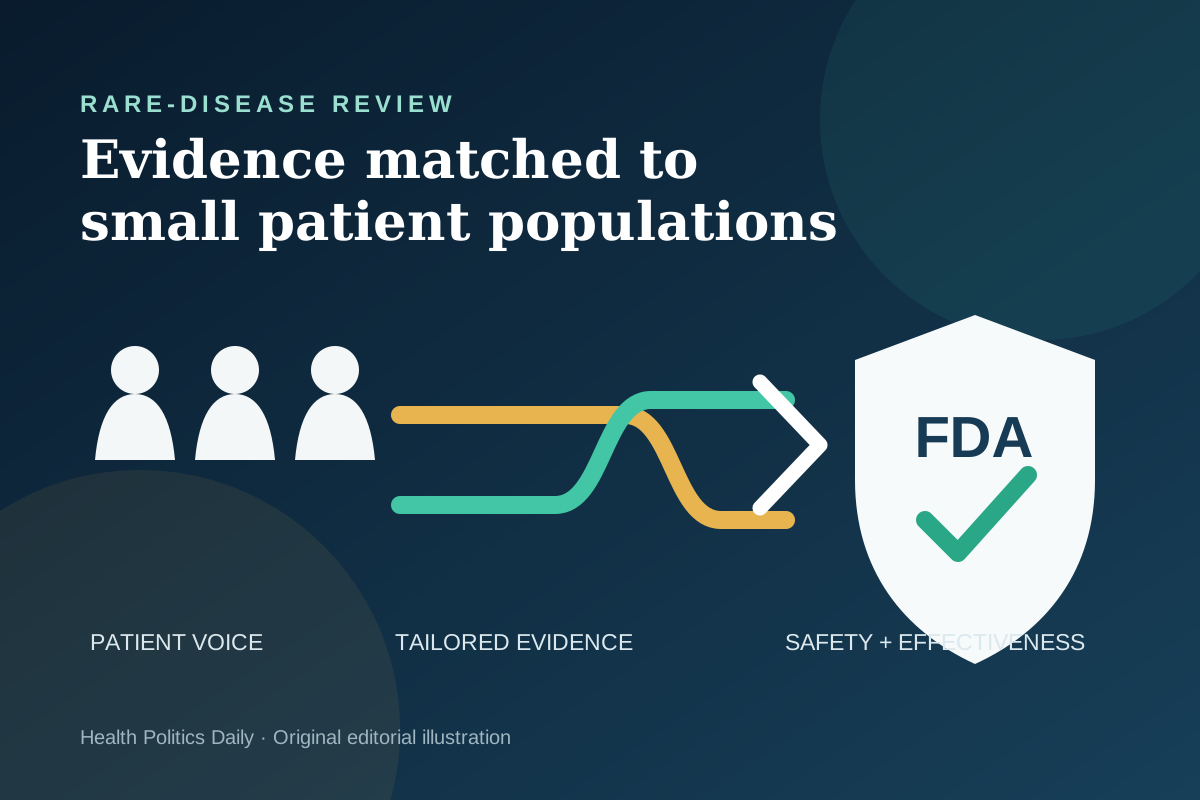
The Food and Drug Administration announced the Rare Disease Framework Initiative on Wednesday. Its stated goal is to tailor advice and review decisions to the evidence reasonably attainable for a disease, its progression, patient population and proposed product.
The agency will seek public input at an October 28 meeting, through a forthcoming request for information and in stakeholder roundtables. Verified fact: the process is underway. Not yet established: which regulations, guidance documents or internal procedures will change, or when.
What the Proposal Covers
Trials, endpoints, manufacturing and post-approval duties are in scope
The FDA's 10-page white paper says the review runs from pre-investigational-new-drug discussions through post-approval obligations. It includes clinical endpoints, statistical methods, patient input, outside expertise, chemistry and manufacturing controls, and pre-approval inspections.
The agency proposes risk-based approaches and greater use of novel trial designs, real-world evidence and statistical methods suited to small populations. It also seeks more consistent decisions across the drug and biologics centers. The framework continues to require the statutory showing of safety and effectiveness.
Why It Matters
Rare diseases create evidence problems that large conventional trials may not solve
The FDA estimates that about 30 million Americans live with one of roughly 7,000 to 10,000 rare conditions, while only about 5% of recognized rare diseases have an approved treatment. Some conditions affect only hundreds of people worldwide, patients may be geographically dispersed, and reliable natural-history data or validated endpoints may not exist.
Analysis: predictable, disease-specific expectations could help developers design feasible studies earlier and reduce avoidable delays. The tradeoff is that flexibility must still produce reliable evidence; a smaller or unconventional trial is not automatically adequate, and a plausible scientific theory is not proof of clinical benefit.
Practical Implications
Patients and developers gain a route to influence the framework
- Patients and caregivers: the initiative promises input at early and defined milestones, but it does not change current treatment or guarantee access to an experimental therapy.
- Drug developers: possible guidance revisions may clarify acceptable endpoints, statistics, manufacturing controls and post-approval studies; existing requirements remain in force meanwhile.
- Clinicians and researchers: the FDA plans to use more outside disease expertise, particularly where natural history is poorly understood.
- Investors: the announcement is a policy process, not evidence that any company or product will be approved. This article is not investment or medical advice.
What Remains Uncertain
Deliverables and deadlines are intentionally open
The white paper says possible outcomes include revised regulations, new or updated guidance, reviewer training and closer alignment between FDA centers. It does not set a completion date or identify a first list of products that would use the framework.
Forecast: the October 28 meeting will reveal where patient groups, researchers and industry agree—and where they disagree—on acceptable evidence. Opinion: Health Politics Daily takes no position on a particular evidentiary model; success should be judged by whether the eventual rules are transparent, consistently applied and capable of supporting trustworthy benefit-risk decisions.
Bias Lens: access, rigor and regulatory flexibility
FDA has opened a public framework process. No treatment was approved, no final rule was issued, and statutory safety and effectiveness requirements remain.
Coverage comparison: The announcement has so far drawn primarily technical rather than clearly partisan coverage. Bloomberg Law emphasizes the top-to-bottom regulatory review and recent disputes over delayed or rejected therapies. The FDA emphasizes access, patient voice and continuing rigor, while the Biotechnology Innovation Organization, an industry group rather than a news outlet, emphasizes delay and development feasibility.
A meaningful left-center-right split was not evident in substantial coverage available at publication, so this lens does not assign ideological labels merely to manufacture symmetry. The main framing difference is institutional: regulator, news organization and industry advocate.
Principal Sources
Primary documents and corroborating context
- FDA — Rare Disease Framework overview
- FDA — A New Framework for Rare Disease Review white paper
- FDA — October 28 public meeting
- Bloomberg Law — regulatory and institutional context
No directly relevant official or publisher-authorized video with clear embedding permission was available at publication.
Related Coverage