Finance · Corporate governance · Technology
SpaceX and Tesla Form Special Committees to Explore a Merger
Independent directors are studying a possible combination, Elon Musk said. The companies have not agreed to terms, and any deal would face shareholder votes and regulatory review.
By Health Politics Daily News Desk · October 20, 2026 at 10:04 p.m. ET
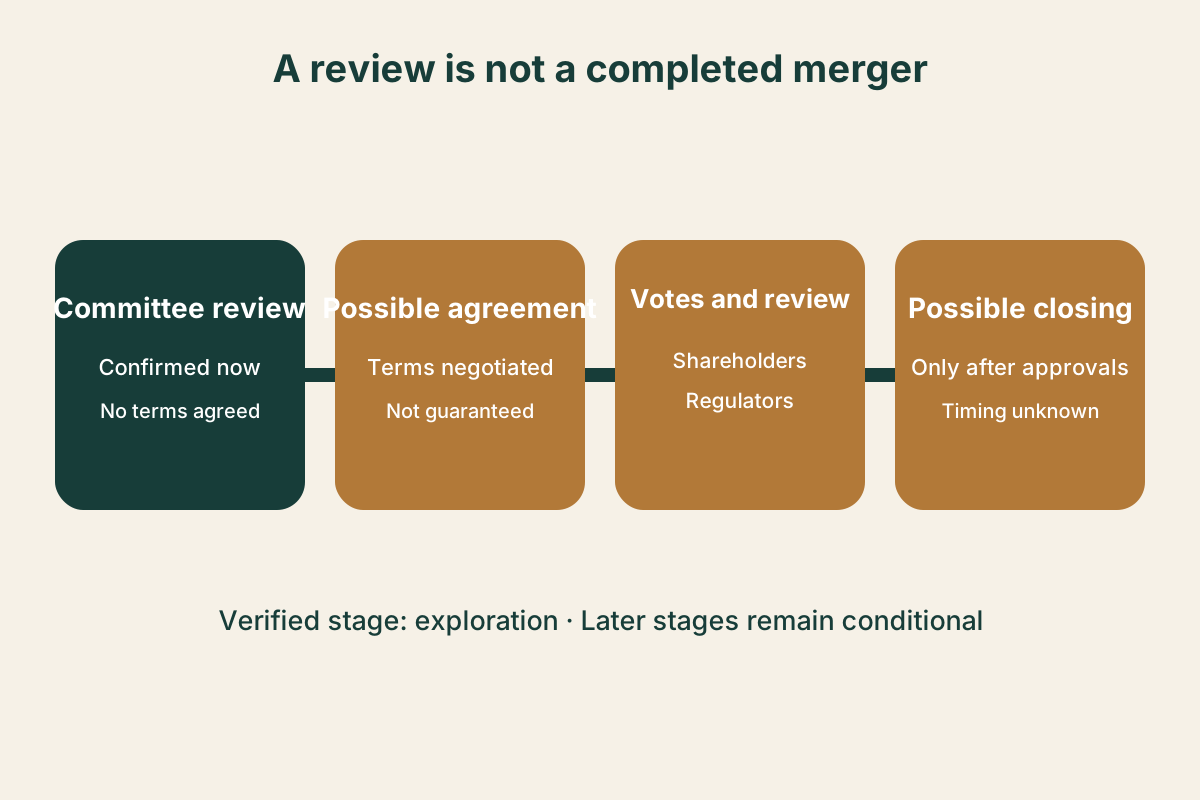
SpaceX and Tesla have each formed a special committee of independent directors to examine a possible merger, SpaceX and Tesla chief executive Elon Musk said during SpaceX’s October 20 earnings call. That is the first formal step disclosed by the companies after months of investor speculation. It is not a merger agreement.
Musk said the committees had not agreed on transaction terms and that there was no guarantee they would. He also said he is not serving on either committee because of his financial interests in both companies. The companies had not filed a merger agreement or announced a price, structure, timetable or exchange ratio by publication time.
What is verified
SpaceX’s official third-quarter earnings page provides the webcast, earnings update and investor Q&A. In that call, Musk confirmed the two committees and described a combination as potentially worthwhile, while warning listeners not to treat it as certain.
The disclosure came alongside SpaceX results showing third-quarter revenue of about $14.6 billion and net income of $4.4 billion. The company’s earnings release reports that revenue rose 161% from a year earlier. Those results help explain investor attention, but they do not establish the value or fairness of a hypothetical Tesla transaction.
Tesla’s SEC record also shows an existing financial tie: the company completed a roughly $2 billion investment in SpaceX Class A shares in March 2026 after SpaceX acquired xAI. That holding is context for the boards’ conflict-of-interest safeguards; it is not evidence that a wider combination has been approved.
Why special committees matter
A special committee can give directors without the same conflicts responsibility for evaluating a transaction, retaining advisers and deciding whether negotiations should continue. Here, the governance issue is unusually prominent because Musk leads both companies and owns substantial stakes in each.
The committees’ central questions would likely include relative valuation, governance, financing, which company would be the legal acquirer, treatment of minority shareholders and whether sharing technology or services could deliver the claimed benefits without a full merger. Those are analytical questions, not disclosed decisions.
What would have to happen next
If the committees reach agreement, the companies would need to disclose definitive terms. Musk said a Tesla vote would require support from holders of at least 50% of all outstanding Tesla shares, not merely a majority of shares cast. The exact voting standards and approvals would ultimately depend on the signed documents, corporate law and formal disclosures.
A multitrillion-dollar combination involving electric vehicles, satellite communications, launch services, artificial intelligence and government contracts would also invite regulatory scrutiny. The scope and timetable cannot be known before agencies receive an actual transaction to review.
Practical implications
For Tesla and SpaceX shareholders, the useful documents have not yet appeared: there is no price, exchange ratio, independent valuation, financing plan or proxy statement to assess. After-hours share moves show market reaction, not the probability or merits of a deal. This article does not provide personalized investment advice.
Employees, customers and public agencies should expect normal operations unless the companies announce otherwise. Existing commercial collaboration—such as AI infrastructure, manufacturing expertise and satellite connectivity—does not by itself transfer contracts, warranties, employment terms or regulatory obligations.
What remains uncertain
The committees could recommend negotiations, seek alternatives or end the review. Even signed deals can change or fail during shareholder and regulatory review. No reliable public timetable exists, and forecasts that assign a closing date or combined value before terms are disclosed should be treated as estimates rather than facts.
For context on the financial environment surrounding large AI infrastructure programs, see our reporting on the AI stock selloff and data-center credit risk and on AI investment’s near-term inflation pressures.
Bias Lens: “exploring a merger” is the shared baseline
Verified baseline: SpaceX and Tesla have formed independent special committees to examine a possible combination. No terms have been agreed, no definitive agreement has been announced and the outcome is uncertain.
Left-of-center — The Verge: Places the disclosure within SpaceX’s AI-driven revenue growth and broader product ambitions. That framing emphasizes the strategic story but gives the committee process less prominence.
Center — Associated Press: Leads with the earnings results, then describes the merger as possible and not imminent. Its framing gives readers the financial event that produced the disclosure and preserves uncertainty.
Right-of-center — The Wall Street Journal: Centers the formation of committees, Musk’s exclusion from them and the need for shareholder approval. That governance-first framing makes the procedural barriers most visible.
How to read the differences: The outlets agree on the core facts but choose different entry points—strategy, earnings or governance. These labels describe broad editorial orientation, not the accuracy of any individual report; the primary webcast and future filings remain the controlling evidence.