GLOBAL FINANCE — CRITICAL MINERALS — DEVELOPMENT
World Bank Targets $19 Billion for Critical Minerals Financing Through 2030
The World Bank plans to increase its critical-minerals financing roughly fivefold, directing more capital toward extraction, processing and local industry while leaving individual projects subject to approval and safeguards.
By Health Politics Daily News Desk · Published Friday, October 16, 2026 at 2:00 a.m. America/New_York · Approximately 7 minutes
By Health Politics Daily News Desk · Published Friday, October 16, 2026 at 2:00 a.m. America/New_York · Approximately 7 minutes
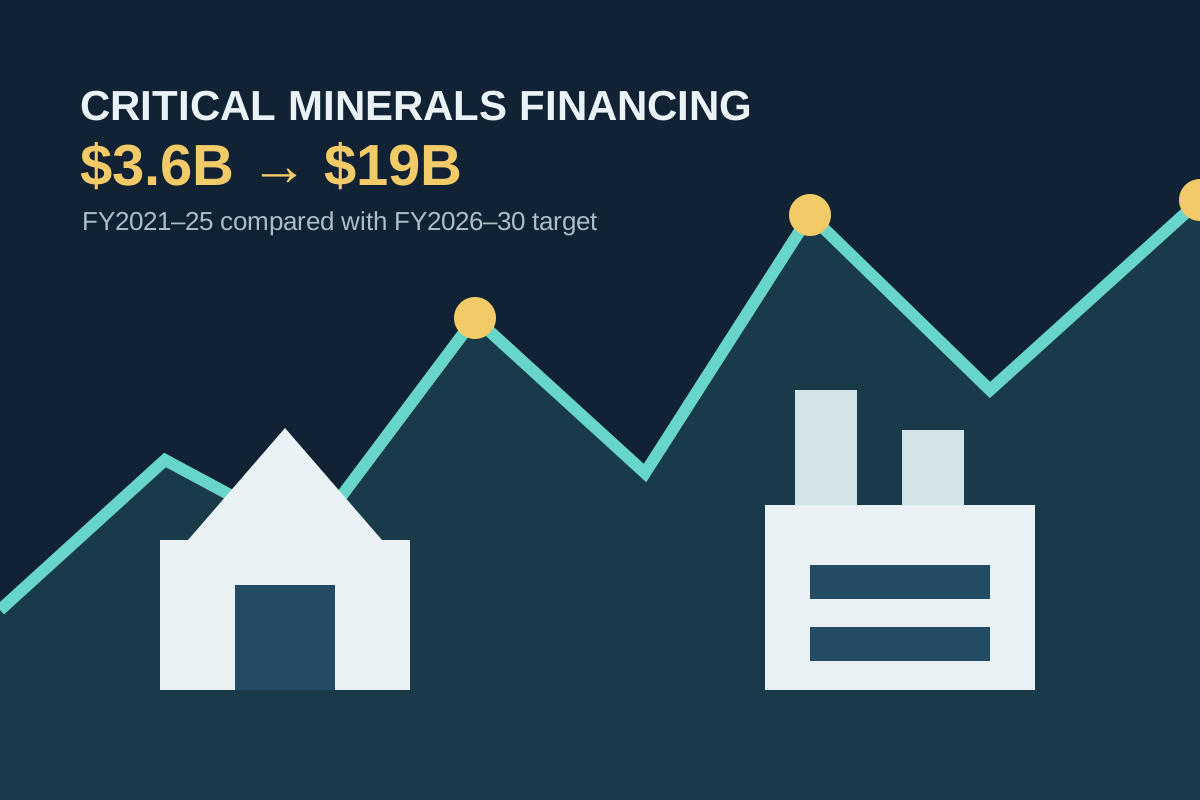
9 billion in fiscal 2026–2030. Health Politics Daily · Original data illustration based on World Bank figures, CC BY 4.0Verified Baseline
The World Bank set a five-year financing target of $19 billion
World Bank President Ajay Banga said the institution plans to quintuple its critical-minerals business over five years. The new Metals and Minerals implementation plan targets $19 billion during fiscal years 2026 through 2030, compared with $3.6 billion in fiscal 2021 through 2025, according to Reuters.
The Bank has identified 20 partner countries and says it is beginning country compacts with other multilateral development banks. The stated aim is to build local industries so producing countries retain more jobs and value rather than exporting only raw material. The World Bank's Metals and Minerals program page highlights financing for mining, processing, institutional capacity and infrastructure.
What the Number Means
A financing target is not $19 billion of grants or approved projects
World Bank Group financing can include loans, guarantees, equity investments and private capital mobilized alongside public funding. The headline figure therefore should not be read as a single budget allocation, a cash transfer to governments or a commitment that every proposed mine will proceed.
Individual projects still require technical, financial, environmental and social review. Timelines can extend for years because mines and processing plants require permits, infrastructure, community engagement and buyers. Currency, commodity prices and political conditions can also change whether a project remains viable.
Why It Matters
Mineral supply chains affect energy, technology and national security
Lithium, nickel, cobalt, graphite, copper and rare-earth elements are used in batteries, electricity networks, semiconductors, defense systems and advanced manufacturing. The International Energy Agency says many clean-energy technologies depend on concentrated mineral supply chains, leaving economies exposed to disruptions and price swings.
For producing countries, the policy question is not only how much ore leaves the ground, but where refining, manufacturing, employment and tax revenue occur. Country compacts that connect extraction to processing and infrastructure could retain more value locally, though outcomes will depend on contract terms, governance and project selection.
Practical Implications
The plan could expand project pipelines without changing consumer prices quickly
Governments and companies in partner countries may gain additional options for project preparation, guarantees and co-financing. Communities near proposed sites should expect project-specific consultation and disclosure rather than assume the global target overrides local review.
Consumers and investors should not treat the announcement as a near-term forecast for battery, vehicle or electronics prices. New mineral capacity generally takes years to develop, and prices depend on demand, processing bottlenecks, trade rules and competing projects.
What Remains Uncertain
The Bank has not published a complete project list or financing mix
The public materials do not yet identify all 20 countries, the allocation among mining, processing and infrastructure, or how much of the $19 billion would come directly from World Bank institutions versus mobilized private capital. The treatment of deep-sea mining is also unsettled; Banga said the Bank would take a precautionary approach consistent with its policies.
Analysis: the scale indicates a strategic shift toward supply-chain development, not merely a collection of isolated mining loans. Forecast: competition for viable projects and processing capacity is likely to intensify, but actual disbursements may differ from the target. Opinion: Health Politics Daily takes no position on specific projects; transparent financing terms and measurable local benefits will be necessary to judge results.
Bias Lens: how the financing plan is framed
The World Bank is targeting $19 billion in critical-minerals financing for fiscal 2026–2030, versus $3.6 billion in the prior five-year period, and has identified 20 partner countries.
Center coverage: Reuters emphasizes the financing scale, partner countries and pressure from major shareholders to strengthen supply chains. Institutional framing: the World Bank emphasizes local jobs, value addition and development benefits. Environmental-policy framing: Associated Press coverage of the Bangkok meetings highlights public concern about environmental degradation and inequality surrounding large development institutions.
No timely, detailed mainstream left-leaning and right-leaning pair had examined this specific financing target at publication time. The available difference is therefore described as institutional versus accountability framing rather than forced partisan symmetry.
Principal Sources
Primary information and corroborating reporting
- World Bank — Metals and Minerals program
- Reuters — Banga remarks and financing target
- International Energy Agency — critical-minerals uses and supply-chain context
- Associated Press — public accountability context at the Bangkok meetings
No suitable directly relevant official or publisher-authorized video with clear embedding permission was available.
Related Coverage