International · United Kingdom · Courts
Russell Brand Convicted of Rape and Three Sexual Assaults
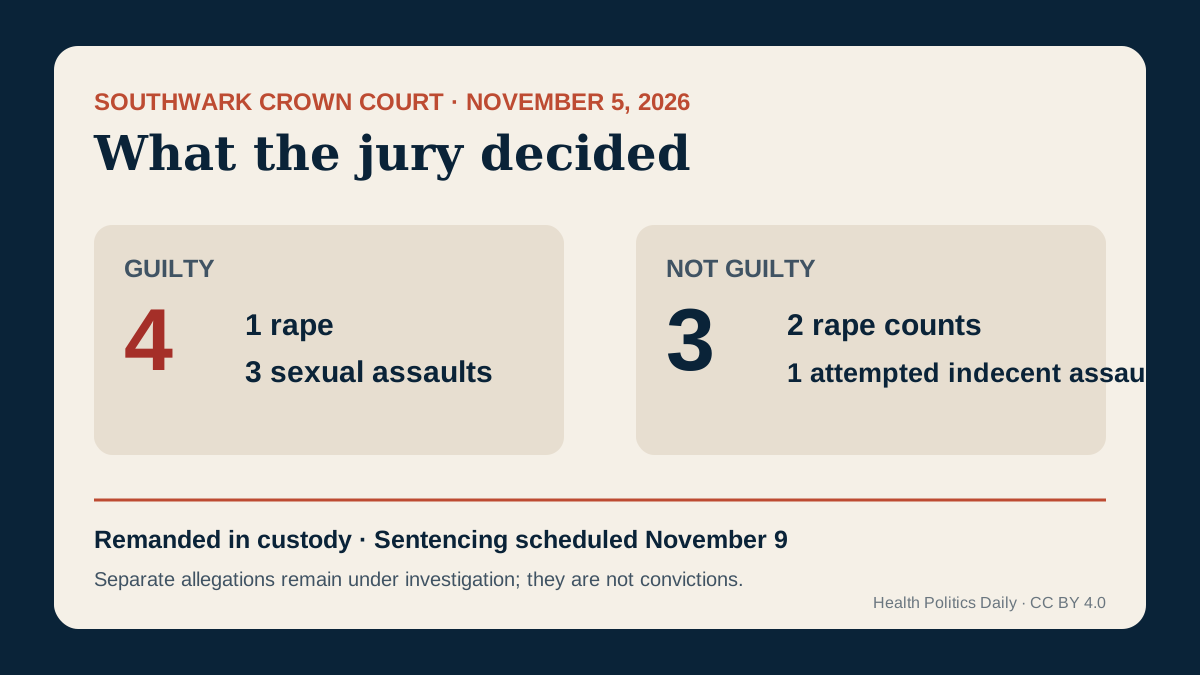
A unanimous London jury returned four guilty verdicts and acquitted Brand on three other counts. He has been remanded in custody and is due to be sentenced on Monday, November 9.
What the jury decided
A jury at Southwark Crown Court found British comedian and media personality Russell Brand guilty on Thursday of one count of rape and three counts of sexual assault involving four women. The offences occurred between 2004 and 2009, according to the Crown Prosecution Service.
The jury acquitted Brand of two other rape counts and one count of attempted indecent assault. Brand, 51, had pleaded not guilty to all seven charges. Reporting the acquittals alongside the convictions is essential: the verdict applies count by count, not as a general judgment on every allegation presented at trial.
Judge Joel Bennathan remanded Brand in custody and said he faces a significant prison term. Sentencing is scheduled for Monday, November 9. The sentence has not yet been imposed, so reports about its precise length remain forecasts or descriptions of possible legal ranges—not a court decision.
How investigators built an older case
The Metropolitan Police said detectives contacted more than 100 witnesses, took more than 400 statements and reviewed more than 1,400 documents. With little or no surviving forensic or surveillance evidence, investigators reconstructed timelines through testimony, historical records, photographs, floor plans and Brand’s past public appearances and writings.
Police began investigating after a 2023 joint investigation by Channel 4’s Dispatches, The Times and The Sunday Times. The four women in the convictions were not known to one another, authorities said. Under UK law and court rules, the complainants are entitled to lifelong anonymity.
What remains unresolved
The Metropolitan Police said two additional rape allegations remain under investigation and files have been submitted to prosecutors. Those matters are separate from Thursday’s verdict. An investigation or prosecutorial review does not establish that an offence occurred, does not mean a charge will be filed and must not be treated as another conviction.
Brand may pursue available appeal procedures after sentencing. An appeal is not automatic, and no appellate court has ruled on the verdict. The BBC and other organizations that employed or worked with Brand may also face renewed scrutiny of their workplace practices, but any institutional findings should be reported separately from the criminal case.
Why the verdict matters beyond one defendant
The case illustrates how non-recent sexual-offence prosecutions can proceed even when physical evidence is no longer available. The CPS said prosecutors used a suspect-focused approach that examined the defendant’s conduct rather than relying on assumptions about how victims should react or how quickly they should report.
That does not remove the prosecution’s burden of proof. The jury was required to assess each charge separately and convict only if satisfied beyond reasonable doubt. Its mixed verdict—four convictions and three acquittals—shows that the panel differentiated among the counts.
For readers affected by sexual violence, the article’s source pages include UK support and reporting contacts. Health Politics Daily does not publish complainants’ identities or unnecessary graphic details.
Fact, analysis, forecast and opinion
Verified fact: Brand was convicted of one rape and three sexual assaults, acquitted on three other counts, remanded in custody and scheduled for sentencing November 9. Analysis: the case demonstrates both the evidentiary challenges and the possibility of prosecuting offences reported years later. Forecast: the sentence, any appeal and the outcome of separate investigations remain unknown. Opinion: Health Politics Daily takes no position beyond reporting the jury’s verdict and the legal status of unresolved matters.
Bias Lens: verdict, celebrity and institutional accountability
Verified baseline: the jury returned four guilty verdicts and three not-guilty verdicts. Brand denied all charges; sentencing has not occurred; two separate allegations remain under investigation.
The left-leaning Guardian gave substantial attention to survivor testimony, workplace settings and questions about how institutions responded to Brand’s conduct. Centrist Reuters organized its coverage around the individual counts, the evidence heard and the mixed verdict. Right-leaning Fox News foregrounded Brand’s celebrity profile, the guilty counts and the prospect of imprisonment.
Those emphases shape what readers notice first, but none changes the court record. Avoiding sensational details, distinguishing acquittals from convictions and keeping separate investigations clearly labeled produces the most reliable baseline.
Related legal context
Courts distinguish allegations, charges, verdicts and sentences at every stage. Our prior explainers on a grand jury’s decision not to indict and the indictment of a federal officer explain why an accusation or charge is not equivalent to a conviction. See also our editorial standards for handling allegations and corrections.
Principal sources
- Crown Prosecution Service — verdict and case summary
- Metropolitan Police — investigation and verdict statement
- Associated Press — courtroom report
- Reuters — count-by-count verdict details
Sky News’ authorized verdict coverage and video is linked rather than embedded so the publisher retains playback, rights and accessibility controls.
No comments yet.