International Politics · Sudan · Civilian Protection
Nyala Market Drone Strike: MSF Confirms 36 Bodies as Higher Toll Is Investigated
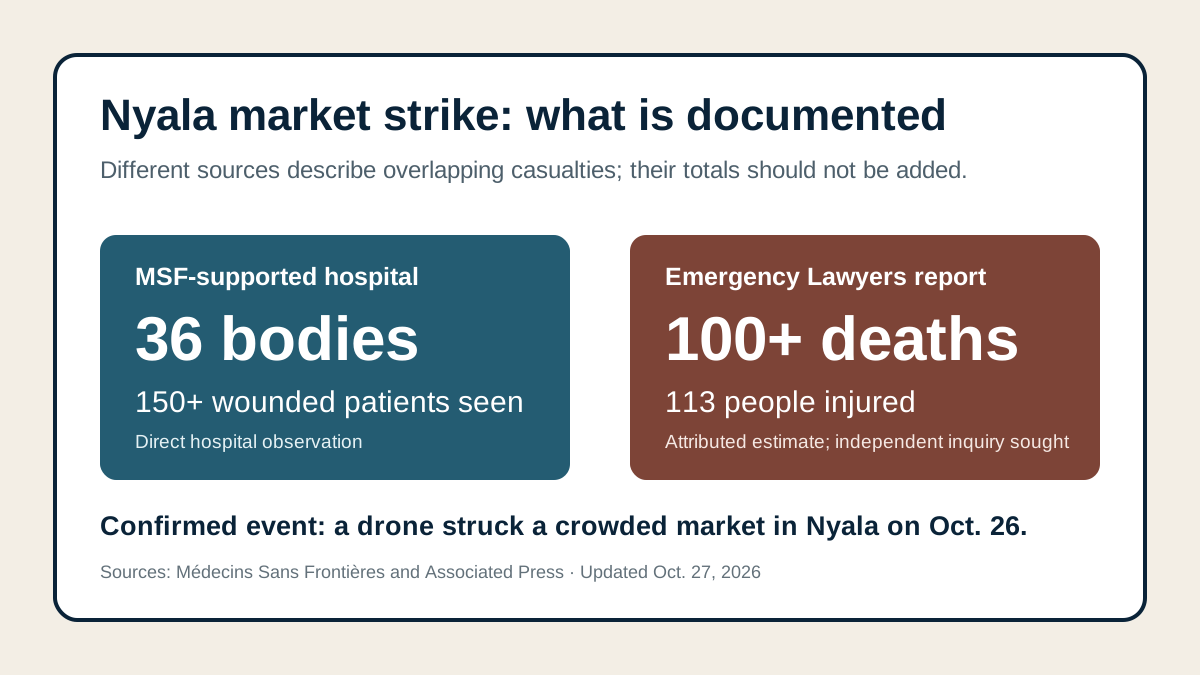
Doctors Without Borders says its supported hospital received 36 bodies and treated more than 150 wounded patients. A Sudanese rights group reports more than 100 deaths, but the different counts have not been independently reconciled.
By Health Politics Daily News Desk · October 27, 2026 at 10:00 p.m. ET
Verified baseline
A drone struck a busy market in western Nyala, South Darfur, at about 8 p.m. local time Monday, October 26. Médecins Sans Frontières, which supports Nyala Teaching Hospital, said the facility received 36 bodies and saw more than 150 wounded patients. Medical staff treated shrapnel wounds and severe burns, including among women and children.
MSF attributed the strike to the Sudanese Armed Forces and said a second strike hit a civilian neighborhood. The Associated Press reported that Emergency Lawyers, a Sudanese rights group, placed the toll above 100 dead and 113 injured and called for an independent investigation. The military had not publicly provided a response in the reporting reviewed for this article.
Why the casualty figures differ
MSF’s 36-body figure describes what reached one supported hospital at the time of its update. It is a directly observed minimum, not necessarily a citywide final toll. The Emergency Lawyers estimate may include people recovered elsewhere, but its underlying list and counting method were not publicly available in the sources reviewed.
Other early reports cited at least 21 deaths, while an RSF-aligned local administration reported 102. These figures may reflect different facilities, reporting times or political information channels. They should not be added together, and the largest number should not be presented as independently confirmed without a documented reconciliation.
What is known about the target and responsibility
Witnesses and medical reporting identify the impact site as a market where civilians gathered for food and work. MSF said 21 of the 36 bodies received at the hospital were wearing civilian clothing. Civilian clothing alone does not establish the status of every victim, and reports that armed RSF members also used the market do not remove the obligation to distinguish military targets from civilians.
Nyala is controlled by the paramilitary Rapid Support Forces, which has fought Sudan’s military since April 2023. Both forces have used drones and have been accused of attacks affecting homes, hospitals, markets and essential infrastructure. Establishing who launched this strike, what was targeted and whether international humanitarian law was violated requires an independent investigation with access to flight, weapons and casualty evidence.
Why the attack matters for daily life
Markets are not only commercial spaces; they are points of access to food, income and transport. Repeated attacks can close supply routes, overwhelm hospitals and deepen hunger even for people far from the immediate blast. MSF noted that another Nyala market strike on October 16 killed at least four people and injured others.
Families seeking missing relatives should use recognized hospitals, humanitarian organizations and local tracing services rather than circulating graphic or unverified social-media posts. People in affected areas should follow locally issued safety guidance when it is available. This report cannot provide real-time security directions.
Fact, analysis, forecast and opinion
Verified fact: a drone hit a Nyala market, and one MSF-supported hospital received 36 bodies and treated more than 150 wounded patients. Attributed reports: Emergency Lawyers says more than 100 people died and blames Sudan’s military; MSF also attributes the strike to the military. Analysis: repeated market attacks compound civilian harm by disrupting food access and medical capacity. Forecast: the toll may change as facilities and recovery teams reconcile records, but its final level cannot be predicted. Opinion: Health Politics Daily supports an independent investigation, civilian protection and accountability under international law without taking a side in Sudan’s war.
Bias Lens: verified floor, higher estimates and wartime attribution
Verified baseline: a drone struck the market; MSF directly documented 36 bodies and more than 150 wounded patients at its supported hospital. Higher totals and responsibility claims remain attributed pending independent reconciliation.
A responsible left-center-right comparison was not available across directly relevant coverage at publication, so this lens does not manufacture ideological symmetry. MSF centers hospital observations and civilian protection. AP leads with the rights group’s higher toll while also reporting MSF’s direct count. Al Jazeera, citing AFP, initially emphasized the lower early hospital estimate and the market’s reported use by some RSF fighters.
The framing difference is primarily evidentiary and chronological: direct hospital intake, a broader rights-group estimate or an earlier medical report. None alone establishes the final toll or the legality of the strike.
What remains uncertain
The final number of dead and injured, the civilian-combatant breakdown, the intended target, the weapon used and the chain of command remain unresolved. Public evidence has not yet reconciled the separate casualty lists or established whether advance precautions and proportionality requirements were met.
Principal sources
- Médecins Sans Frontières — direct hospital observations
- Associated Press — Emergency Lawyers report and conflict context
- U.N. Human Rights Office — wider October drone-attack pattern
- United Nations — civilian-infrastructure and humanitarian briefing
No suitable directly relevant official or publisher-authorized video with clear downstream embedding permission was available, so no video was embedded.