U.S. Politics · White House · Executive Branch
Trump Names Stephen Miller White House Chief of Staff, Replacing Susie Wiles
Miller will move from deputy chief of staff to the West Wing’s top staff role on Monday, November 9. The appointment may change how policy is coordinated, but it does not create new presidential powers or alter laws on its own.
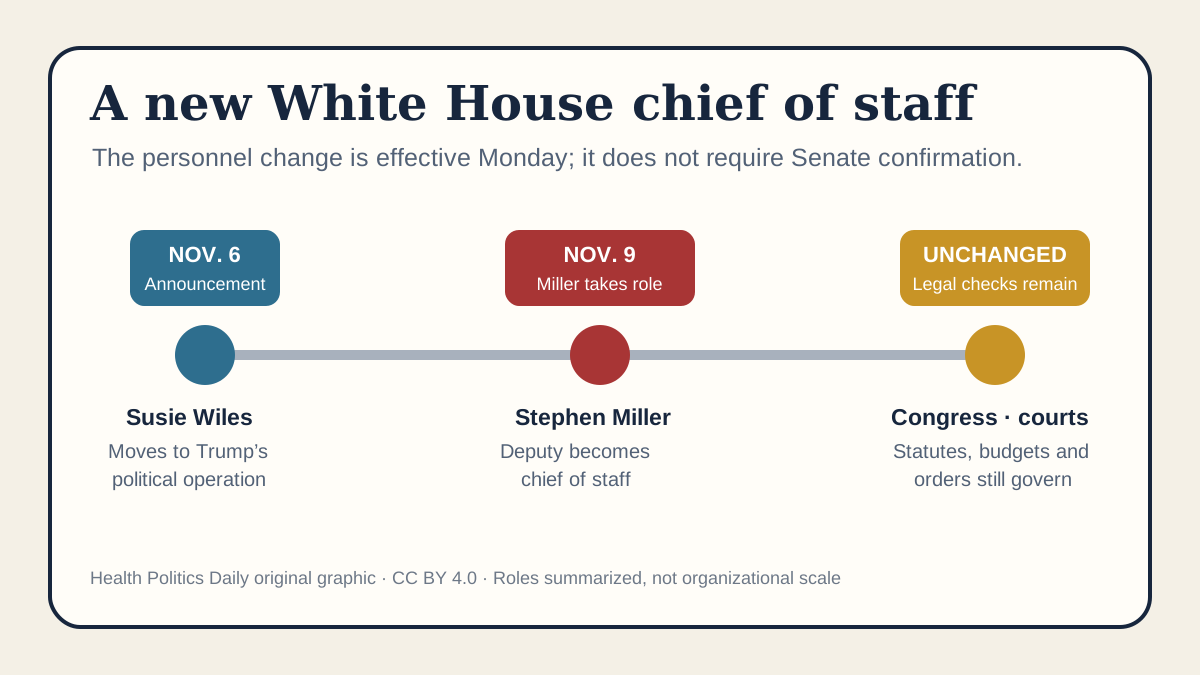
Verified baseline: Miller takes the role Monday
President Donald Trump announced on November 6 that Stephen Miller will become White House chief of staff on Monday, November 9. Reuters reported from the president’s social-media statement that Trump called Miller one of his most trusted advisers and said Susie Wiles will move to his political operation.
Wiles said separately that November 6 was her last day as chief of staff and that her commitment to Trump’s political mission would continue. She was the first woman to serve in the role and the longest-serving chief of staff across Trump’s two presidencies.
Miller has been serving as deputy chief of staff for policy. The Associated Press describes him as a central architect of the administration’s restrictive immigration agenda whose portfolio expanded to homeland-security coordination, domestic policy and anti-fraud initiatives.
No Senate confirmation is required
The White House chief of staff is a presidential staff position, not a Cabinet office confirmed by the Senate. Under 3 U.S.C. §105, the president may appoint White House Office employees and assign their official duties. Miller therefore does not need a confirmation hearing or Senate vote before starting.
That distinction matters after Democrats won control of the next Senate. The incoming majority can decide whether many judges, Cabinet officials and other nominees advance, as explained in Health Politics Daily’s guide to the new Senate majority. It cannot block this personnel choice through the ordinary confirmation process.
Congress still controls appropriations, legislation and oversight. Courts can review executive actions when plaintiffs have standing and legal claims. Agencies must still use the procedures and authorities that apply to each policy. A change in West Wing management does not erase those checks.
What a chief of staff can—and cannot—do
The job’s power comes mainly from organization and access: coordinating senior advisers, managing information reaching the president, setting internal priorities and helping agencies execute presidential decisions. The precise arrangement varies by administration and by the authority a president delegates.
A chief of staff cannot personally enact a statute, appropriate money, issue an agency rule without lawful process or decide a federal case. Miller can advocate for policy and organize its implementation, but legal authority still belongs to the president, Congress, agencies and courts under their respective roles.
Because Miller already held a senior policy role, the appointment is partly a promotion of an existing adviser rather than the arrival of an outsider. The consequential question is whether his broader management authority changes which proposals receive priority and how disputes among officials are resolved.
Why the timing matters
The change follows Republican losses in the November 3 midterm elections and comes less than two months before Democrats take control of both chambers of Congress. Trump did not say the election result caused the personnel change. Reporting that connects the timing is context, not proof of motive.
The new Congress is expected to increase oversight of immigration enforcement, executive-branch spending and White House initiatives. A chief of staff experienced in policy advocacy may centralize the administration’s response, but congressional committees will control their own hearing and subpoena strategies.
The transition also comes while courts are examining several administration projects and policies. For example, a judge has temporarily stopped work on the proposed Memorial Circle arch. Changing the chief of staff does not alter that order or any other court deadline.
What happens to Susie Wiles
Trump said Wiles will move to his political operation. That phrase does not establish a detailed title, duties, compensation arrangement or whether her work will occur inside or outside government. Those details were not public at publication.
A political operation is legally distinct from official White House work in important contexts, including campaign finance and the use of government resources. The announcement alone does not show how those boundaries will be managed. Any firm conclusion should wait for formal staffing or campaign disclosures.
Practical implications
- For people in immigration proceedings: the appointment does not itself change anyone’s status, hearing date, filing deadline or appeal rights.
- For federal employees and contractors: existing laws, contracts, agency directives and ethics requirements remain in force unless changed through an authorized process.
- For Congress: lawmakers cannot vote on Miller’s appointment, but they can conduct oversight, legislate and control funding subject to the constitutional process.
- For agencies: the White House may change policy emphasis or coordination, but agencies must identify legal authority for concrete actions.
- For the public: announcements about possible policy shifts should be separated from signed orders, published rules, enacted laws and final court decisions.
Fact, analysis, forecast and opinion
Verified fact: Trump named Miller chief of staff effective November 9 and said Wiles will join his political operation. Analysis: promoting a senior policy adviser may put more policy coordination under one official as the administration prepares for divided government. Forecast: immigration and executive-power questions are likely to remain central, but specific changes are not established until the administration announces or implements them. Opinion: Health Politics Daily does not endorse or oppose either official or the personnel decision.
What remains uncertain
The White House has not published a new organizational chart, list of Miller’s delegated responsibilities or names of any deputies who may inherit parts of his previous portfolio. It is also unknown how the transition will affect access to the president, internal policy review or relations with Cabinet secretaries.
Wiles’ exact political role and the legal structure supporting it remain unspecified. Statements predicting moderation, escalation or a specific policy package are analysis unless supported by formal actions.
Bias Lens: loyalty, hard-line policy or continuity?
Verified baseline: Miller, currently deputy chief of staff for policy, becomes chief of staff on November 9. Wiles is leaving the White House role and moving to Trump’s political operation. The job does not require Senate confirmation.
Left-leaning — The Guardian: foregrounds Miller’s role in immigration enforcement and characterizes the choice as an unusually hard-line appointment. Center — Associated Press: emphasizes the post-midterm timing, Miller’s expanded portfolio and Wiles’ record as the first woman and Trump’s longest-serving chief of staff. Right-leaning — Fox News: leads with Trump’s trust in Miller and Wiles’ positive departure statement while also noting Miller’s immigration role.
The difference is emphasis: ideological consequences, institutional and electoral context, or loyalty and continuity. All three agree on the personnel change and effective date; none can yet establish how Miller will manage the full White House operation.
Principal sources
- Reuters — President Trump’s November 6 announcement and transition timing
- U.S. House Office of the Law Revision Counsel — 3 U.S.C. §105
- Associated Press — personnel change and official backgrounds
- Reuters — announcement, timing and transition
No directly relevant official or publisher-authorized video with clear embedding permission was available at publication, so no video was embedded.
No comments yet.