U.S. Politics · Federal Courts · Presidential Appointments
What Democrats’ Senate Majority Changes for Trump’s Judges and Cabinet Nominees
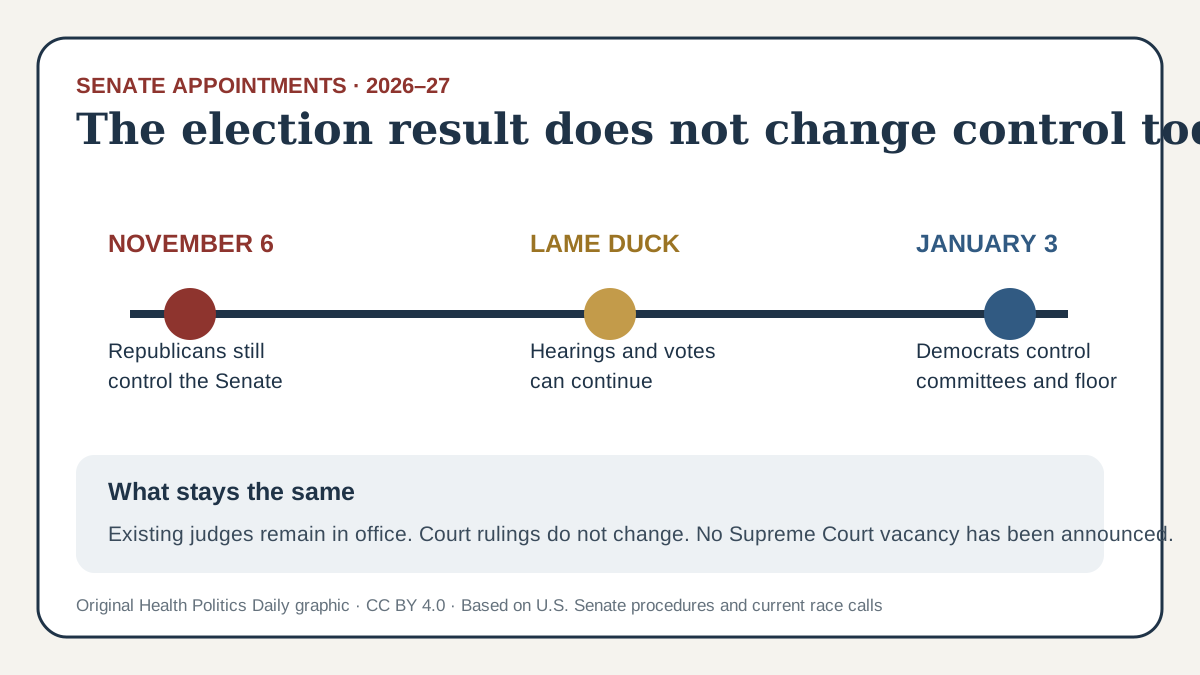
Democrats will hold at least 54 Senate seats when the new Congress begins January 3, giving them control over which presidential nominations advance. Republicans still run the Senate until then, creating a consequential lame-duck window.
Verified baseline: Democrats have won at least 54 Senate seats
Democrats have secured at least 54 seats in the 100-member Senate following Tuesday’s elections, according to current race calls reported by the Associated Press and reflected in Fox News’ election results. The final number could rise because the Alaska and Mississippi races remained unresolved at publication.
The result does not transfer power immediately. The current Republican majority retains control through the end of the 119th Congress. The Democratic majority takes office when the 120th Congress convenes on January 3, 2027.
Under Article II of the Constitution, the president nominates Supreme Court justices, lower-court judges and many senior executive officials, but appointments require the Senate’s advice and consent. The Senate’s official explanation notes that committees may advance, reject or simply not act on nominations.
What changes on January 3
A Democratic majority will select committee chairs, control the floor schedule and decide whether most Trump nominees receive hearings or votes. Senate Democratic leader Chuck Schumer, who is expected to become majority leader, told AP that his caucus would block a new conservative Supreme Court justice and reject nominees it considers unqualified.
That power reaches beyond the courts. Cabinet secretaries, ambassadors, U.S. attorneys, U.S. marshals and many leaders of independent agencies also require Senate confirmation. A vacancy would not guarantee that the president’s preferred replacement receives a vote.
Democratic control does not give the Senate power to remove judges already confirmed or rewrite their decisions. Federal judges hold office under existing constitutional rules, and current Cabinet officials remain unless they resign, are removed or otherwise leave office. The election changes the path for future appointments, not the legal status of present officeholders.
The lame-duck window comes first
Republicans can still schedule hearings and confirmation votes before the current Congress ends. Reuters reports that 13 judicial nominees had already received committee hearings and could reach the floor, while nine more were scheduled for hearings beginning November 10. The White House said it expects pending judicial nominees to be confirmed before year-end.
The Senate Judiciary Committee’s public tracker shows nominees at different procedural stages: some have appeared at hearings, some are on the executive calendar and others remain referred to committee. That means there is no single automatic outcome for every nominee.
Under Senate Rule XXXI, nominations still pending at the end of a Congress are generally returned to the president unless the Senate agrees otherwise. The president may resubmit them to the new Congress, but they would then enter a process controlled by the Democratic majority.
What this means for the Supreme Court
The Court’s membership has not changed. No justice has announced a new vacancy. Justices Clarence Thomas, 78, and Samuel Alito, 76, are the oldest members, but age and political speculation do not establish retirement plans.
Alito told Fox News that he would remain through the current term, which ends next summer. Thomas has not announced an imminent retirement. A vacancy before January 3 could produce an intense lame-duck confirmation fight, but that is a scenario, not a confirmed event.
Starting January 3, the new majority could decline to advance a Supreme Court nominee. A president cannot unilaterally install a life-tenured justice through the ordinary appointment process. Temporary recess appointments have a complicated and contested history, and no such plan has been announced.
Practical implications
- For people with cases in federal court: existing judges keep their seats, and court deadlines or rulings do not change because Senate control changes.
- For agencies and regulated industries: future leadership vacancies may last longer or be filled by acting officials, but each office has its own succession statute and time limits.
- For judicial nominees: the next eight weeks matter. A hearing does not guarantee committee approval, and committee approval does not guarantee a floor vote.
- For voters: senators do not choose judges independently; they approve or reject people nominated by the president.
- For political forecasting: neither a Supreme Court vacancy nor a particular Democratic response should be treated as settled until a justice retires and leaders announce procedure.
Fact, analysis, forecast and opinion
Verified fact: Democrats have secured at least 54 seats and will control the Senate beginning January 3; Republicans remain in control until then. Analysis: control of committees and the floor gives the incoming majority the practical power to slow, reject or ignore presidential nominations. Forecast: Republicans are likely to prioritize pending judges during the lame-duck session, but the number confirmed is unknown. Opinion: Health Politics Daily does not endorse either party’s nominees or confirmation strategy.
What remains uncertain
The final Senate margin depends on uncalled races. The current majority has not published a final lame-duck calendar for every pending nomination, and absences or defections can affect close votes. It is also unknown which executive or judicial vacancies may arise after January, whom Trump would nominate, or whether the parties would negotiate over individual candidates.
Supreme Court speculation is especially uncertain because the justices decide for themselves when to retire. Statements from party leaders describe intended strategy, not a binding rule for every future nominee.
Bias Lens: mandate, obstruction or constitutional check?
Verified baseline: Democrats will control at least 54 Senate seats on January 3. The Senate must consent to covered nominations; the current Republican Senate can continue acting until the present Congress ends.
Left-leaning — The Guardian: frames the result as a broad check on Trump and emphasizes Democrats’ ability to stop nominees and investigate the administration. Center — Associated Press: foregrounds the institutional shift and compares it with earlier Republican confirmation tactics, while noting that no justice has announced a retirement. Right-leaning — Fox News: centers conservative concern about a closing confirmation window and Alito’s statement that he will stay through the Court’s term.
The difference is emphasis: electoral accountability, procedural power or lost opportunity for conservative appointments. None changes the common facts about the January 3 handoff, the Senate’s constitutional role or the absence of a Supreme Court vacancy.
Principal sources
- U.S. Senate — constitutional power and nomination process
- U.S. Senate Rules Committee — Standing Rules governing nominations
- Senate Judiciary Committee — judicial nomination tracker
- White House — nominations and appointments archive
- Associated Press — incoming majority and party positions
- Reuters — pending nominations and lame-duck schedule
No directly relevant official or publisher-authorized video with clear embedding permission was available at publication, so no video was embedded.
No comments yet.