U.S. Politics · Congress · Executive Branch
White House Warns Democratic Investigations Could Be Criminal; Oversight Chair Rejects Claim
The exchange previews a separation-of-powers fight over subpoenas, executive privilege and the limits of Congress's investigative authority when Democrats take control in January.
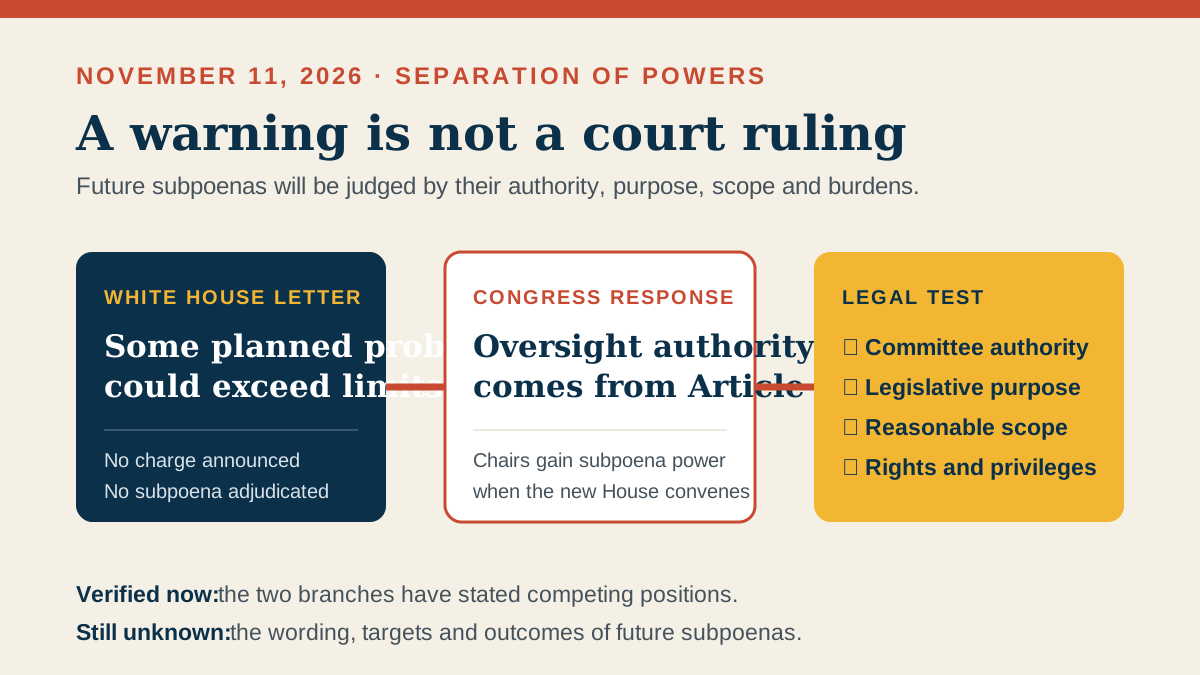
Verified baseline: a warning and a formal response
White House counsel Will Scharf told Rep. Robert Garcia, the top Democrat on the House Oversight and Government Reform Committee, that some investigations planned for the next Congress could exceed constitutional limits. In a three-page letter dated November 9, Scharf argued that congressional inquiries must advance a legitimate legislative purpose and said processes intended only to intimidate officials or deprive people of constitutional rights could warrant investigation.
Garcia, who is expected to chair the committee when Democrats take control of the House in January, rejected the warning. In an official committee statement Wednesday, he said Congress's authority comes from Article I of the Constitution and described oversight as part of a coequal branch's lawmaking role.
No subpoena identified in the letter has been ruled unlawful, and the White House did not announce a criminal charge or open prosecution. The exchange concerns anticipated investigations, not a court judgment about a specific demand for documents or testimony.
What Congress can investigate
Congressional oversight is broad because lawmakers need information to write laws, review how agencies administer them, decide whether programs should change and expose waste, fraud or misconduct. The nonpartisan Congressional Research Service says investigations of executive agencies and government operations usually satisfy the legislative-purpose requirement.
The power is not unlimited. The Supreme Court has said compulsory demands must serve a valid legislative purpose and cannot be used solely for law enforcement, punishment or exposure for its own sake. Witnesses retain constitutional rights and privileges, and subpoenas involving a president's personal records receive closer separation-of-powers scrutiny.
Those principles do not decide a future dispute in advance. Courts generally examine the committee's jurisdiction, its authorizing resolution, the stated legislative objective, the request's breadth, the burden on the recipient and any claim of executive privilege.
What changes in January
Democratic committee chairs will be able to schedule hearings, request records and issue subpoenas under House rules and committee procedures. A ranking minority member can ask agencies for information now, but cannot unilaterally exercise the committee's compulsory power without a delegation from the House or committee.
That distinction matters for the public record. Garcia's current letters are requests; subpoenas issued after the new Congress convenes would carry legal consequences and could trigger negotiations, privilege claims, contempt proceedings or lawsuits. The site has separately explained what the incoming Democratic Senate majority changes for nominations and how Jim Jordan's election as House Republican leader reshapes the minority's response.
Why subpoena fights rarely have an instant answer
Congress and the executive branch usually begin with accommodation: narrowing requests, agreeing on search terms, protecting sensitive information or arranging testimony. If talks fail, the House can pursue civil enforcement or contempt. Criminal contempt referrals go to the Justice Department, creating an obvious institutional complication when the department is asked to act against executive-branch officials.
Executive privilege can protect some presidential communications, national-security information and law-enforcement interests, but it is not a blanket exemption from congressional oversight. Whether it applies depends on who created the record, what it contains and why Congress says it needs the information.
For officials, businesses or private citizens who receive a demand, the practical step is to preserve relevant records and obtain counsel rather than assume that either side's public description resolves the legal issue. This article provides general information, not individualized legal advice.
What the public should watch
- Committee authorization: whether the new House adopts rules and investigative mandates broad enough to support each inquiry.
- Purpose and scope: whether subpoenas identify potential legislation and seek information no broader than reasonably necessary.
- Accommodation: whether the committee and executive branch negotiate before turning to contempt or court.
- Enforcement: whether any dispute becomes a civil lawsuit, contempt referral or privilege case—and what a court actually rules.
Fact, analysis, forecast and opinion
Verified fact: the White House counsel issued the warning, and Garcia issued a formal response asserting Congress's oversight authority. Analysis: the letters establish the legal positions each branch is likely to use before Democrats gain subpoena power. Forecast: disputes are likely, but no particular subpoena, privilege claim or court outcome can be predicted before the requests are written. Opinion: Health Politics Daily takes no position on which investigations Congress should pursue; public claims should distinguish political rhetoric, a duly authorized subpoena, a privilege assertion and a judicial ruling.
What remains uncertain
The next Congress has not finalized its committee rules, targets or subpoena language. The White House has not said whether it would challenge every investigation or negotiate case by case. Attorney General Todd Blanche separately acknowledged Congress's oversight authority and said the administration would continue responding to congressional subpoenas and letters, but the Justice Department has not announced how it would evaluate a specific future referral.
Bias Lens: constitutional warning, intimidation or political overreach?
Verified baseline: Scharf's letter invoked the legitimate-legislative-purpose limit and raised possible criminality; Garcia's official response asserted Congress's Article I authority. Neither document establishes that a specific subpoena is lawful or unlawful.
Left-leaning — The Guardian: foregrounded Garcia's accusation that the warning was an unconstitutional attempt to deter oversight and connected the dispute to the election's anti-corruption debate. Center — Associated Press: led with the clash, then included the legal limit, planned investigative subjects, Blanche's acknowledgment of oversight authority and calls for restraint from lawmakers in both parties. Right-leaning — Fox News Digital: in pre-letter coverage of the same planned investigations, emphasized Democratic warnings to administration officials and Sanders's concern that investigations could displace economic priorities.
The outlets are not reporting at identical moments, so Fox's article is used only to show the prior framing of the investigative agenda—not as coverage of Scharf's letter. The main difference is which risk leads: executive intimidation, potential abuse of oversight or distraction from governing. The governing legal test remains case-specific.
Principal sources
- Office of White House Counsel — November 9 letter
- House Oversight Committee Democrats — Garcia's official response
- Congressional Research Service — Congressional Oversight Manual
- U.S. Supreme Court — Trump v. Mazars USA
- Justice Department Manual — congressional relations
- Associated Press — corroboration and political context
No directly relevant official or publisher-authorized video with clear, persistent embedding permission was available at publication, so no video was embedded or linked.
No comments yet.