U.S. courts · Education · Civil rights
Supreme Court Takes Up Maryland Magnet-School Admissions Case
The October 19 grant asks how families must support discrimination claims against facially neutral admissions rules. It does not decide the policy’s legality.
By Health Politics Daily News Desk · October 19, 2026 at 1:59 p.m. ET
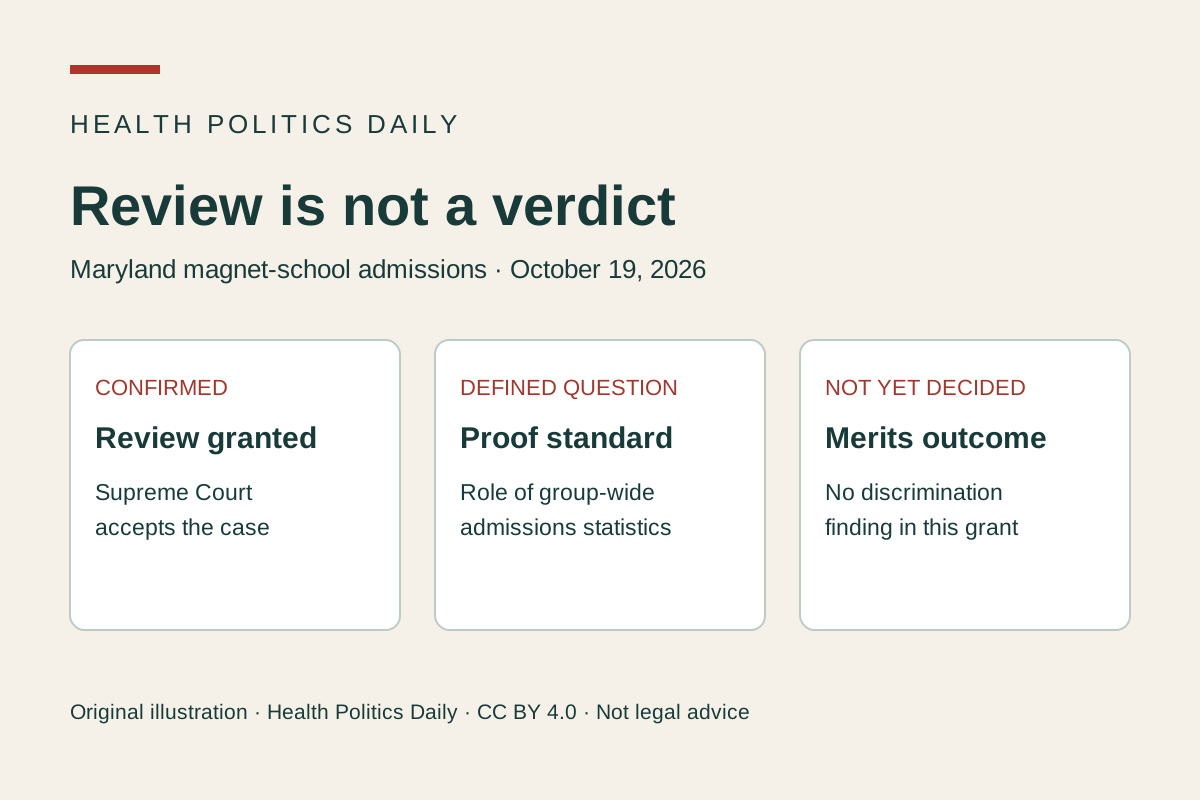
The U.S. Supreme Court agreed on October 19 to hear a challenge arising from Montgomery County, Maryland’s magnet-middle-school admissions policies. The case could clarify an important threshold for families alleging intentional discrimination: whether they must show a group-wide statistical disadvantage before their claim can proceed.
Today’s action is a decision to review a legal question, not a finding that the school district discriminated against Asian American students. Nor is it an order awarding a child admission or replacing a school’s selection rules.
The question the justices accepted
The official docket in case 26-12, Association for Education Fairness v. Montgomery County Board of Education, records a grant limited to whether a plaintiff challenging a facially neutral admissions policy as discriminatory must establish an aggregate disparate impact on the targeted racial group relative to its share of the applicant pool.
In plain language, the dispute concerns the role of overall admissions statistics when someone alleges discriminatory intent behind rules that do not expressly classify applicants by race. It is not simply a referendum on whether lotteries are good or whether selective programs should exist.
Why the parents and school board disagree
The parent association’s petition argues that an individual’s equal-protection claim should not fail solely because the racial group’s overall admissions share clears a statistical benchmark. The association alleges that apparently neutral criteria were adopted for a discriminatory purpose. Those are the challengers’ allegations, not established findings in their favor.
The board’s opposition brief describes a race-blind lottery introduced when the pandemic made an in-person aptitude test impractical. It argues that the complaint did not adequately allege either disproportionate impact or discriminatory intent. The competing accounts require careful attention to which policy and period each side discusses.
What the lower court actually decided
In its February 3, 2026 opinion, the Fourth Circuit affirmed dismissal of the amended complaint under the rule governing failure to state a legally sufficient claim. It relied on circuit precedent requiring disparate impact and found no reversible error. The opinion also recounts the district court’s conclusion that the complaint lacked facts supporting an inference of discriminatory intent.
This procedural history matters. A pleading-stage dismissal concerns whether a case can go forward under the governing standard; it should not be casually described as a completed trial of every contested allegation. The Supreme Court has now selected a narrower legal issue for review.
What is at stake for families
Reuters reports that the dispute concerns four selective public middle schools offering enriched instruction. It places the case in the wider debate following the Court’s 2023 college-admissions ruling, while identifying the proof requirement as the issue here.
Analysis: For families, the practical stakes include access to advanced instruction and the ability to challenge admissions decisions. For districts, they include clarity about how courts assess claims against neutral-looking criteria. A rule about evidence can affect which lawsuits proceed without itself selecting an admissions formula.
Asian American students and parents should not be treated as a single political viewpoint. The challenger association is represented by Pacific Legal Foundation, while organizations supporting the district include Asian American community groups. A party’s position does not speak for every family in a demographic category.
How the competing advocates frame fairness
In its October 19 statement, Pacific Legal Foundation emphasizes individual students’ rights and argues against a statistical barrier to considering intent. It represents the challengers and is an interested advocate.
The Legal Defense Fund’s statement, issued with organizations supporting the reforms, emphasizes wider screening and reduced barriers to opportunity. It defends the policy’s legality. That is advocacy supporting the district, not the Supreme Court’s conclusion.
Bias Lens: diversity, individual rights and the proof question
Verified baseline: Review was granted on a defined question about aggregate impact. No merits ruling finding unlawful discrimination was issued in that grant.
Left-leaning—NBC News: Its public post linking its report presents the case as another race-and-admissions dispute. The full report was unavailable for this review; this observation is limited to the verified headline, not its complete treatment.
Center—Reuters: The linked report leads with the challenge to lottery admissions and identifies the narrower legal issue. It attributes discrimination claims to the parents rather than presenting them as a new court finding.
Right-leaning—The Daily Signal: Its report connects the dispute to the earlier college-admissions decision and emphasizes the challengers’ individual-rights argument. Its opening description of race-based admissions should be read alongside the docket’s description of a facially neutral policy.
These are bounded comparisons of linked coverage, not stereotypes about audiences. The two advocates above provide more direct competing arguments, but neither is neutral reporting. Whether the policy is discriminatory is the disputed question, not a premise this article adopts.
What remains uncertain—and what to check next
The final legal standard, outcome and any later effect on school procedures remain unresolved. Readers can follow briefs and scheduling on the official docket; this edition does not report a confirmed argument date or predict the justices’ votes. Families should use current district notices for actual admissions instructions, rather than assume today’s grant creates a new deadline or entitlement.
For other examples of distinguishing a procedural court action from its wider consequences, see our Supreme Court and DOGE records report and political advertising rates case explainer. They concern separate disputes, not precedents this article says control school admissions.
Sources and media
This report prioritizes the Supreme Court docket, the Fourth Circuit opinion and both sides’ filings, with Reuters corroboration. No suitable directly relevant authorized video was verified; none is embedded or rehosted. The original explanatory illustration is licensed CC BY 4.0. This is general reporting, not legal advice.